Neutrino Energy
A comprehensive, physics-grounded overview of neutrinovoltaic energy conversion - from Nobel Prize foundations to the current state of development.
What Is Neutrino Energy?
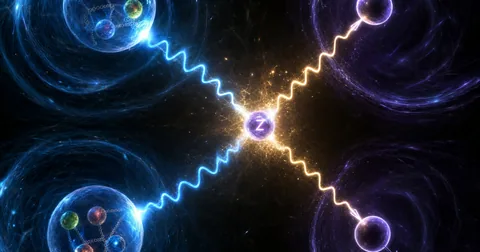
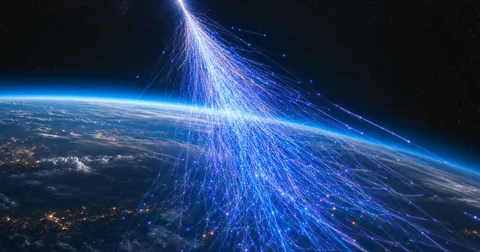
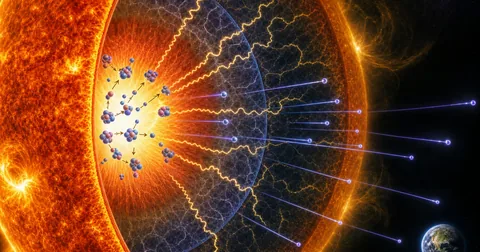
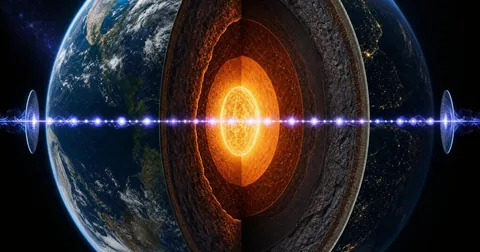
Neutrino energy refers to the conversion of persistent environmental radiation - primarily neutrinos, but also cosmic muons, electromagnetic fluctuations, and thermal noise - into usable electrical energy. The technology is called neutrinovoltaics.
The core principle is not new physics. It combines four well-documented mechanisms into a single conversion architecture:
- Coherent neutrino-nucleus scattering (CEvNS) - neutrinos transfer momentum to atomic nuclei
- Phonon-electron coupling - lattice vibrations excite charge carriers in graphene
- Plasmonic absorption - graphene captures electromagnetic fluctuations across a broad spectrum
- Nonlinear rectification - asymmetric junctions convert stochastic input into net DC current
Physical Foundations
Neutrinos Have Mass
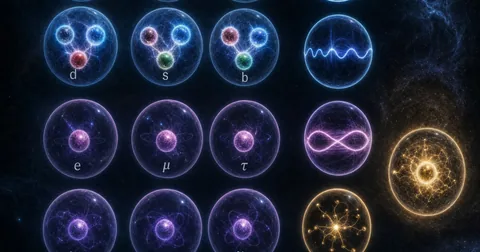
The 2015 Nobel Prize in Physics was awarded to Takaaki Kajita and Arthur B. McDonald for proving that neutrinos oscillate between flavors - which is only possible if they have mass. Mass means momentum. Momentum means interaction with matter.
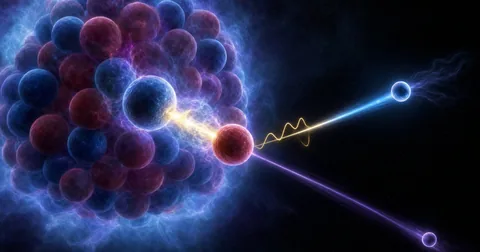
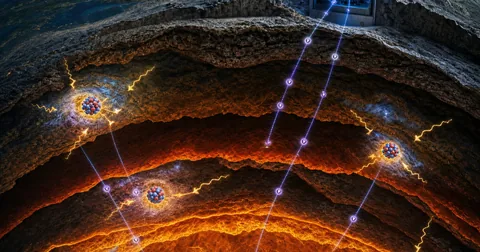
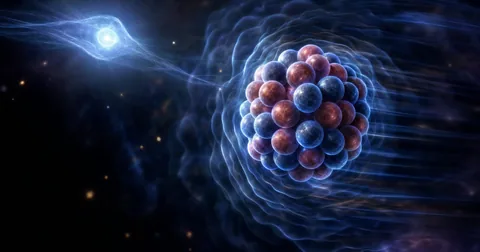
In 2017, the COHERENT collaboration at Oak Ridge National Laboratory achieved the first-ever measurement of coherent elastic neutrino-nucleus scattering (CEvNS) - a process predicted by Daniel Z. Freedman in 1974. This confirmed that neutrinos can transfer measurable momentum to atomic nuclei.
Graphene as a Conversion Material
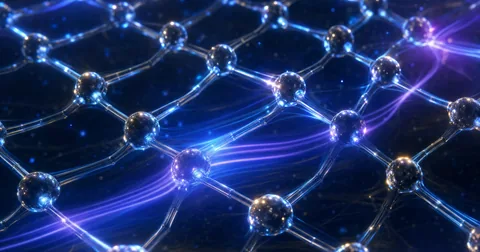
Graphene - a single layer of carbon atoms arranged in a hexagonal lattice - exhibits four properties that make it uniquely suited for environmental energy conversion:
- Ultra-high carrier mobility - electrons move with minimal resistance (Bolotin et al. 2008: up to 200,000 cm²/V·s)
- Brownian-driven current - thermally induced lattice vibrations produce measurable electrical current (Thibado et al. 2020)
- Broadband plasmonic absorption - graphene interacts with electromagnetic radiation across an unusually wide spectrum (Grigorenko et al. 2012)
- Strong phonon-electron coupling - mechanical vibrations efficiently transfer energy to the electronic system (Giustino 2017)
Not a Perpetuum Mobile
Neutrinovoltaic technology does not claim to create energy from nothing. It is an open system that converts external environmental flux into structured electrical output.
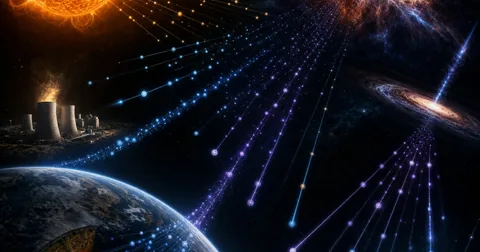
The energy inputs are persistent and multi-channel:
- Neutrino flux
- ~6.5 × 10¹⁰ neutrinos/cm²/s from the Sun alone
- Cosmic muons
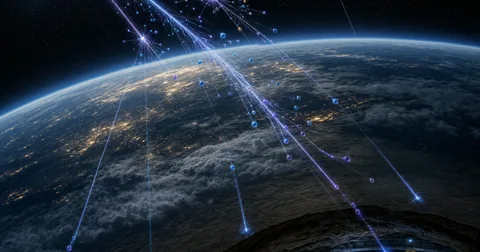
- ~10,000 muons/m²/minute at sea level
- Electromagnetic radiation
- Ambient RF, infrared, and broadband environmental EM fields
- Thermal fluctuations
- Brownian motion at any temperature above 0 K
The 6-Stage Conversion Chain
Each stage is grounded in an established physical mechanism. The innovation lies in chaining them into a coherent conversion architecture - not in inventing new physics.
- 01
Momentum Transfer
Neutrinos, cosmic muons, and ambient radiation interact with matter
- 02
Mechanical Response
Graphene lattice vibrates in response to momentum transfer
- 03
Phonon-Electron Coupling
Lattice vibrations couple to the electron gas in graphene
- 04
Nonlinear Rectification
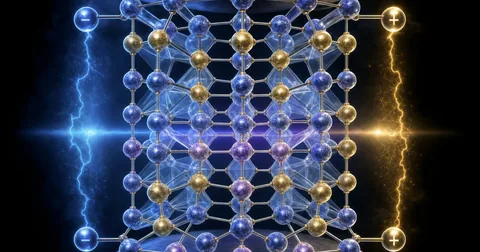
Asymmetric doping in graphene-silicon junctions breaks time-reversal symmetry
- 05
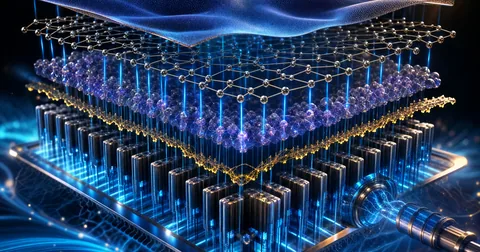
Layer Summation
12 alternating graphene-silicon layers sum individual outputs
- 06
DC Stabilization
Power conditioning circuitry smooths output fluctuations
The Master Formula
The output of a neutrinovoltaic system is expressed as the device efficiency applied to the effective environmental flux and its energy-dependent coupling, integrated over the active converter volume.
P(t) = η × ∫V Φ_eff(r, t) × σ_eff(E) dV
⟨P⟩ = η × ∫V ∫ Φ_eff(E, r) × σ_eff(E) dE dV
P(t)- Instantaneous electrical output power
η- Technological and device efficiency (geometry, phonon→electron, interface, collection)
Φ_eff(r, t)- Effective flux density - neutrinos, muons, and ambient electromagnetic radiation
σ_eff(E)- Energy-dependent effective coupling and interaction cross-section
∫_V … dV- Integration over the active converter volume
⟨P⟩- Long-term mean power (additionally integrated over energy E)
Status & Outlook
Intellectual honesty requires distinguishing between what is known, what is testable, and what remains open. Every claim on this site is categorized accordingly.
Established through peer-reviewed experiments and independently confirmed.
- Neutrinos have mass (Nobel Prize 2015, Kajita & McDonald)
- Coherent elastic neutrino-nucleus scattering occurs (COHERENT 2017)
- Graphene exhibits exceptional carrier mobility (Bolotin et al. 2008)
- Brownian motion in graphene produces measurable current (Thibado et al. 2020)
- Phonon-electron coupling in 2D materials is well characterized (Giustino 2017)
Measurement protocols exist. Results pending independent verification.
- Net power output of the 12-layer graphene-silicon architecture
- Conversion efficiency per individual stage of the chain
- Relative contribution of each environmental input channel
- Long-term stability and degradation characteristics
- Scalability from laboratory to production-grade modules
The principle is established, but precise numbers require further measurement.
- End-to-end system efficiency under real-world conditions
- Exact flux-to-power ratio per square meter of active surface
- Optimal layer count and doping profiles for maximum output
- Cost-per-watt at production scale
References
- T. Kajita, "Discovery of atmospheric neutrino oscillations," Nobel Lecture, 2015 Proof that neutrinos have mass - Nobel Prize in Physics 2015 DOI ↗
- A. B. McDonald, "The Sudbury Neutrino Observatory: Observation of flavor change for solar neutrinos," Nobel Lecture, 2015 Confirmed solar neutrino flavor transformation DOI ↗
- D. Akimov et al. (COHERENT Collaboration), "Observation of coherent elastic neutrino-nucleus scattering," Science 357, 1123–1126, 2017 First measurement of CEvNS - predicted 43 years earlier DOI ↗
- D. Z. Freedman, "Coherent effects of a weak neutral current," Physical Review D 9, 1389, 1974 Theoretical prediction of coherent neutrino-nucleus scattering DOI ↗
- A. H. Castro Neto et al., "The electronic properties of graphene," Reviews of Modern Physics 81, 109, 2009 Comprehensive review of graphene's unique electronic structure DOI ↗
- K. I. Bolotin et al., "Ultrahigh electron mobility in suspended graphene," Solid State Communications 146, 351–355, 2008 Demonstrated record carrier mobility in graphene DOI ↗
- F. Giustino, "Electron-phonon interactions from first principles," Reviews of Modern Physics 89, 015003, 2017 Foundational framework for phonon-electron coupling DOI ↗
- A. N. Grigorenko et al., "Graphene plasmonics," Nature Photonics 6, 749–758, 2012 Graphene's plasmonic properties and light-matter interaction DOI ↗
- J. A. Formaggio and G. P. Zeller, "From eV to EeV: Neutrino cross sections across energy scales," Reviews of Modern Physics 84, 1307, 2012 Comprehensive neutrino cross-section measurements DOI ↗
- P. M. Thibado et al., "Fluctuation-induced current from freestanding graphene," Physical Review E 102, 042101, 2020 Experimental proof of current generation from graphene Brownian motion DOI ↗
- K. Scholberg, "Prospects for measuring coherent neutrino-nucleus elastic scattering at a stopped-pion neutrino source," Physical Review D 73, 033005, 2006 Measurement perspectives for CEvNS DOI ↗
- Super-Kamiokande Collaboration, "Evidence for oscillation of atmospheric neutrinos," Physical Review Letters 81, 1562, 1998 First evidence of neutrino oscillation - neutrinos have mass DOI ↗
- H. T. Schubart, "Materialverbund zur Nutzung der Energie von Neutrinostrahlung und kosmischer Strahlung," Patent WO2016142056A1, 2016 Core patent for the neutrinovoltaic multilayer conversion architecture DOI ↗