How Are Neutrinos Detected? Inside the World's Great Neutrino Detectors
Roughly 100 trillion neutrinos are streaming through your body as you read this sentence - and almost none leave a directly observable trace. Neutrinos are the universe's most elusive known particles: electrically neutral, almost massless, and so reluctant to interact that most sail straight through the entire Earth without touching a single atom. So how are neutrinos detected at all? The answer is one of the great feats of modern experimental physics. To catch the "ghost particle," scientists build enormous, exquisitely shielded instruments - a single neutrino detector can fill a mountain cavern or a cubic kilometre of Antarctic ice - and wait patiently for the rare, telltale flash of one interaction. This page explains why detection is so hard, how it actually works, and the landmark experiments that turned an almost undetectable particle into a tool for exploring the cosmos.
Why are neutrinos so hard to detect?
A neutrino is an elementary particle - a lepton - with no electric charge and a tiny but non-zero mass. It feels neither electromagnetism, because it carries no charge, nor the strong nuclear force, responding only to gravity and the weak nuclear force. The weak force lives up to its name, acting over an almost vanishingly short range, so a neutrino interacts with matter only on the rarest of occasions.
The numbers are staggering. About 100 trillion neutrinos from the Sun pass through every person every second, pouring straight through the planet as if it were transparent. A single neutrino could travel through a light-year of solid lead with only an even chance of being stopped. Detecting something so aloof means playing a game of extreme odds: fill a detector with a vast number of target atoms, watch it for a long time, and you may record just a handful of interactions.
The second challenge is noise. The signals are so faint that ordinary background radiation - the constant rain of cosmic-ray particles through the atmosphere - would swamp them completely. That is why almost every major neutrino detector is buried deep underground: beneath a mountain, inside a mine, or under kilometres of ice or water. The rock overhead filters out that background, leaving the instrument quiet enough to notice a genuine neutrino event.
How are neutrinos detected? The trick of indirect detection
The crucial insight is that we never observe a neutrino directly. Instead, detectors look for the aftermath of the rare moment when a neutrino strikes an atomic nucleus or an electron. In a charged-current interaction, the neutrino transforms into its partner charged lepton - an electron, muon, or tau - which carries charge and can be tracked. In a neutral-current interaction, the neutrino stays a neutrino but transfers energy and momentum, knocking a particle the instrument can record. Either way, it is these secondary particles, not the neutrino itself, that reveal the event.
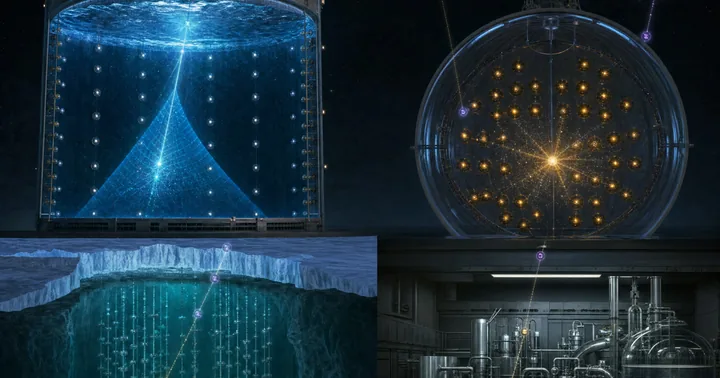
The most famous technique relies on Cherenkov radiation. When a charged particle travels through water or ice faster than light does in that same medium, it emits a cone of faint blue light - the optical equivalent of a sonic boom. Thousands of ultra-sensitive photomultiplier tubes lining the detector catch this glow, and from its pattern and precise timing physicists reconstruct the direction, energy, and even the flavour of the neutrino that started it.
Other detectors use different methods. Liquid-scintillator experiments register tiny sparks of light when a neutrino triggers a reaction such as inverse beta decay - the very process Clyde Cowan and Frederick Reines used to detect the neutrino for the first time in 1956. Earlier radiochemical experiments instead counted individual atoms that neutrinos had transmuted from one element into another. Each approach amplifies one almost invisible event into a measurable signal.
How are neutrinos detected in practice? IceCube, Super-Kamiokande and SNO
IceCube, at the South Pole, is the largest neutrino detector on Earth. It instruments a full cubic kilometre of clear Antarctic ice with 5,160 optical sensors frozen along 86 vertical cables, between roughly 1.5 and 2.5 kilometres deep; the ice itself is the target. IceCube specialises in the highest-energy neutrinos from violent objects far beyond our galaxy, and in 2013 it reported the first solid evidence of these astrophysical neutrinos, opening a new window on the universe.
Super-Kamiokande, about a kilometre beneath Mount Ikeno in Japan, is a stainless-steel tank holding 50,000 tonnes of ultrapure water, watched by around 11,000 photomultiplier tubes. It was here, in 1998, that Takaaki Kajita's team found that atmospheric neutrinos change flavour in flight - the first clear evidence of neutrino oscillation, and therefore that neutrinos must have mass.
The Sudbury Neutrino Observatory (SNO), two kilometres down in a Canadian nickel mine, used 1,000 tonnes of heavy water. That gave it a unique power: it could count electron neutrinos alone and, separately, all three flavours together. In 2001 and 2002, Arthur McDonald's team showed that the missing solar neutrinos that had long puzzled physicists had not vanished - they had simply oscillated into other flavours on the way from the Sun. Kajita and McDonald shared the 2015 Nobel Prize in Physics for these discoveries.
Man-made neutrinos: the CERN and Fermilab accelerator experiments
Nature is not the only neutrino source; physicists also manufacture them. At laboratories such as CERN in Europe and Fermilab in the United States, powerful accelerators slam protons into a target to create a controlled, intense beam of neutrinos aimed at a distant detector. Because the beam's composition is known at the source, comparing it with what arrives hundreds of kilometres away is a precise way to measure how neutrinos oscillate.
A celebrated example was CERN's beam, fired 730 kilometres through the Earth to the OPERA detector at Italy's Gran Sasso laboratory, which caught the first evidence of muon neutrinos turning into tau neutrinos. In the United States, Fermilab sends beams to experiments such as NOvA and, in the coming years, the flagship DUNE project, whose neutrinos will travel 1,300 kilometres to a detector deep in South Dakota. In Japan, the T2K experiment fires neutrinos from the J-PARC accelerator at Super-Kamiokande.
Nuclear reactors offer another intense, man-made source. Reactor experiments - Daya Bay in China, Double Chooz in France, and RENO in South Korea - used the antineutrinos streaming from reactor cores to pin down the last unknown neutrino mixing angle, a parameter describing how the three flavours blend as they travel. Between accelerator beams and reactors, the once-untouchable neutrino has become a routine laboratory tool.
Milestones in neutrino detection, from 1956 to COHERENT
The neutrino began as a theorist's reluctant guess. In 1930 Wolfgang Pauli proposed an unseen particle to rescue the law of energy conservation in radioactive decay, calling it a remedy he was almost ashamed to suggest. It took 26 years to confirm: in 1956 Cowan and Reines detected it beside a nuclear reactor, work that eventually earned Reines a share of the Nobel Prize decades later.
The following decades brought a cascade of discoveries. Ray Davis's Homestake experiment made the first detection of solar neutrinos in the 1960s, but found only about a third of the expected number - the solar neutrino problem that oscillation would ultimately explain. In 1987, detectors in Japan, the United States and Russia caught a burst of neutrinos from a supernova in a neighbouring galaxy, founding the field of neutrino astronomy. The oscillation results from Super-Kamiokande and SNO then proved that neutrinos have mass.
Two more recent milestones stand out. In 2017 the COHERENT experiment in the United States observed coherent elastic neutrino-nucleus scattering for the first time - a long-predicted process in which a neutrino nudges an entire nucleus at once, confirming that neutrinos transfer measurable momentum to matter, and doing so with a detector small enough to carry. And in 2018 IceCube traced a single high-energy neutrino back to a distant blazar - a flaring galaxy powered by a supermassive black hole - a landmark in multi-messenger astronomy.
From detecting neutrinos to neutrinovoltaic: where the research fits
The science of neutrino detection carries a subtle implication: neutrinos, for all their aloofness, do interact with matter, transferring energy and momentum when they do. The 2015 Nobel Prize established that neutrinos have mass, and the COHERENT result in 2017 showed directly that a neutrino can push on a nucleus. Those peer-reviewed findings motivate a research direction quite different from building detectors.
The Neutrino Energy Group, a research organisation founded in Berlin in 2008, is exploring whether the constant flux of the environment can be converted into a small electric current. Its neutrinovoltaic research is deliberately careful about its own claims: the target is not neutrinos alone but the combined ambient flux - cosmic radiation, thermal fluctuations, and electromagnetic waves as well - captured with a patented multilayer graphene-and-silicon architecture (Patent WO2016142056A1). It draws on the physics above, together with Thibado and colleagues' 2020 demonstration of charge generation from the thermal, Brownian motion of graphene.
It is essential to be clear about the difference. A neutrino detector is designed to observe rare individual interactions, not to generate usable power, and neutrinovoltaic is an in-development research programme - not a finished product, and emphatically not a source of free or unlimited energy. Like a solar cell, any such device could only convert a fraction of the energy already flowing through an open system; it would never create energy from nothing. Whether that ambient flux can be harnessed practically remains an open research question, best followed with honest scepticism. Read more in our explainer on what neutrinovoltaic is at /science/what-is-neutrinovoltaic/.
Frequently asked questions
How are neutrinos detected?
Indirectly. Detectors never see the neutrino itself; they record the charged particles produced on the rare occasion a neutrino strikes a nucleus or electron. The most common method is catching the cone of blue Cherenkov light those particles emit in water or ice, though liquid scintillators and radiochemical techniques are also used. Because interactions are so rare, detectors are enormous and buried deep underground to shield them from background radiation.
Why are neutrinos so difficult to detect?
Because they are electrically neutral and interact only through the weak nuclear force and gravity, neutrinos pass through matter almost undisturbed. About 100 trillion cross your body every second with no effect, and a single one could travel through a light-year of lead with only even odds of being stopped. Detecting them therefore requires vast volumes of target material and long observation times to capture a handful of interactions.
What is the IceCube neutrino observatory?
IceCube is the world's largest neutrino detector, built into a cubic kilometre of clear ice at the South Pole. Its 5,160 light sensors, frozen up to about 2.5 kilometres deep, catch the faint blue Cherenkov glow when a high-energy neutrino interacts in the ice. It specialises in astrophysical neutrinos from distant cosmic sources, and in 2018 it traced one back to a blazar - a black-hole-powered galaxy - billions of light-years away.
Do CERN and Fermilab make neutrinos?
Yes. Both laboratories create intense, controlled neutrino beams by firing high-energy protons at a target. The resulting neutrinos are aimed at detectors hundreds of kilometres away - CERN's beam reached the OPERA detector at Gran Sasso in Italy, while Fermilab's beams feed experiments such as NOvA and the upcoming DUNE project. These accelerator neutrino experiments let physicists study oscillation with great precision.
What did the COHERENT experiment discover?
In 2017 the COHERENT experiment made the first observation of coherent elastic neutrino-nucleus scattering, a process in which a neutrino scatters off an entire nucleus at once rather than a single particle inside it. The result confirmed a prediction made decades earlier and provided direct evidence that neutrinos transfer measurable momentum to matter - achieved with a detector far smaller than the giant underground observatories.
What is Cherenkov radiation and why does it matter for detection?
Cherenkov radiation is the faint blue light emitted when a charged particle moves through a medium such as water or ice faster than light travels in that medium - an optical version of a sonic boom. When a neutrino interaction produces a fast-moving charged particle, this glow lets detectors like Super-Kamiokande and IceCube reconstruct the neutrino's energy and direction from the pattern of light.