Cherenkov Radiation: The Sonic Boom of Light
Lean over the pool of a nuclear reactor and you will see something eerie: the water around the fuel glows a deep, electric blue. Nothing is burning, and no lamp is switched on. That glow is Cherenkov radiation - light created by particles moving so fast that they outrun light itself inside the water. It sounds like a violation of Einstein's rules, but it is not; the physics is subtle, precise, and beautiful. It is also profoundly useful. The same blue flash that haloes reactor fuel is how the largest neutrino detectors on Earth, from Japan's Super-Kamiokande to IceCube at the South Pole, see particles that are otherwise invisible.
What Is Cherenkov Radiation? A Sonic Boom Made of Light
When a jet flies faster than sound, it overtakes its own pressure waves. The waves can no longer spread out ahead of the aircraft, so they pile up into a cone-shaped shockwave - the sonic boom. Cherenkov radiation is the same phenomenon translated into electromagnetism: a charged particle overtakes the light waves it disturbs in a material, and those waves stack into a cone of real, visible light.
The precision matters here. Nothing ever travels faster than light in a vacuum - that limit, c = 299,792,458 metres per second, is absolute. But light slows down inside transparent materials. In water it travels at roughly 225,000 kilometres per second, about 75 percent of c, because the refractive index of water is 1.33. A sufficiently energetic electron or muon can outpace that local speed limit while still fully respecting Einstein's universal one. The moment it does, the medium lights up. That threshold - the phase velocity of light in the medium, c divided by the refractive index n - is the defining condition of the entire effect.
The Cherenkov Effect: How a Particle Outruns Light in a Medium
As a charged particle races through water or glass, its electric field briefly polarises the molecules it passes, tugging their electrons out of position. When the molecules relax, they emit tiny electromagnetic ripples. Below the light-speed threshold, those ripples spread out ahead of the particle and cancel each other through destructive interference - no glow. Above the threshold, the particle keeps outrunning its own ripples, and along one particular cone they all arrive in step, adding up coherently into a bright shockfront of light. This is the Cherenkov effect.
Three conditions must be met at once:
- The particle must carry electric charge - neutral particles like neutrinos produce no Cherenkov light directly.
- The medium must be a transparent dielectric, such as water, ice, glass or even air.
- The particle's speed must exceed c/n, the phase velocity of light in that medium.
The Cherenkov Cone: A Mach Angle for Light
Exactly like a supersonic shockwave, the light forms a cone at a characteristic angle given by cos θ = 1/(nβ), where β is the particle's speed as a fraction of c. In water, a particle moving at essentially the speed of light radiates its cone at about 41 degrees - the maximum angle water allows. Slower particles produce narrower cones, and at the threshold speed the cone closes entirely and the light vanishes.
The threshold also sets an energy price of admission. In water, an electron needs a kinetic energy of about 0.26 MeV before it can radiate; the muon, some 200 times heavier, needs roughly 55 MeV. This is why Cherenkov light is a signature of genuinely high-energy physics: everyday charged particles simply are not fast enough. Measure the cone's angle and opening direction, and you can reconstruct how fast the particle was moving and where it was going - which is precisely what particle detectors do.
Why Is Cherenkov Radiation Blue?
The blue colour is written directly into the physics. The Frank–Tamm formula, derived in 1937, shows that the radiated energy rises with frequency: the number of photons emitted per interval of wavelength scales roughly as 1/λ². Short wavelengths win. Violet light near 400 nanometres is emitted far more strongly than red light near 700 nanometres, so the spectrum tilts hard toward the blue end.
In fact, much of the Cherenkov emission happens in the ultraviolet, where human eyes see nothing at all. Of the visible portion, violet and blue dominate - and because our eyes are more sensitive to blue than to violet, the glow registers as that unmistakable deep blue. Two more subtleties complete the picture: the spectrum is continuous, with no bright lines, which distinguishes Cherenkov light from fluorescence; and the emission cannot climb indefinitely into the extreme ultraviolet or X-ray range, because there the refractive index of the medium drops below the faster-than-light condition's reach, and the effect switches off.
Where You Can Actually See Cherenkov Light
Cherenkov radiation is not a laboratory curiosity - it appears anywhere fast charged particles meet a transparent medium:
- Nuclear reactor and spent-fuel pools: beta particles ejected by fission products exceed light's speed in water, bathing the core in blue. The water itself is the shielding; the glow is the visible signature of the radiation it is stopping.
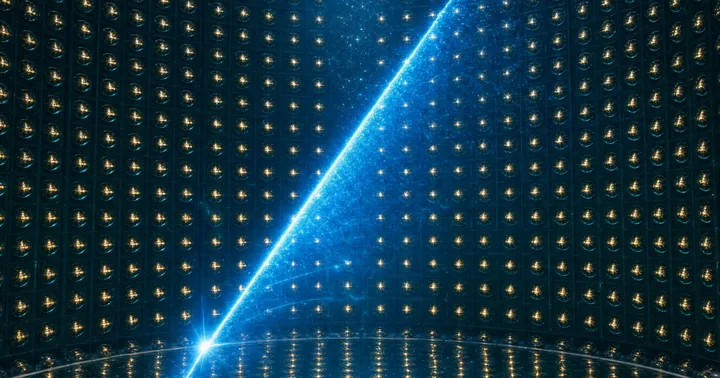
- Super-Kamiokande, Japan: 50,000 tonnes of ultrapure water watched by more than 11,000 photomultiplier tubes, one kilometre underground, waiting for Cherenkov rings from neutrino interactions.
- IceCube, Antarctica: 5,160 optical sensors frozen into a full cubic kilometre of glacial ice between 1,450 and 2,450 metres deep, using the ice sheet itself as the Cherenkov medium.
- The night sky: ultra-high-energy gamma rays striking the atmosphere create particle showers whose faint Cherenkov flashes - cones barely more than a degree wide in thin air - are caught by telescopes such as H.E.S.S., MAGIC and VERITAS.
Pavel Cherenkov and the 1958 Nobel Prize
In 1934, a young Soviet physicist named Pavel Cherenkov was studying luminescence in liquids under the supervision of Sergey Vavilov in Moscow. Gamma-irradiated solutions were expected to fluoresce - but Cherenkov noticed a faint blue glow even from the pure solvent, where no fluorescent substance was present. Careful measurements showed the light was directional and polarised in ways fluorescence could never be. Something new was happening.
The theoretical explanation came in 1937 from Igor Tamm and Ilya Frank, whose classical electrodynamics treatment predicted the cone angle and the blue-weighted spectrum exactly. In 1958, Cherenkov, Frank and Tamm shared the Nobel Prize in Physics for the discovery and interpretation of the effect. Vavilov, who had guided the original work, had died in 1951 and could not be honoured - which is why Russian literature often calls it Vavilov–Cherenkov radiation. You will also see the spellings Čerenkov and Cerenkov; they all name the same blue shockwave.
Cherenkov Light Is How Neutrino Detectors See the Invisible
Here is the elegant twist: neutrinos are electrically neutral, so they can never produce Cherenkov light themselves. But on the rare occasion a neutrino collides with a nucleus or electron in water or ice, it hurls a charged particle - an electron or a muon - forward faster than light travels through that medium. That secondary particle radiates a Cherenkov cone, which the surrounding photomultipliers record as a ring of blue light. In a very real sense, Cherenkov light is how experiments at this scale detect neutrinos at all.
The rings even reveal the neutrino's identity: muons carve sharp, clean circles, while electrons scatter and shower, smearing the ring's edge. Reading those patterns is how Super-Kamiokande demonstrated in 1998 that neutrinos oscillate between flavours - proof that they have mass, honoured with the 2015 Nobel Prize in Physics awarded to Takaaki Kajita and Arthur McDonald. IceCube, meanwhile, uses the same blue flashes in Antarctic ice to trace astrophysical neutrinos back to sources millions - in some cases billions - of light-years away.
Why Cherenkov Physics Matters for Neutrinovoltaic Research
Every Cherenkov ring in a detector is hard evidence of the same underlying fact: neutrinos, though ghostly, physically interact with matter and hand over real energy and momentum when they do. The 2015 Nobel Prize established that neutrinos have mass; the COHERENT experiment showed in 2017 that neutrinos transfer measurable momentum to entire atomic nuclei. Those results frame a research question that the Berlin-based Neutrino Energy Group, founded in 2008 by Holger Thorsten Schubart, has pursued ever since: whether the continuous stream of ambient radiation passing through every material - neutrinos alongside thermal, cosmic and electromagnetic background flux - can be induced to generate small electric currents in engineered materials.
The group's neutrinovoltaic approach, based on a patented graphene-silicon multilayer (WO2016142056A1) and informed by Paul Thibado's 2020 work on charge harvesting from graphene's atomic-scale motion, works nothing like a Cherenkov detector - there is no water tank, no light, no speed threshold. It remains research in development, not a product on sale. But it belongs to the same scientific lineage: the century-long effort, running from Cherenkov's blue glow to today's new energy technology, to turn the invisible traffic of particles through matter into something we can measure - and perhaps one day use.
Frequently asked questions
What causes Cherenkov radiation?
A charged particle moving through a transparent medium faster than light's phase velocity in that medium briefly polarises the molecules along its path. Their emitted ripples can no longer outrun the particle, so they add up coherently into a cone-shaped shockwave of light - the optical analogue of a sonic boom.
Does Cherenkov radiation break the speed of light?
No. Nothing exceeds c, the speed of light in a vacuum. Light travels more slowly inside materials - about 75 percent of c in water - and a high-energy particle can outpace that reduced local speed while fully obeying special relativity.
Why is Cherenkov radiation blue and not another colour?
The Frank–Tamm formula shows emission rises steeply at shorter wavelengths: the number of photons emitted per interval of wavelength scales roughly as 1/λ². Much of the output is actually ultraviolet; within the visible range, violet and blue dominate, and human eyes perceive the mixture as deep blue.
Is Cherenkov radiation itself dangerous?
The blue glow is ordinary visible light and completely harmless. What can be dangerous is the environment that produces it - the intense ionising radiation near reactor fuel. In spent-fuel pools, the same water that slows light enough to glow also acts as highly effective radiation shielding.
Who discovered Cherenkov radiation, and when?
Pavel Cherenkov first characterised the glow in 1934 while working under Sergey Vavilov in Moscow. Igor Tamm and Ilya Frank explained it theoretically in 1937, and the three shared the 1958 Nobel Prize in Physics. It is also called Vavilov–Cherenkov radiation.
Can Cherenkov radiation occur in air?
Yes, but only barely. Air's refractive index is about 1.0003, so a particle must move extremely close to c - an electron needs roughly 21 MeV - and the cone opens just over one degree wide. Gamma-ray telescopes like H.E.S.S. and MAGIC detect exactly these faint atmospheric flashes.