Atmospheric Neutrinos: Cosmic-Ray Showers and the Discovery of Mass
Every second, the Earth's atmosphere acts as a vast natural particle collider. Protons and heavier nuclei from space - cosmic rays - slam into oxygen and nitrogen tens of kilometres overhead, spraying out short-lived particles whose decays flood the planet with atmospheric neutrinos. For decades these were merely a curiosity and a nuisance background in underground detectors. Then, in 1998, they became the key to one of physics' great discoveries: that neutrinos change identity as they travel, and therefore must have mass. This is the story of how particles born in the sky rewrote the Standard Model.
What are atmospheric neutrinos?
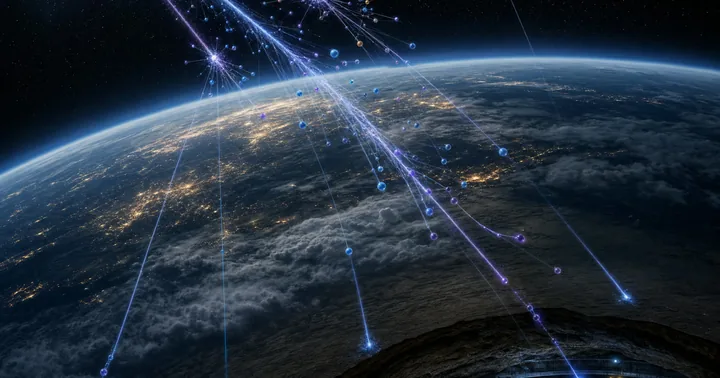
Atmospheric neutrinos are neutrinos created in the Earth's atmosphere as a by-product of cosmic-ray collisions. When a high-energy proton or nucleus from space strikes an air molecule roughly 15 to 20 kilometres up, it produces a shower of secondary particles - chiefly charged pions and kaons. These are unstable and decay in flight, and their decay chains are prolific sources of neutrinos.
They span an enormous energy range, from a few hundred million electronvolts (sub-GeV) up to many teraelectronvolts, overlapping the low end of astrophysical neutrino spectra. Because they arrive from every direction - raining down from the sky above a detector and streaming up through thousands of kilometres of rock and iron from the far side of the planet - atmospheric neutrinos gave experimenters something extraordinary: a single natural source spanning baselines from about 15 km to nearly 13,000 km. That range turned out to be exactly what was needed to catch neutrinos in the act of oscillating.
To understand why they matter, it helps to first be clear on what a neutrino is: a nearly massless, electrically neutral lepton that interacts only through the weak nuclear force and gravity, which is why trillions pass through your body unnoticed every second.
How cosmic rays make them: pion and kaon showers
The production mechanism is a cascade. A primary cosmic ray - most often a proton - hits an atmospheric nucleus and generates a hadronic shower dominated by pions and kaons. A positively charged pion decays into a positive muon and a muon neutrino; the muon then decays into a positron, an electron neutrino, and a muon antineutrino. The mirror chain holds for negatively charged pions.
Counting the neutrinos from a full pion-to-muon-to-electron chain gives two muon-type neutrinos for every one electron-type neutrino. This clean, calculable ratio of roughly 2:1 became the crucial benchmark. Physicists could predict the expected mix from first principles, so any measured departure from 2:1 was a signal that something was happening to the neutrinos in flight.
At higher energies the muons increasingly reach the ground before decaying, so the ratio rises above 2:1, and kaon decays add their own contributions. The muon itself was first identified in exactly these cosmic-ray showers, long before its role in the neutrino story was understood.
The first detections: neutrinos from the sky, 1965
Atmospheric neutrinos hold a historic distinction: they were the first natural neutrinos detected other than those from the Sun. In 1965, two deep-underground experiments independently recorded them within months of each other - one in the Kolar Gold Fields of southern India, led by teams from the Tata Institute, Osaka and Durham, and one in the East Rand gold mine in South Africa, led by Frederick Reines, who had co-discovered the neutrino itself a decade earlier in the 1956 Cowan–Reines experiment.
Both groups went kilometres underground for the same reason: rock filters out the flood of cosmic-ray muons that would otherwise swamp any detector at the surface, while neutrinos pass through unimpeded. The signature they hunted was a muon produced by a neutrino interacting in the surrounding rock. These pioneering measurements confirmed that the atmosphere really does generate a steady neutrino flux - but the instruments of the day were far too small to notice that anything odd was happening to it.
The atmospheric neutrino anomaly
By the 1980s, a new generation of massive underground detectors was built primarily to search for proton decay, with atmospheric neutrinos as an unavoidable background. To subtract that background, experimenters had to measure the muon-to-electron neutrino ratio - and it came out wrong. Detectors were seeing far fewer muon neutrinos than the reliable 2:1 prediction demanded.
The IMB experiment in Ohio and the Kamiokande detector in Japan both reported this deficit through the late 1980s. The shortfall was consistent enough to earn a name - the 'atmospheric neutrino anomaly' - but not yet decisive. Some physicists suspected an error in the flux calculations or the detector modelling rather than new physics. What was missing was a smoking gun: proof that the missing muon neutrinos were disappearing in a way no mundane explanation could reproduce.
The suspected culprit was already on the table in theory. Decades earlier, Bruno Pontecorvo had proposed that neutrinos might oscillate between types if they had mass - the phenomenon of neutrino oscillation. The anomaly looked like oscillation, but looking like it was not enough.
Super-Kamiokande and the discovery of atmospheric neutrino oscillation
The decisive evidence came from Super-Kamiokande, a 50,000-tonne water Cherenkov detector buried about a kilometre deep in the Kamioka mine in Japan. Its inner volume, viewed by more than 11,000 photomultiplier tubes, reconstructs the faint cone of Cherenkov radiation emitted when a neutrino interaction produces a fast charged particle in the water. Crucially, the detector could tell muon events from electron events and could reconstruct the direction of the incoming neutrino.
That directional power was everything. A downward-going neutrino has travelled only about 15 km from the atmosphere directly overhead; an upward-going one has crossed the entire Earth, some 13,000 km, before reaching the detector. Since oscillation depends on the distance travelled, Super-Kamiokande could watch the same neutrino species at dozens of different baselines simultaneously by binning events in zenith angle.
In June 1998, at the Neutrino '98 conference in Takayama, Takaaki Kajita presented the result on behalf of the collaboration. Downward-going muon neutrinos arrived at the expected rate, but upward-going ones - those that had crossed the planet - were depleted by roughly half. Electron neutrinos showed no such distortion. The muon neutrinos were disappearing in precise proportion to how far they had flown. This was the first model-independent evidence of atmospheric neutrino oscillation, and therefore that neutrinos have a non-zero mass.
What the oscillation revealed: mass, mixing, and tau appearance
The pattern told physicists what the muon neutrinos were turning into. They were oscillating predominantly into tau neutrinos, governed by a large mixing angle close to maximal - meaning the transition is nearly complete at the right baseline - and a mass-squared difference of about 2.5 × 10⁻³ electronvolts squared. Oscillation is sensitive only to differences between mass values, not the masses themselves, so it proves neutrinos are massive without yet revealing how heavy they are.
Because the disappearing muon neutrinos should reappear as tau neutrinos, the natural follow-up was to catch that appearance directly. The OPERA experiment, firing a beam from CERN 730 km through the Earth to the Gran Sasso laboratory in Italy, confirmed tau-neutrino appearance in the 2010s, and Super-Kamiokande later found statistical evidence for the tau component in its own atmospheric data. The picture held together.
The importance was recognised at the highest level. The 2015 Nobel Prize in Physics was awarded to Takaaki Kajita and Arthur B. McDonald 'for the discovery of neutrino oscillations, which shows that neutrinos have mass' - Kajita for the atmospheric result at Super-Kamiokande and McDonald for the complementary solar-neutrino result at the Sudbury Neutrino Observatory. Massive neutrinos remain the clearest experimental crack in the Standard Model, which had assumed them to be exactly massless.
The current frontier: mass ordering and new detectors
Atmospheric neutrinos are now precision tools rather than anomalies. As they pass through the dense Earth, matter effects subtly alter their oscillation in a way that depends on the still-unknown ordering of the neutrino masses - the so-called mass hierarchy. Because upward-going atmospheric neutrinos naturally sample the full range of paths through the Earth's mantle and core, they are one of the leading ways to settle that question.
A new generation of instruments is built around this. IceCube's DeepCore array and its planned Upgrade at the South Pole measure atmospheric oscillations in Antarctic ice; KM3NeT/ORCA is doing the same on the Mediterranean seabed; India's proposed INO would use a magnetised iron calorimeter to distinguish neutrinos from antineutrinos. Meanwhile Hyper-Kamiokande, the successor to Super-K, and the DUNE experiment in the United States will combine atmospheric data with accelerator beams to pin down the mass ordering and search for differences between neutrinos and antineutrinos. These sit among the world's major neutrino observatories, and the broader web of natural neutrino sources - solar, reactor, and geoneutrinos - each probes a different piece of the same puzzle.
From cosmic showers to energy research
The atmospheric-neutrino story is a reminder that the environment is permanently awash in particle radiation - cosmic rays overhead, neutrinos of every origin passing through, thermal and electromagnetic waves all around us. This ambient flux is the starting point for the applied research pursued by the Neutrino Energy Group, founded in Berlin in 2008, into a concept it calls neutrinovoltaic: whether a graphene-based multilayer material can convert a fraction of that constant environmental flux into a usable electric current, an idea it groups with the wider field of energy harvesting.
It is important to be precise about status. This is early-stage research, not a proven technology or a purchasable product, and atmospheric neutrinos in particular interact far too weakly to be a practical power source on their own. What the physics of atmospheric neutrinos genuinely offers is not energy but understanding - the hard-won discovery that these ghostly particles have mass, a result that reshaped fundamental physics and continues to drive experiments across the globe.
Frequently asked questions
What are atmospheric neutrinos?
Atmospheric neutrinos are muon and electron neutrinos produced when high-energy cosmic rays strike nuclei in the Earth's upper atmosphere, generating showers of pions and kaons whose decays release the neutrinos. They span energies from sub-GeV to TeV and arrive from all directions, having travelled anywhere from about 15 km to 13,000 km before reaching a detector.
How do cosmic rays produce atmospheric neutrinos?
A cosmic-ray proton hits an air nucleus and creates a cascade of charged pions and kaons. A pion decays into a muon and a muon neutrino, and the muon then decays into an electron, an electron neutrino, and a muon antineutrino. This chain yields roughly two muon-type neutrinos for every one electron-type neutrino.
Why is the 1998 Super-Kamiokande result so important?
Super-Kamiokande found that upward-going muon neutrinos, which had crossed the whole Earth, were depleted by about half compared with downward-going ones, in exact proportion to distance travelled. This was the first firm, model-independent evidence of atmospheric neutrino oscillation, proving that neutrinos change type and therefore have mass - contradicting the Standard Model's assumption of massless neutrinos.
Who discovered atmospheric neutrino oscillation and what prize did it win?
Takaaki Kajita presented the Super-Kamiokande discovery in 1998. He shared the 2015 Nobel Prize in Physics with Arthur B. McDonald of the Sudbury Neutrino Observatory 'for the discovery of neutrino oscillations, which shows that neutrinos have mass.'
When were atmospheric neutrinos first detected?
They were first detected in 1965 by two deep-underground experiments: one in the Kolar Gold Fields in India and one in the East Rand gold mine in South Africa, the latter led by Frederick Reines. They were the first natural neutrinos observed other than those from the Sun.
What do muon neutrinos oscillate into?
Atmospheric muon neutrinos oscillate predominantly into tau neutrinos, governed by a near-maximal mixing angle and a mass-squared difference of about 2.5 × 10⁻³ eV². This tau-neutrino appearance was later confirmed directly by the OPERA experiment using a CERN-to-Gran Sasso beam.
Can atmospheric neutrinos be used as an energy source?
No. Atmospheric neutrinos interact far too weakly to serve as a practical power source. Research groups such as the Neutrino Energy Group study whether ambient environmental flux more broadly might be harvested with graphene-based materials, but that is early-stage research, not a proven or purchasable technology.