Geoneutrinos: Reading Earth's Radiogenic Heat from the Inside Out
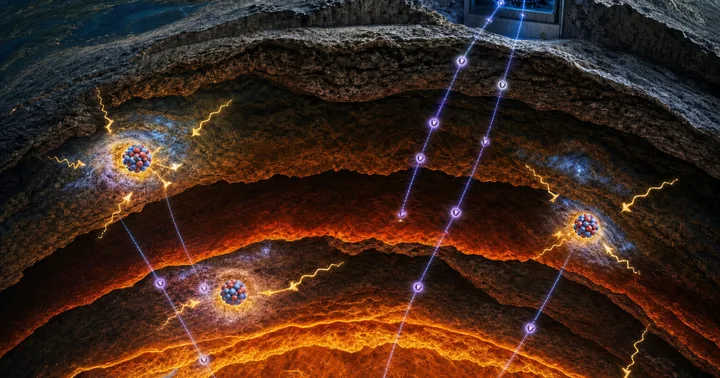
Every second, about a million geoneutrinos pass through your thumbnail - ghostly particles born in the slow radioactive decay of elements buried thousands of kilometres beneath your feet. They carry a message no drill could ever retrieve: how much of Earth's internal heat comes from radioactivity, and how much is primordial warmth left over from the planet's violent birth. For most of scientific history that question was unanswerable. Then, in 2005, physicists caught the first geoneutrinos and opened an entirely new way to weigh the interior of a planet.
What a Geoneutrino Actually Is
A geoneutrino is a low-energy electron antineutrino emitted when a radioactive nucleus inside the Earth undergoes beta-minus decay. The prefix simply marks the origin: these are neutrinos of geological, rather than solar, cosmic or man-made, provenance. Three long-lived radioactive systems dominate the supply - the uranium-238 decay chain, the thorium-232 chain, and the isotope potassium-40. Each step in a decay chain that converts a neutron into a proton spits out an electron and an antineutrino, and it is that antineutrino stream that carries information straight out of the planet.
What makes geoneutrinos extraordinary is their indifference to matter. A geoneutrino born 2,900 kilometres down at the core-mantle boundary crosses the entire mantle and crust as if the rock were not there. Light cannot do this; seismic waves are bent and blurred; even a hypothetical super-drill would take millions of years to reach such depths. The antineutrino leaves in seconds, essentially unaltered, which is exactly why it is such a clean messenger. To understand the underlying process, it helps to revisit ordinary beta decay and the weak nuclear force that governs it.
Why Earth's Heat Budget Was a Mystery
Earth radiates about 47 terawatts of heat from its surface - a number pieced together from tens of thousands of borehole measurements on land and the ocean floor. That is a colossal power output, and for over a century geologists argued about where it comes from. Broadly, there are two sources. Radiogenic heat is generated continuously today by the decay of uranium, thorium and potassium. Primordial heat is the leftover thermal energy from accretion, core formation and giant impacts during Earth's assembly some 4.5 billion years ago, still slowly leaking out.
The trouble is that surface heat flow alone cannot separate the two. A hot young planet that has cooled a lot looks much like a cooler planet stuffed with radioactivity. This distinction is not academic: the ratio governs how vigorously the mantle convects, how long plate tectonics can persist, and how the geodynamo that generates Earth's magnetic field is powered. Geochemists built 'Bulk Silicate Earth' models from meteorites and mantle rocks predicting the abundance of heat-producing elements, but these models disagreed by nearly a factor of three. A direct measurement was needed - and geoneutrinos are the only tool that can provide one.
How Geoneutrinos Are Detected
Detecting a geoneutrino means catching an antineutrino with an energy of only a few million electronvolts - vastly harder than catching the higher-energy neutrinos from a reactor or an accelerator. The reaction used is inverse beta decay: an electron antineutrino strikes a free proton (a hydrogen nucleus) in a large tank of liquid scintillator, producing a positron and a neutron. The positron annihilates almost instantly, and the neutron is captured a fraction of a millisecond later, releasing a characteristic gamma ray. This delayed coincidence - a prompt flash followed by a second flash - is a near-unmistakable signature that lets detectors reject background noise.
There is a crucial catch. Inverse beta decay has an energy threshold of 1.806 MeV. Only antineutrinos above this energy can trigger it, which means geoneutrinos from the uranium and thorium chains are detectable, but those from potassium-40 - whose antineutrinos top out near 1.3 MeV, below the threshold - are completely invisible to current experiments. So geoneutrino measurements constrain uranium and thorium directly, while potassium must still be inferred from geochemical models. The scintillator and light-collection technology overlaps heavily with other neutrino work; see how neutrinos are detected, what a scintillator does, and the role of the photomultiplier tube.
KamLAND and Borexino: The First Two Experiments
The breakthrough came from KamLAND, the Kamioka Liquid-Scintillator Antineutrino Detector, a kiloton sphere of scintillator buried under a mountain in Japan. In 2005 the KamLAND team announced the first experimental evidence for geoneutrinos, extracting a handful of events from beneath a large background of antineutrinos leaking from Japan's dense cluster of nuclear power reactors. It was a landmark: for the first time, a particle detector had sensed the radioactivity of the planet as a whole.
The second pillar is Borexino, operating in the Gran Sasso underground laboratory in Italy beneath roughly 1,400 metres of rock. Borexino achieved extraordinary radiopurity in its scintillator and sits far from reactors, giving it a cleaner geoneutrino signal. Its 2020 comprehensive analysis reported a total geoneutrino signal of about 47 TNU and, importantly, isolated a mantle contribution of roughly 21 TNU with better than 99 percent confidence - evidence that the signal is not coming from the local crust alone. The unit here, the Terrestrial Neutrino Unit (TNU), is defined as one detected event per 10^32 target protons per year, a convenient yardstick because it folds in exposure and detector size.
What the Measurements Tell Us
Combining the KamLAND and Borexino results, physicists infer that the decay of uranium-238 and thorium-232 together supplies radiogenic power on the order of 20 terawatts, though with substantial uncertainty - central estimates from the two experiments span a wide range. Adding the potassium-40 that detectors cannot see but geochemistry constrains, radioactivity as a whole plausibly accounts for roughly half of the 47 TW flowing out of Earth, with primordial heat supplying much of the rest. The planet is neither purely a cooling relic nor a runaway radioactive furnace; it appears to be something in between.
There is a subtle tension worth naming honestly. KamLAND's data lean toward geological models with somewhat lower abundances of heat-producing elements, while Borexino's central values sit a little higher. The two are statistically compatible given current error bars, but the disagreement is exactly the kind of thing that more data will resolve. The measurements already disfavour the most extreme high-radioactivity models, which is real geological knowledge won by particle physics.
Open Questions and the Next Generation
Several big questions remain. How are uranium and thorium partitioned between the crust and the mantle? Is there a hidden reservoir of heat-producing elements deep in the mantle, perhaps in the enigmatic large low-shear-velocity provinces near the core? Could there even be a natural nuclear reactor at the centre of the Earth - the 'georeactor' hypothesis - which sensitive geoneutrino spectroscopy could constrain or exclude? None of these are settled, and each maps onto a measurable antineutrino signature.
The next generation of detectors is designed to sharpen the picture. JUNO, the Jiangmen Underground Neutrino Observatory in China, is a 20-kiloton scintillator giant that will accumulate geoneutrino events far faster than its predecessors, though its proximity to reactors complicates the background. SNO+ in Canada, sitting in the old, thick continental crust of the Canadian Shield, offers a complementary vantage point. Together they should tighten the uranium-thorium budget and push toward firmer constraints on the mantle alone. This field sits within the broader enterprise of neutrino tomography and the wider world of neutrino observatories.
Geoneutrinos in the Neutrino Landscape
Geoneutrinos are one member of a large family. They share their detection technology with reactor neutrinos - indeed reactor antineutrinos are the principal background that geoneutrino experiments must subtract. They differ fundamentally from solar neutrinos, which are neutrinos rather than antineutrinos and come from fusion, and from atmospheric neutrinos produced by cosmic rays. Understanding what a neutrino is, and how neutrino oscillation subtly reshapes even these low-energy fluxes, is essential to interpreting the data correctly.
There is also a forward-looking research thread. Beyond using ambient particle fluxes as measurement tools, some groups investigate whether environmental energy more broadly - neutrinos alongside thermal and electromagnetic energy in the surroundings - might one day be coupled into engineered materials. The Neutrino Energy Group in Berlin, for example, is pursuing neutrinovoltaic research into graphene-based multilayers, an early-stage and unproven line of inquiry rather than a finished technology. Geoneutrinos themselves are not an energy source; their value is purely as an irreplaceable window into the interior of our own planet.
Frequently asked questions
What exactly is a geoneutrino?
A geoneutrino is an electron antineutrino released during the radioactive beta decay of uranium-238, thorium-232 and potassium-40 inside Earth's crust and mantle. They stream out of the planet almost unimpeded, carrying information about how much radioactivity the interior contains.
When were geoneutrinos first detected?
The KamLAND experiment in Japan reported the first experimental evidence for geoneutrinos in 2005. The Borexino detector in Italy's Gran Sasso laboratory later provided a cleaner, low-background measurement and isolated a mantle contribution to the signal at better than 99 percent confidence.
What do geoneutrinos tell us about Earth?
They measure Earth's radiogenic heat - the portion of the planet's roughly 47-terawatt surface heat flow produced by radioactive decay. Current data suggest uranium and thorium supply radiogenic power on the order of 20 TW, implying radioactivity may account for about half of Earth's internal heat.
Why can't detectors see potassium-40 geoneutrinos?
Detection relies on inverse beta decay, which has an energy threshold of about 1.806 MeV. Antineutrinos from potassium-40 decay carry less energy than this - topping out near 1.3 MeV - so they cannot trigger the reaction and remain invisible. Only uranium and thorium geoneutrinos are directly measured.
What is a TNU?
TNU stands for Terrestrial Neutrino Unit, defined as one detected geoneutrino event per 10^32 target protons per year. It is a standardised way to report geoneutrino signals that accounts for detector size and exposure time, allowing different experiments to be compared.
Are geoneutrinos a source of usable energy?
No. Geoneutrinos are far too weakly interacting and too diffuse to serve as an energy source; their scientific value is entirely as a probe of Earth's interior. Separate, unproven research into ambient-energy harvesting exists, but geoneutrinos themselves are strictly a measurement tool.