Neutrino Tomography: Imaging the Earth's Interior With Neutrinos
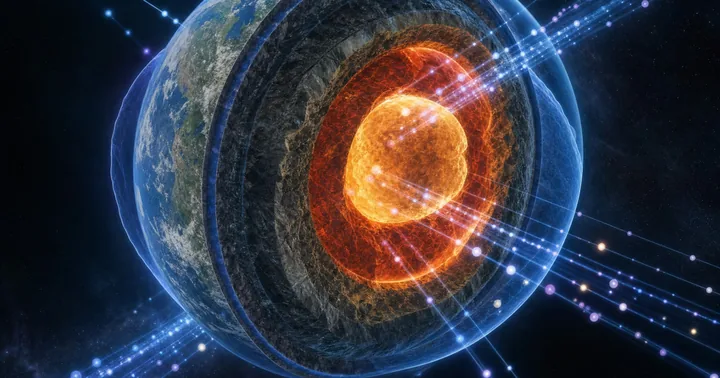
Almost nothing stops a neutrino. That is exactly why it makes such an unlikely, and such a powerful, imaging tool. Ordinary tomography, from a hospital CT scanner to seismic imaging of the planet, works by sending a probe through an object and reading how it is attenuated or bent. X-rays cannot pass through thousands of kilometres of rock and iron; seismic waves can, but they are refracted and reflected in complicated ways. Neutrino tomography exploits a particle that sails almost undisturbed through the entire Earth, yet interacts just often enough that, at the right energies, its passage leaves a measurable fingerprint of the matter it traversed. Over the past decade this once-theoretical idea produced its first real result: a weighing of the planet's dense interior using cosmic neutrinos.
What neutrino tomography actually measures
Neutrino tomography covers a family of techniques united by one idea: read the interior of a dense object from how neutrinos are changed by passing through it. The target is almost always the Earth, because it is the only body both dense enough and conveniently placed to sit between a neutrino source and a detector. Depending on the neutrino's energy, two distinct physical effects do the imaging.
The first is absorption tomography. A neutrino has an interaction probability that rises with energy. Below roughly 10 TeV the Earth is effectively transparent; above it, the planet starts to absorb a measurable fraction of neutrinos travelling along the longest chords through the dense core. Comparing the flux arriving from straight overhead with the flux arriving through the whole planet reveals how much matter lay in the way, exactly as a shadow reveals an object's thickness.
The second is oscillation tomography. At lower energies, from a few GeV downward, neutrinos are not appreciably absorbed but their flavour oscillations are reshaped by the electrons they pass through. Mapping how the oscillation pattern is distorted is a way to map the electron density along the path. The two methods probe different energy windows and, in principle, different quantities, so they are complementary rather than competing.
The physics: absorption and the matter effect
Absorption tomography rests on the neutrino-nucleon cross section, which grows steadily with energy. At tera-electronvolt (TeV) energies and above, a neutrino crossing a full Earth diameter of about 12,740 kilometres has a non-negligible chance of being removed from the beam by a deep-inelastic interaction. Neutrinos skimming near the surface travel through low-density crust and survive; those coming from directly below a detector plough through the iron-rich core, where densities reach roughly 13 grams per cubic centimetre, and are preferentially absorbed. The angular pattern of survivors is therefore a direct readout of the density profile - a genuine, if coarse, shadow of the core.
Oscillation tomography relies on the Mikheyev–Smirnov–Wolfenstein (MSW) effect, named for Stanislav Mikheyev, Alexei Smirnov and Lincoln Wolfenstein. As neutrinos travel through matter, coherent forward scattering off electrons adds an extra potential that shifts their oscillation probabilities. The size of that shift depends on the local electron number density. In principle, precisely measuring how neutrino oscillation is altered along different paths through the Earth lets you reconstruct the electron-density profile independently of gravity or seismology. Because the effect is resonant at particular energies, detectors observing GeV-scale atmospheric neutrinos are naturally sensitive to the core.
A long theoretical prehistory
The idea is older than the instruments that could realise it. In the 1970s and 1980s several physicists independently noticed that neutrinos might see inside the Earth. The Soviet physicist Gurgen Askaryan proposed that neutrino beams could be used for geological prospecting. Around the same time, Alvaro De Rújula, Sheldon Glashow, Richard Wilson and Georges Charpak published a detailed study - 'Neutrino exploration of the earth', a 1983 Physics Reports article - on using neutrino beams to explore the Earth's interior and search for dense ore or oil bodies.
For decades the concept stalled on a brutal practical problem: you need an enormous number of neutrinos and an enormous detector, because even at their most absorbable, neutrinos interact rarely. Purpose-built neutrino beams powerful enough for tomography were, and remain, beyond reach. The breakthrough came not from building a better source but from using a free one - the steady rain of high-energy neutrinos produced when cosmic rays strike the upper atmosphere - together with a detector large enough to catch them: a full cubic kilometre of Antarctic ice.
Weighing the Earth with IceCube
In 2018 a team led by Andrea Donini, Sergio Palomares-Ruiz and Jordi Salvadó carried out the first tomographic weighing of the Earth using neutrino absorption, published in Nature Physics that November. They analysed one year of data from the IceCube Neutrino Observatory at the South Pole, selecting on the order of twenty thousand upward-going atmospheric muon neutrinos with energies ranging from around a tera-electronvolt to several hundred TeV. Neutrinos arriving from steep angles had crossed the core; those from near the horizon had only grazed the mantle.
By comparing how many neutrinos survived along each path, the team reconstructed the Earth's total mass and the distribution of that mass between core and mantle. Their result - a mass of about six trillion trillion kilograms, with a denser core than mantle - agreed with what gravity and seismology had long established. That agreement was the point. For the first time, the planet's interior density had been measured by a completely independent probe that responds only to matter it physically passes through, blind to the gravitational and seismic assumptions that underpin conventional geophysics. The uncertainties were large, at the level of tens of percent, but the method worked.
The measurement leans on IceCube's ability to reconstruct both the energy and, crucially, the arrival direction of each event. Those directions are recovered from Cherenkov light, the same signal used across neutrino observatories to reconstruct how neutrinos are detected in deep ice and water.
Mapping the core through oscillations
Absorption tomography needs very high energies and therefore rare events. Oscillation tomography works at GeV energies, where atmospheric neutrinos are far more abundant, and it promises something absorption cannot easily give: sensitivity to composition, not just density. The MSW matter effect depends on the electron fraction of the material - the number of electrons per nucleon - which differs between the silicate mantle and the iron-nickel core.
This raises a tantalising prospect. Seismology tells us the core is denser than the mantle but is largely blind to its precise chemistry; the long-debated 'light element' problem of the core is a chemistry question. Oscillation tomography could, in principle, measure the core's electron fraction directly and help settle whether the core contains the lighter elements geochemists suspect. No experiment has yet achieved this - the signal is subtle and the required statistics are demanding - but it defines one of the field's most exciting long-term goals.
The detectors that will sharpen the picture
Today's tomographic results are proof-of-principle: low-resolution, statistics-limited, consistent with what we already knew. Sharper images depend on the next generation of large neutrino telescopes now under construction. KM3NeT/ORCA in the Mediterranean and the proposed IceCube Upgrade and IceCube-Gen2 at the South Pole are optimised for exactly the GeV-scale atmospheric neutrinos that oscillation tomography needs, with denser instrumentation to resolve the core.
With years of data, these instruments could move from confirming the Earth's mass to genuinely mapping the density and electron-fraction contrast across the core–mantle boundary. Combined with absorption tomography at higher energies, the two approaches could eventually deliver a neutrino-based cross-section of the planet that stands beside seismology as an independent geophysical tool. It will remain a coarse image for a long time - neutrino tomography will not rival a seismometer network for detail - but it answers questions, about deep composition, that seismology struggles to reach.
Beyond the Earth: monitoring and speculative scanning
The same principles inspire smaller-scale ambitions. Because nuclear reactors are intense, well-understood neutrino sources, detectors placed nearby can monitor reactor power and even infer fuel composition and plutonium content - a genuine and actively developed tool for nuclear non-proliferation safeguards, sometimes described as reactor 'imaging'. This is closely tied to the physics of coherent elastic neutrino-nucleus scattering, which offers a compact way to detect reactor neutrinos.
More speculative proposals imagine using neutrinos to scan cargo containers or probe deeply buried structures. These remain firmly theoretical: the neutrino fluxes and detector sizes required are wildly impractical with any foreseeable technology. It is important to be honest that this end of the field is thought experiment, not engineering. What is real, demonstrated and improving is tomography of the whole Earth using natural neutrino fluxes.
There is a broader research thread that shares this fascination with how neutrinos and other ambient radiation interact with dense matter. The Neutrino Energy Group's in-development neutrinovoltaic research, and the wider field of energy harvesting, study whether the tiny momentum deposited when environmental flux meets an engineered material can be captured at all. That is a separate, unproven, early-stage line of enquiry - not a product and not established science - but it springs from the same underlying question that makes tomography possible: what, exactly, happens when a neutrino does interact with the matter it passes through.
Limits, uncertainties and open questions
Neutrino tomography is real but young, and its limits should not be understated. Every result so far is statistics-starved: the IceCube weighing rested on tens of thousands of carefully selected events accumulated over a year, yielding a mass measurement with tens of percent uncertainty rather than the parts-per-million precision of gravitational geodesy. The angular and energy resolution of even the best detectors sets a floor on how finely the interior can be sliced. And the absorption method's cross section itself depends on particle-physics inputs that must be calibrated, entangling the geophysics with the underlying physics.
The open questions are correspondingly ambitious. Can oscillation tomography measure the core's electron fraction well enough to constrain its chemistry? Can absorption and oscillation data be combined into a single consistent density profile? Can next-generation telescopes reach the statistics needed to see structure, not just bulk mass? None is answered yet. What has been established is the principle - that a particle which barely notices the Earth can nonetheless be made to reveal its heart - and that alone marks neutrino tomography as one of the more quietly remarkable achievements at the border of particle physics and geophysics.
Frequently asked questions
What is neutrino tomography?
Neutrino tomography is the use of neutrinos to image the interior of a dense object, most often the Earth. Because high-energy neutrinos are slightly absorbed and their oscillations reshaped as they cross matter, measuring how they emerge on the far side reveals the density and composition of everything they passed through - an independent alternative to seismic imaging.
Has anyone actually imaged the Earth with neutrinos?
Yes, at low resolution. In 2018 a team led by Andrea Donini, Sergio Palomares-Ruiz and Jordi Salvadó used one year of IceCube data and atmospheric neutrino absorption to weigh the Earth and confirm that its core is denser than its mantle. The result, published in Nature Physics in 2018, agreed with gravity and seismology while relying on none of their assumptions.
How is neutrino tomography different from a CT scan?
Both read an object from how a probe is changed on its way through. A CT scan sends X-rays through the body, but X-rays cannot penetrate thousands of kilometres of rock and iron. Neutrinos can cross the entire Earth, so they can probe depths no other beam reaches - at the cost of interacting so rarely that images are coarse and require enormous detectors.
What are the two main types of neutrino tomography?
Absorption tomography, which works above roughly 10 TeV, reads the density profile from how many high-energy neutrinos are absorbed along paths of different length through the planet. Oscillation tomography, which works at GeV energies, reads the electron density from how the MSW matter effect distorts neutrino flavour oscillations. The two probe different energy ranges and are complementary.
Could neutrino tomography reveal what the Earth's core is made of?
Potentially. Oscillation tomography is sensitive to the electron fraction of matter, which differs between the silicate mantle and the iron-rich core. In principle this could measure the core's chemistry directly and help resolve the long-standing question of which light elements it contains. No experiment has achieved this yet; it is a goal for next-generation detectors like KM3NeT/ORCA and IceCube-Gen2.
Can neutrinos be used to scan cargo or hidden objects?
Reactor monitoring is real: detectors near a nuclear reactor can infer its power and fuel from the neutrinos it emits, a genuine safeguards tool. Scanning cargo containers or buried structures with neutrinos, however, remains purely theoretical - the fluxes and detector sizes required are impractical with any foreseeable technology. The one demonstrated application is tomography of the whole Earth using natural neutrino fluxes.