Neutrino Life Cube
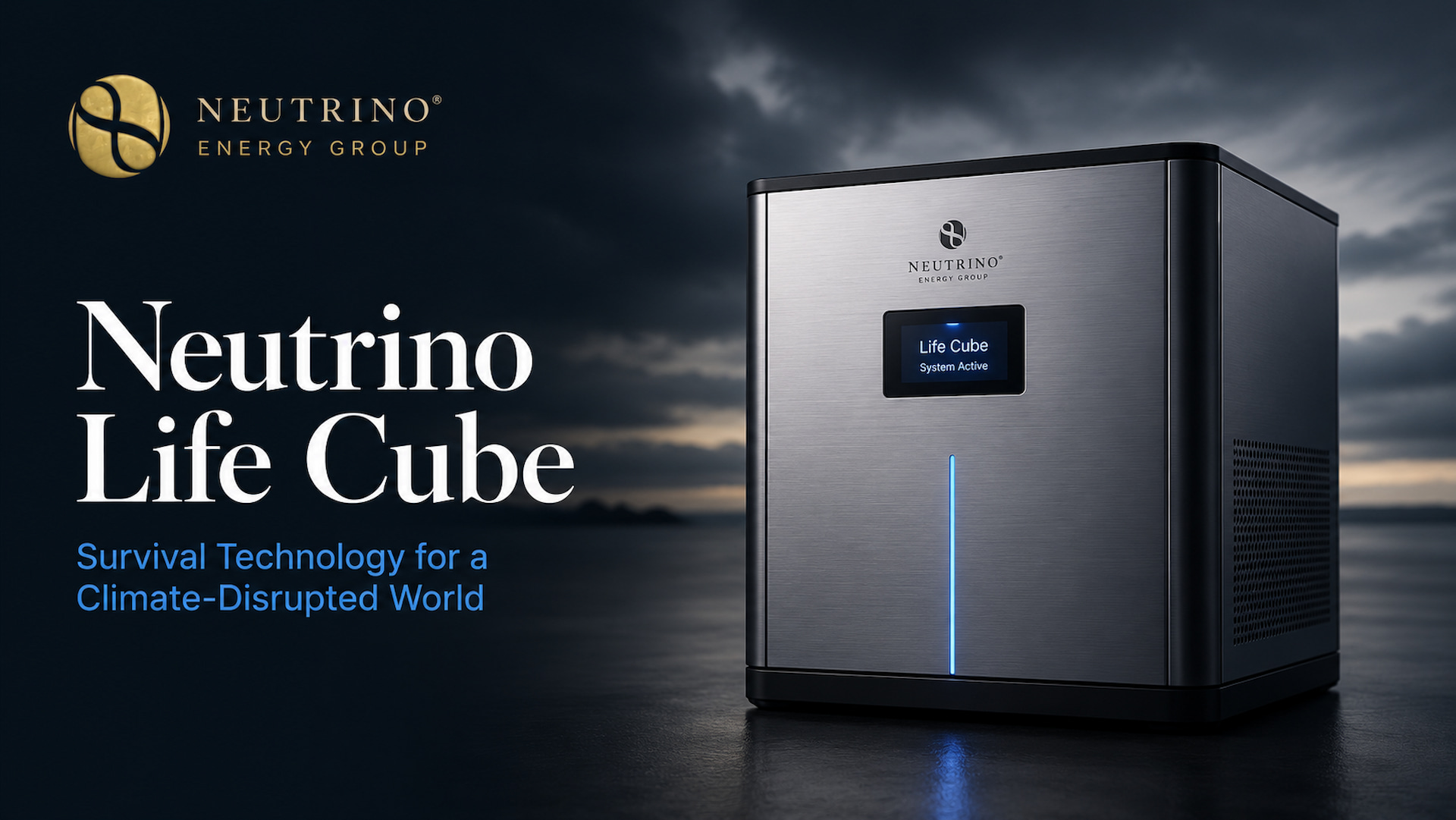
One self-contained unit. Continuous power. Clean water from air. The Neutrino Life Cube is infrastructure that remains when infrastructure disappears.
Design targets - independent verification pending
- Power output
- 1–1.5 kW continuous, no fuel
- Clean water
- 12–25 L/day from ambient air
- Fuel required
- None ambient flux conversion
- External water source
- Not required atmospheric extraction
- Grid connection
- Not required standalone operation
- Moving parts (generator)
- None solid-state
- Emissions
- Zero no combustion, no waste
- Operation
- 24/7, any location weather-independent
The Problem It Solves
When a disaster strikes — hurricane, earthquake, flood — the sequence is almost always the same. The power grid fails within hours. Drinking water becomes unsafe within a day. Hospitals exhaust backup power. Relief depends on supply chains that must survive the disaster themselves in order to reach the people who need it.
The Neutrino Life Cube starts from a different premise: instead of asking how to get power and water into a disaster zone faster, it asks what happens if a self-contained unit never needed either delivered in the first place.
Everything in One Box
The Life Cube packages three integrated systems into a single deployable unit: a neutrinovoltaic power generator producing 1 to 1.5 kW of continuous output, a climate control module, and an atmospheric water generation and purification system capable of producing 12 to 25 litres of treated drinking water per day depending on climatic conditions.
These aren't three components sharing a housing out of convenience — they are integrated so that the generator's output directly and continuously drives the water and climate functions, without a battery that needs external recharging and without fuel that needs replenishing.
Atmospheric water generation from ambient air is established technology. What has always kept it from working at meaningful scale in disaster and off-grid contexts is the energy requirement. The Life Cube addresses that constraint at the root by making the power source as self-sufficient as the water extraction it feeds.
The Physics of Self-Sufficiency
The neutrinovoltaic generator at the core uses multilayer graphene and doped-silicon stacks engineered to couple with a multi-channel ambient flux: particle momentum transfers, cosmic muon flux, electromagnetic fluctuations, and thermal gradients — converting these into stable electrical output with no fuel and no moving parts.
Unlike solar panels that go dark at night or under cloud cover, smoke, and dust — exactly the conditions disaster zones often produce — or wind turbines that stop in dead calms and can be damaged by extreme winds, the neutrinovoltaic generator's inputs are not atmospheric in that sense. They are not interrupted by surface weather events.
Three Deployment Timescales
- Acute Phase
- Field hospitals after earthquakes, storms, and floods — immediate power and water without pre-positioned fuel or supply chains.
- Interim Infrastructure
- Community health posts in regions where the grid was badly damaged or was always sparse — operating month after month without fuel deliveries.
- Permanent Deployment
- Communities with depleted groundwater and unreliable rainfall — a continuous source of power and water indefinitely.
- Off-Grid Living
- Remote homes, research stations, and mobile installations requiring autonomous energy and water independence.
White Paper
The complete technical and humanitarian case for the Neutrino Life Cube is documented in the official white paper, published July 2026.
Download: Neutrino Life Cube — Continuous Energy. Treated Water. Human Progress. (PDF) →