What Is Graphene? The One-Atom-Thick Wonder Material, Explained
Run a pencil across paper and you will almost certainly leave behind a few flakes of graphene - the thinnest material ever isolated, hiding in plain sight for centuries. So what is graphene, exactly? It is a single sheet of carbon atoms, one atom thick, with a list of record-breaking properties that reads like science fiction: stronger than steel, more conductive than copper, nearly invisible, yet flexible enough to fold like paper. This guide covers what graphene is, how it is made, which graphene uses are real today - and why this material sits at the heart of modern energy research, including our own.
What Is Graphene? A Single Sheet of Carbon
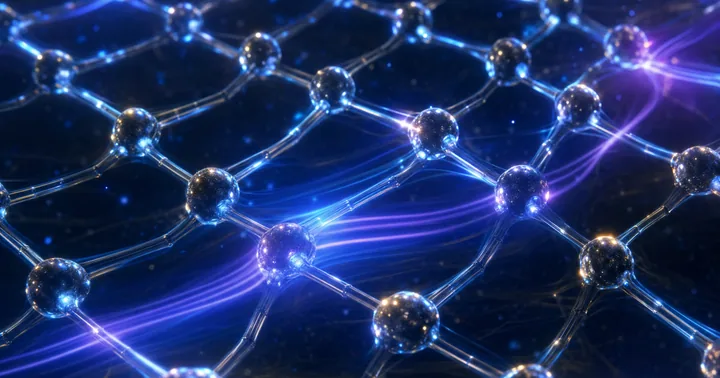
Graphene is a two-dimensional crystal: a flat sheet of carbon atoms bonded in a hexagonal honeycomb pattern, just 0.34 nanometres thick. You would need to stack roughly three million graphene layers to reach one millimetre. Graphite - the "lead" in your pencil - is simply billions of these sheets loosely stacked on top of one another, which is why a pencil sheds them so easily.
What makes a single sheet extraordinary is what the geometry does to electrons. Each carbon atom bonds to three neighbours, leaving one electron free to roam across the whole lattice. In this flat honeycomb, those electrons behave as if they were nearly massless, travelling at around 1/300th of the speed of light with astonishingly little scattering. No other known material conducts charge this way at room temperature.
The Scotch-Tape Discovery and the 2010 Nobel Prize
For decades, physicists doubted that a free-standing two-dimensional crystal could even exist - theory suggested thermal fluctuations would tear it apart. Then, in 2004, Andre Geim and Konstantin Novoselov at the University of Manchester settled the question with a piece of sticky tape. During their famous "Friday night experiments," they peeled layers off a block of graphite with adhesive tape, folded and peeled again and again until only single-atom layers remained, then transferred the flakes onto a silicon wafer, where they became visible under a microscope.
The pair received the 2010 Nobel Prize in Physics for the achievement - remarkably fast, just six years after their 2004 paper in Science. Geim remains the only person to have won both a Nobel Prize and an Ig Nobel Prize (the latter for magnetically levitating a frog), a fitting résumé for a discovery born of playful experimentation.
Graphene Properties: The Record Sheet
Graphene's properties are not incrementally better than those of other materials - several of them are outright records. The headline numbers:
- Strength: an intrinsic tensile strength of about 130 gigapascals - roughly 200 times stronger than structural steel by weight, making it the strongest material ever tested.
- Electron mobility: above 200,000 cm²/V·s in pristine suspended samples - more than 100 times that of silicon, which is why graphene conducts electricity so exceptionally well.
- Thermal conductivity: laboratory measurements approaching 5,000 W/m·K, several times higher than copper (~400 W/m·K).
- Transparency: a single layer absorbs only about 2.3% of visible light, making it almost perfectly transparent.
- Flexibility and impermeability: it can stretch elastically by around 20%, bend without breaking, and is impermeable to all gases - even helium atoms cannot pass through.
How Is Graphene Made? From Sticky Tape to Industrial Reactors
How is graphene made? The answer depends on what you need it for - a handful of perfect flakes for research, or tonnes of powder for industry. The main production routes:
The core tension of the graphene industry lives in this list: quality, size, and price - pick two. Records measured on pristine lab flakes do not automatically transfer to bulk powders, which is why serious applications specify exactly what grade of graphene they use.
- Mechanical exfoliation: the original scotch-tape method. Produces the highest-quality flakes in tiny quantities - still the gold standard for laboratory physics.
- Liquid-phase exfoliation: graphite is split apart in solvents using ultrasound or shear mixing. Cheap and scalable, yielding graphene powders and inks of mixed quality.
- Graphene oxide reduction: graphite is oxidised (chemistry dating back to the Hummers method of 1958), separated into single sheets in water, then chemically "reduced" back toward graphene. Defect-rich but industrially practical.
- Chemical vapour deposition (CVD): a carbon-rich gas such as methane decomposes over hot copper foil at around 1,000 °C, assembling large continuous films atom by atom - the route to graphene for electronics and multilayer devices.
What Is Graphene Used For Today? The Real vs. the Hyped
Two decades after its isolation, graphene uses fall into two categories: quietly real and loudly overhyped. The real column keeps growing. Graphene-enhanced composites stiffen tennis rackets, bicycle frames, car parts, and even concrete. Graphene heat-spreading films cool the electronics inside millions of smartphones. Graphene sensors exploit the fact that every single atom sits on the surface, making the material extraordinarily sensitive to gases and biomolecules. Conductive graphene inks enable printed, flexible circuits.
Then there is the "graphene battery." The honest version: today's commercial products are graphene-enhanced lithium-ion batteries, in which small amounts of graphene improve electrode conductivity and heat management, enabling faster charging and longer cycle life. A pure graphene battery does not exist as a mass-market product. Graphene's genuine electrochemical strength lies in supercapacitors - devices that charge in seconds and survive millions of cycles but store far less total energy than a battery. A useful rule of thumb: claims of limitless power or "instant" charging are marketing; claims of incremental, measurable gains are probably real.
Graphene as an Energy Material: The Thibado Experiment
Graphene has also become a serious subject in energy-harvesting research. In 2020, physicist Paul Thibado's group at the University of Arkansas published a peer-reviewed study in Physical Review E showing that freestanding graphene is never truly still: at room temperature the sheet ripples and buckles continuously, and when the team connected it to a circuit through diodes, that motion produced a small, measurable current. The result matters because it demonstrated cleanly that a graphene sheet's ambient motion can be converted into electrical work without violating thermodynamics - the energy is drawn from the surrounding heat bath, not conjured from nothing.
The honest caveats: the measured power is on the scale of picowatts - trillionths of a watt - per circuit. Thibado's own framing is that millions of such microcircuits on a chip might one day power tiny sensors, not households. But as a proof of principle for renewable energy innovations at the microscale, it is a landmark: graphene can act not just as a conductor, but as an active energy-converting material.
Why Graphene Matters for Neutrinovoltaic Research
This is where graphene intersects with our own work. The Neutrino Energy Group, a Berlin-based research organisation founded in 2008, is developing neutrinovoltaic technology: a patented multilayer of doped graphene and silicon on a metallic substrate (patent WO2016142056A1), designed to convert several forms of ambient energy - the thermal motion of the graphene lattice, electromagnetic radiation, and, under the research hypothesis, the tiny momentum transferred by passing particles such as neutrinos - into small electric currents.
The scientific anchors are public record. The 2015 Nobel Prize in Physics was awarded for the discovery of neutrino oscillations, which prove that neutrinos have mass; the COHERENT experiment showed in 2017 that neutrinos transfer measurable momentum to atomic nuclei; and Thibado's 2020 work demonstrated that graphene's atomic-scale motion can be tapped as a small current. Neutrinovoltaic research asks whether engineered graphene-silicon multilayers can combine such effects usefully. To be clear about status: this is ongoing research and development - not a product you can buy today, and any future output would be small-scale electricity, not unlimited power. Graphene is the reason the question can be asked at all; the broader context is covered in our overview of new energy technology.
Frequently asked questions
Is graphene stronger than diamond?
By the measure of tensile strength, yes: graphene's intrinsic strength of about 130 gigapascals makes it the strongest material ever tested, and pound for pound it outperforms diamond. Diamond remains harder in the everyday sense of scratch resistance, but graphene is far stronger under tension and vastly more flexible.
Why isn't graphene used everywhere yet?
Because quality, size, and cost pull against each other. Perfect flakes exist only in tiny quantities; bulk powders are cheap but defect-rich; large high-quality CVD films remain expensive and hard to integrate into existing silicon manufacturing. Twenty years is a short time in materials science - silicon needed decades to mature too.
What is a graphene battery?
Commercial "graphene batteries" today are actually graphene-enhanced lithium-ion batteries: small graphene additions improve electrode conductivity and heat dissipation, enabling faster charging and longer life. A pure graphene battery is not a mass-market product. Graphene's strongest electrochemical role is in supercapacitors, which charge in seconds but store less total energy than batteries.
Does graphene generate electricity?
Not in the way a solar cell or battery does. However, the 2020 Thibado experiment at the University of Arkansas showed that the natural thermal rippling of freestanding graphene can be converted into a tiny current - on the order of picowatts, drawn from ambient heat in full accordance with thermodynamics. Research programmes, including neutrinovoltaic research into doped graphene-silicon multilayers, are exploring whether such effects can be engineered usefully. This remains research, not a purchasable product.
Is graphene safe?
Graphene locked inside composites, films, and coatings poses no known special risk. Loose graphene nanoparticles, like other nanomaterials, are handled under precautionary workplace rules while toxicology studies continue. Regulators and researchers treat inhalable fine powders with caution, but current evidence does not support alarmist comparisons with asbestos.
Can I make graphene at home?
Technically yes - the Nobel-winning method needs only graphite and adhesive tape. Repeatedly peeling a graphite flake will eventually leave few-layer and even single-layer graphene on the tape. The catch is verification: confirming you have a true monolayer requires a microscope and lab conditions, which is why the feat took until 2004.