Neutrinovoltaic
The graphene-silicon material behind every Neutrino Energy Group product - how invisible ambient radiation is converted into usable electricity.
The Graphene Wave Mechanism
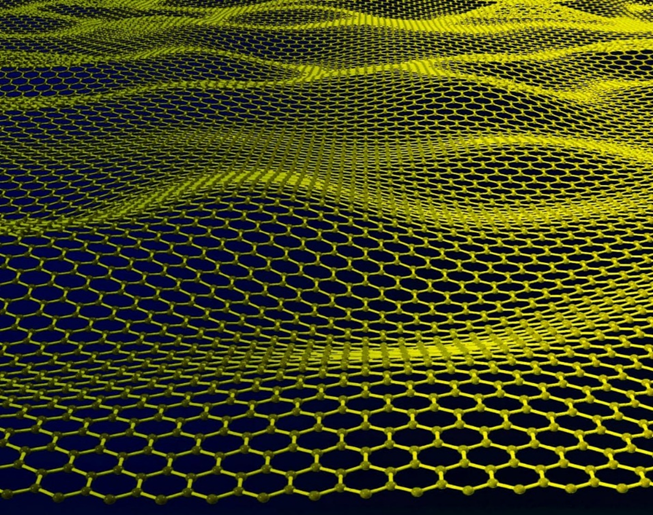
A freestanding graphene membrane is never still. Thermal energy causes the lattice to undulate - a continuous mechanical wave that exists at any temperature above absolute zero.
When graphene is placed on a silicon substrate and subjected to environmental radiation, these waves are amplified and become asymmetric. The asymmetry is crucial: symmetrical oscillation produces no net current - directed, asymmetric vibration drives electrons preferentially in one direction through the quantum ratchet mechanism.
In 2020, Thibado et al. at the University of Arkansas demonstrated experimentally that freestanding graphene membranes generate measurable electrical current from ambient thermal fluctuations alone - without any external energy source.
Why Graphene?
Graphene is a single atomic layer of carbon atoms arranged in a honeycomb lattice - exactly one atom thick. Its properties are extreme along every axis that matters for energy conversion:
The 12-Layer Stack
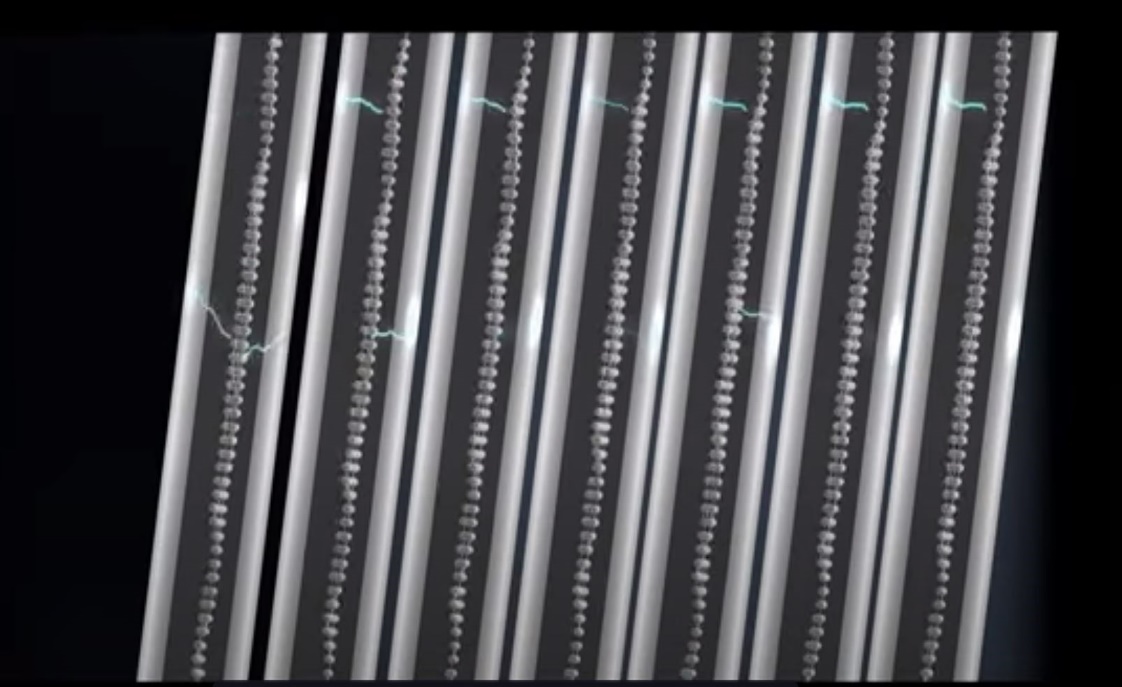
A single neutrinovoltaic cell consists of alternating doped graphene and silicon layers, bonded under controlled conditions. The stack in the Neutrino Power Cube contains 12 such layer pairs per converter module.
The graphene layers are chemically doped to shift the Fermi level, tuning the asymmetry of the rectification junction. The silicon interlayers provide structural stability, phonon scattering surfaces, and secondary conversion pathways for electromagnetic flux.
Each layer pair adds cumulatively to the total voltage - 12 pairs in series produce the target net output of 5–6 kW.
Neutrino Interaction: CEvNS
The specific mechanism by which neutrinos interact with the graphene lattice is coherent elastic neutrino-nucleus scattering (CEvNS). Predicted by Daniel Z. Freedman in 1974 and first measured by the COHERENT collaboration at Oak Ridge National Laboratory in 2017 - CEvNS describes the transfer of momentum from a neutrino to an entire atomic nucleus.
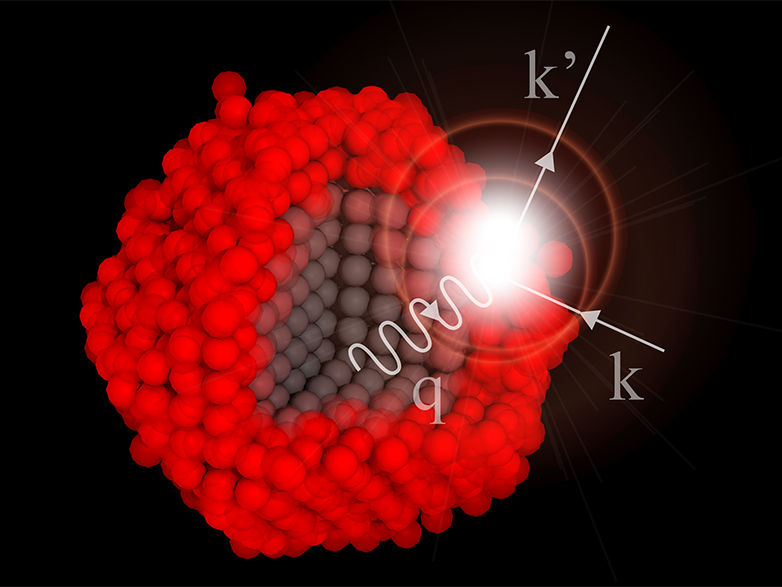
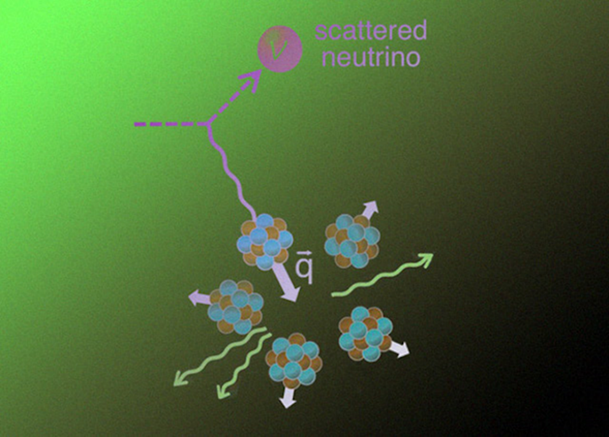
Because CEvNS involves coherent scattering from the entire nucleus (not just one nucleon), the cross-section scales as N² - where N is the number of neutrons. The flux is immense: approximately 6.5 × 10¹⁰ solar neutrinos pass through every square centimetre of Earth every second.
The Six-Stage Conversion Chain
Energy conversion in a neutrinovoltaic cell follows six sequential stages - each grounded in peer-reviewed experimental evidence.
- 01
Particle flux entry
Environmental radiation - neutrinos, cosmic muons, electromagnetic waves, and thermal photons - continuously enters the graphene-silicon stack from all directions.
- 02
CEvNS momentum transfer
Neutrinos interact with atomic nuclei via coherent elastic neutrino-nucleus scattering (CEvNS), transferring measurable momentum to the graphene lattice without absorption.
- 03
Phonon generation
The momentum impulse excites quantised lattice vibrations (phonons). Graphene's unique band structure allows anomalously strong phonon-electron coupling compared to conventional semiconductors.
- 04
Electron excitation
Phonons elevate conduction-band electrons above the Fermi level. Combined with Brownian-driven graphene membrane fluctuations (Thibado 2020), a sustained population of energetic charge carriers is created.
- 05
Asymmetric rectification
The doped graphene-silicon junction is structurally asymmetric. Stochastic charge-carrier motion is rectified into net directional DC current - a quantum ratchet effect rather than thermal equilibrium.
- 06
Voltage buildup & output
12 alternating graphene-silicon layer pairs stack in series. Each layer adds to the cumulative voltage. Power conditioning circuits smooth the raw DC into stable, usable electricity.
Applications
The same core neutrinovoltaic material is the basis for every product in the Neutrino Energy Group portfolio - scaled and adapted for different deployment contexts:
Decentralised power generator for residential and commercial use
Prototype developmentNeutrinovoltaic body panels enabling continuous passive EV charging
Concept phaseDual-source energy module combining radiation and motion harvesting
In developmentHull-integrated conversion material for emission-free ocean operations
Early conceptFrom Tesla to Today
The development of neutrinovoltaics from the earliest scientific foundations to the current verification phase.
The Foundations
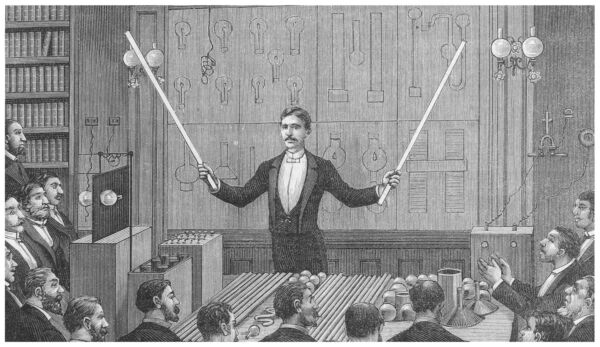
Nikola Tesla demonstrates wireless energy transmission. The idea of harvesting invisible radiation becomes publicly conceivable for the first time.

Neutrino Energy Group Founded
Holger Thorsten Schubart establishes the Neutrino Energy Group in Berlin with a clear vision: to harness neutrinos and ambient radiation as a persistent energy source.

First Public Presentations
The concept is introduced at international conferences for the first time. Scientific interest grows and material research on graphene-silicon multilayers begins in earnest.
Patent & Prototype
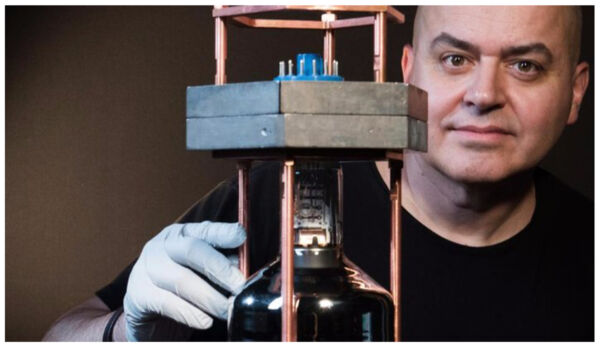
International patent WO2016142056A1 is published. The first functional converter cell is demonstrated in the laboratory.

U.S. Government Cooperation
The U.S. Department of Energy Office of Science confirms the scientific foundation of neutrinovoltaics. International research collaborations are established.
Pi.energy - Mobility
The Pi Mobility product line is unveiled: neutrinovoltaics integrated into vehicle bodies. The Pi Car concept enters its first development phase.

Full Technology Portfolio
Power Cube, Pi Car, Pi Catalyst, Pi Fly, and Nautic Pi - five application platforms built on the same core technology are presented to the public.
Independent Verification Phase
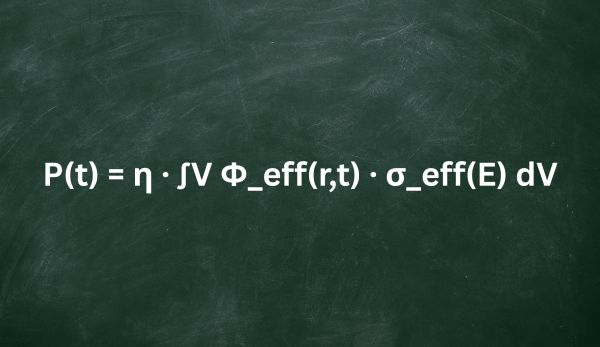
The master formula P(t) = η · ∫V Φ_eff(r,t) · σ_eff(E) dV defines the measurement framework. Independent third-party verification of the Power Cube net output is underway.