The Weak Nuclear Force, Explained
The weak nuclear force is the quiet engine behind some of the universe's most consequential events, from the radioactive decay of atoms to the fusion reactions that make the Sun shine. Alongside gravity, electromagnetism, and the strong nuclear force, it is one of the four fundamental interactions that shape all physical reality. Yet it is the most elusive of the four to picture: it acts only across distances a thousand times smaller than a proton, it can change one kind of particle into another, and it is the reason neutrinos can pass through a light-year of lead almost undisturbed. Understanding the weak force means confronting some of the deepest and strangest ideas in modern physics - and it turns out to be inseparable from the story of the neutrino itself.
What Is the Weak Force?
The weak nuclear force - also called the weak interaction or simply the weak force - is one of the four fundamental forces of nature. Unlike gravity and electromagnetism, whose effects reach across the cosmos, the weak force operates only at extraordinarily short range, roughly 10⁻¹⁸ metres, about one-thousandth the diameter of a proton. Beyond that distance its influence essentially vanishes.
What makes the weak force genuinely unique is not its feebleness but its behaviour. The other three forces, broadly speaking, push and pull particles around. The weak force does something no other force can: it changes the very identity of particles. It can turn a down quark into an up quark, transmute one type of particle into another, and convert a neutron into a proton. This ability to alter 'flavour' is why the weak interaction sits at the heart of radioactivity and stellar fuel-burning.
The force is called 'weak' because, at the low energies of everyday matter, its effects are far less probable than those of electromagnetism or the strong force. A weak-force reaction between two particles can be millions of times less likely than an electromagnetic one. But this apparent weakness, as we will see, is an illusion created by the messengers that carry it.
Beta Decay: The Weak Force at Work
The most familiar manifestation of the weak force is beta decay, a form of radioactivity discovered at the turn of the twentieth century. In beta-minus decay, a neutron inside an atomic nucleus transforms into a proton, emitting an electron and an antineutrino in the process. At the quark level, one of the neutron's down quarks becomes an up quark, and the leftover energy is carried away by the two new particles.
Beta decay posed a famous puzzle in the 1910s and 1920s. The emitted electrons came out with a continuous spread of energies rather than a single fixed value, seeming to violate the conservation of energy. In 1930 Wolfgang Pauli proposed a radical fix: a tiny, electrically neutral, nearly massless particle carrying away the missing energy. Enrico Fermi later named it the neutrino - 'little neutral one' - and in 1934 published the first quantitative theory of beta decay, effectively the first mathematical description of the weak force.
Fermi's theory was so successful that the neutrino was accepted long before it was ever detected. It would take until 1956 for Clyde Cowan and Frederick Reines to catch neutrinos directly. Beta decay remains the textbook example of the weak interaction and the reason the neutrino and the weak force are forever intertwined.
The W and Z Bosons: Carriers of the Weak Force
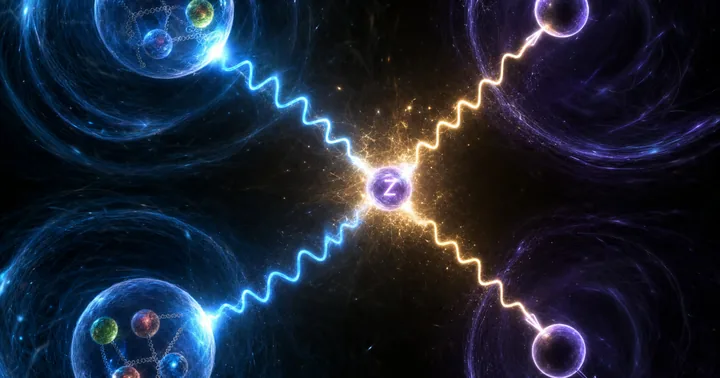
Every fundamental force is transmitted by a messenger particle. Electromagnetism is carried by the massless photon; the strong force by gluons. The weak force is carried by three particles: the electrically charged W⁺ and W⁻ bosons, and the neutral Z boson.
Here lies the resolution to the mystery of the force's weakness and short range. The photon has zero mass, so electromagnetism reaches to infinity. The W and Z bosons, by contrast, are extraordinarily heavy - the W boson has a mass of about 80.4 GeV/c² and the Z boson about 91.2 GeV/c², each roughly 85 to 100 times the mass of a proton. According to quantum mechanics, the more massive the messenger, the shorter the distance it can travel before it must be reabsorbed. That enormous mass is precisely what confines the weak force to about 10⁻¹⁸ metres and makes its reactions so improbable at low energy.
The W and Z bosons were predicted by theory decades before anyone could produce them. Confirming their existence required one of the largest scientific machines ever built, and it turned a beautiful equation into experimental fact.
Electroweak Unification: One Force Behind Two
In the 1960s, Sheldon Glashow, Abdus Salam, and Steven Weinberg proposed one of the most profound ideas in all of physics: that the weak force and electromagnetism are not two separate forces at all, but two faces of a single underlying 'electroweak' interaction. At the very high energies present in the early universe, the two would have been indistinguishable - unified into one. As the cosmos cooled, that symmetry broke, and the electroweak force split into the familiar electromagnetism and the weak force we observe today.
This symmetry breaking, driven by the Higgs mechanism, is what gives the W and Z bosons their great mass while leaving the photon massless. The Higgs field's role in the electroweak theory was one of the main reasons physicists spent decades hunting for the Higgs boson, finally discovered at CERN in 2012.
Glashow, Salam, and Weinberg shared the 1979 Nobel Prize in Physics for the electroweak theory. Their prediction of the W and Z bosons was dramatically confirmed in 1983, when the UA1 and UA2 experiments at CERN's proton-antiproton collider detected both particles at almost exactly the predicted masses. Carlo Rubbia and Simon van der Meer received the 1984 Nobel Prize for that discovery. Electroweak unification is a cornerstone of the Standard Model of particle physics.
Parity Violation: The Force That Knows Left From Right
The weak force hides one more startling secret. For most of the twentieth century, physicists assumed the laws of nature were perfectly mirror-symmetric - that any process and its mirror image were equally possible. This principle is called parity conservation.
In 1956, Tsung-Dao Lee and Chen-Ning Yang noticed that parity had never actually been tested for the weak interaction, and proposed an experiment. Later that year and into 1957, Chien-Shiung Wu carried it out, studying the beta decay of cobalt-60 nuclei aligned in a magnetic field. The electrons came out preferentially in one direction, revealing that the weak force distinguishes left from right - it maximally violates parity. Nature, at its most fundamental level, is not ambidextrous.
This was a genuine shock to the physics community. Lee and Yang received the 1957 Nobel Prize for the theoretical insight. Parity violation is now understood as an intrinsic feature of the weak interaction, tied to the fact that only 'left-handed' particles (and 'right-handed' antiparticles) feel the charged weak force at all.
Why Neutrinos Are Governed by the Weak Force
The weak force explains one of the most remarkable properties of the neutrino. Neutrinos carry no electric charge, so they ignore electromagnetism. They are not made of quarks, so the strong force does not touch them. That leaves only two of the four forces: gravity, which is negligible for such tiny masses, and the weak force. The weak interaction is essentially the only way a neutrino talks to ordinary matter.
Because the weak force is so short-ranged and its reactions so improbable, neutrinos almost never interact. Trillions stream through your body every second, and virtually all of them pass straight through the entire Earth without touching a single atom. Detecting them requires enormous instruments - vast tanks of water or ice watched by thousands of sensors, methods explored in how neutrinos are detected and through phenomena like Cherenkov radiation.
That neutrinos have mass at all - long assumed to be zero - was demonstrated by the discovery of neutrino oscillation, the quantum flickering of a neutrino between its three types as it travels. Takaaki Kajita and Arthur McDonald shared the 2015 Nobel Prize in Physics for that finding, a result with deep implications for the weak sector of the Standard Model.
From Fundamental Force to Applied Research
The weak force is not merely an abstraction for physicists. It powers the proton-proton fusion chain in the Sun, where the very first step depends on a weak-force reaction converting protons into deuterium. Without the weak interaction, stars could not shine and the elements of life could not have formed. On Earth, beta decay underpins radiometric dating, medical imaging with radioactive tracers, and nuclear diagnostics.
The neutrino, the weak force's signature particle, has also become the subject of applied energy research. The Neutrino Energy Group, a research organisation founded in Berlin in 2008, is investigating whether the constant flux of neutrinos and other forms of ambient environmental radiation might be used to generate a small electric current. Any such device would be an open system drawing on this ambient radiation, fully consistent with the conservation of energy - nothing is created from nothing. Their experimental approach, called neutrinovoltaic, studies a patented multilayer of graphene and silicon, drawing on results such as the 2015 Nobel-winning proof that neutrinos have mass and the 2017 COHERENT experiment, which showed that neutrinos can transfer measurable momentum to a nucleus.
It is important to be precise about what this is: an early-stage line of scientific research and development, not a proven technology or a purchasable product. No commercial device exists, and the underlying claims remain the subject of ongoing investigation. But the effort illustrates how the weak force - the most ghostly of nature's four forces - continues to inspire new questions at the frontier of energy harvesting and renewable energy innovation.
Open Questions About the Weak Interaction
For all its successes, the weak force still guards unsolved mysteries. Physicists do not yet know why neutrinos have mass, nor how large those masses actually are - only that they are extraordinarily small. Whether the neutrino is its own antiparticle, a so-called Majorana particle, is being tested in searches for neutrinoless double beta decay, a rare weak-force process that would rewrite parts of the Standard Model if observed.
The weak interaction also offers one of the best hopes for explaining why the universe is made of matter rather than antimatter. Subtle differences in how the weak force treats particles and antiparticles, known as CP violation, may hold part of the answer, and neutrino experiments worldwide are hunting for it.
Finally, the dream of unification does not end with the electroweak theory. Physicists continue to search for a grand unified framework that would fold the strong force in as well, and ultimately gravity - a quest that keeps the weak nuclear force at the very centre of fundamental research more than a century after beta decay first hinted at its existence.
Frequently asked questions
What is the weak nuclear force in simple terms?
The weak nuclear force is one of the four fundamental forces of nature. It acts only over subatomic distances and is unique in its ability to change one type of particle into another - for example, turning a neutron into a proton during radioactive beta decay. It is carried by the heavy W and Z bosons.
Why is the weak force called 'weak'?
It is called weak because its interactions are far less probable than those of electromagnetism or the strong force at everyday energies. This is not because the force is intrinsically feeble but because its carrier particles, the W and Z bosons, are extremely heavy - about 80 to 91 GeV/c² - which confines the force to a range of roughly 10⁻¹⁸ metres.
What particles carry the weak force?
The weak force is transmitted by three particles: the electrically charged W⁺ and W⁻ bosons and the neutral Z boson. Their large mass, unlike the massless photon of electromagnetism, is what makes the weak force so short-ranged. They were discovered at CERN in 1983, confirming the electroweak theory.
How is the weak force related to neutrinos?
Neutrinos have no electric charge and are not affected by the strong force, so the weak force (along with gravity) is essentially the only way they interact with matter. Because weak interactions are so rare, neutrinos can pass through entire planets almost undisturbed, which is why they are so difficult to detect.
What is electroweak unification?
Electroweak unification is the theory, developed by Glashow, Salam, and Weinberg in the 1960s, that the weak force and electromagnetism are two aspects of a single 'electroweak' force. The two separate as the universe cools. The work earned the 1979 Nobel Prize and is a pillar of the Standard Model of particle physics.
Does the weak force really distinguish left from right?
Yes. In 1956–1957, experiments proposed by Lee and Yang and carried out by Chien-Shiung Wu showed that the weak force violates parity - it treats mirror-image processes differently. Only left-handed particles feel the charged weak force, making it the only fundamental force known to distinguish left from right.