Neutrino Observatories and Detectors
Neutrinos pass through matter almost untouched - trillions stream through your body every second and never interact. To study them, physicists build enormous neutrino observatories, burying tens of thousands of tonnes of water, ice or liquid argon far underground where nothing else can reach. When a neutrino does interact, these neutrino detectors record the whisper it leaves behind. From Super-Kamiokande's steel cavern in Japan to IceCube's cubic kilometre of Antarctic ice and the liquid-argon DUNE now rising in South Dakota, these machines have turned an almost undetectable particle into one of the most informative messengers in physics.
Why neutrino detectors have to be enormous - and buried
The defining problem of neutrino physics is weakness. A neutrino interacts only through the weak nuclear force and gravity, so its chance of striking an atomic nucleus is minuscule. A neutrino of typical energy could cross a light-year of lead with only even odds of being stopped. There is no lens, no antenna, no way to focus them. The only strategy that works is brute scale: pack an immense number of target atoms into one place and wait for the rare collision.
That is why every serious observatory is measured in thousands of tonnes. More target mass means more nuclei, which means more of the fleeting interactions that reveal a neutrino's passage. It also means the signals are precious and easily buried, so the second design rule is shielding.
Cosmic-ray muons raining down from the atmosphere would swamp any surface detector with false signals. Builders therefore place observatories deep underground - inside mountains, in old mines, or under kilometres of ice and seawater. Roughly a kilometre or more of rock absorbs the cosmic-ray background while leaving neutrinos, which ignore the rock entirely, free to arrive. The result is a quiet, dark cavern where a single flash of light can be trusted.
How neutrino detectors actually catch a signal
A neutrino is never seen directly. What detectors record is the charged particle it produces when it finally hits a nucleus or electron. Several technologies convert that interaction into a measurable signal, and the great observatories are essentially different answers to the same question.
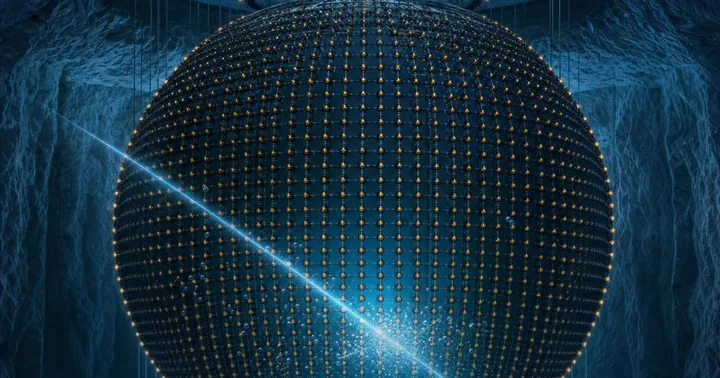
Water Cherenkov detectors fill a tank with ultrapure water and line the walls with thousands of light sensors. When a neutrino interaction creates a fast electron or muon moving faster than light travels in water, it emits a cone of Cherenkov radiation - a bluish shockwave of light. The ring it paints on the wall reveals the particle's direction, energy and type.
Scintillation detectors use a liquid that emits a brief flash of light when any charged particle passes through it. Because a scintillator responds to lower-energy events than Cherenkov light allows, these detectors excel at low-energy neutrinos from the Sun, reactors and Earth's interior.
Liquid-argon time projection chambers (LArTPCs) are the newest workhorse. A neutrino strikes an argon nucleus, the freed charge drifts through a strong electric field, and wire or readout planes reconstruct the event in fine three-dimensional detail, almost like a photograph. Older radiochemical detectors took a different route entirely, counting atoms transmuted by neutrino capture. In many of these detectors the light is amplified by the photomultiplier tube, a device sensitive enough to register a single photon. For the full physics, see how neutrinos are detected.
Super-Kamiokande and the water Cherenkov giants
The archetype of the modern neutrino observatory sits about 1,000 metres beneath Mount Ikeno in the Kamioka mine, Japan. Super-Kamiokande, operating since 1996, is a stainless-steel tank holding 50,000 tonnes of ultrapure water watched by about 11,000 large photomultiplier tubes. Its predecessor, Kamiokande, detected neutrinos from Supernova 1987A and the Sun; Super-Kamiokande went further.
In 1998 the experiment announced that atmospheric muon-neutrinos were disappearing in a way that depended on how far they had travelled - the first compelling evidence of neutrino oscillation, and therefore that neutrinos have mass. That discovery earned Takaaki Kajita a share of the 2015 Nobel Prize in Physics.
Its successor, Hyper-Kamiokande, is now under construction nearby with a tank several times larger - on the order of 260,000 tonnes of water - aimed at hunting for differences between neutrinos and antineutrinos and searching for proton decay. Water Cherenkov technology scales well, which is why it keeps growing.
SNO and SNOLAB: solving the solar neutrino problem
For decades experiments counting solar neutrinos found only about a third of the number the Sun should produce - the so-called solar neutrino problem, first exposed by Raymond Davis Jr.'s radiochemical experiment in the Homestake mine.
The answer came from the Sudbury Neutrino Observatory (SNO), about 2,070 metres down in a nickel mine in Ontario, Canada. SNO used 1,000 tonnes of heavy water, whose deuterium let it measure both electron-neutrinos alone and all three neutrino flavours together. In 2001–2002 it showed that the total flux closely matched solar-model predictions: the missing electron-neutrinos had simply oscillated into other flavours on the way from the Sun. Arthur McDonald shared the 2015 Nobel with Kajita for this result.
The SNO cavern has since grown into SNOLAB, one of the deepest and cleanest underground laboratories in the world, now home to dark-matter searches and next-generation neutrino experiments.
IceCube and KM3NeT: turning ice and sea into telescopes
To catch the rarest, highest-energy neutrino sources from the distant cosmos, physicists needed targets far bigger than any tank. The solution was to instrument nature itself. The IceCube Neutrino Observatory, completed in 2010 at the South Pole, embeds 5,160 optical sensors on 86 cables frozen into a full cubic kilometre of clear Antarctic ice, between roughly 1,450 and 2,450 metres deep. The ice is the detector.
IceCube's landmark moment came in September 2017, when a single very-high-energy neutrino, IceCube-170922A, was traced back to a flaring blazar - a supermassive black hole named TXS 0506+056 - helping launch the field of multimessenger astronomy, where neutrinos, light and gravitational waves are studied together.
In the Mediterranean, the KM3NeT collaboration is building the same idea into deep seawater. Its ARCA detector off Sicily targets high-energy cosmic neutrinos, while ORCA off the French coast studies lower-energy atmospheric neutrinos to pin down the ordering of neutrino masses. In 2025 KM3NeT reported KM3-230213A, an extraordinarily energetic event with an estimated energy of around 220 PeV - the most energetic neutrino yet observed - underscoring how sea and ice observatories open windows the Sun and reactors cannot.
DUNE, JUNO and the precision era
The next decade belongs to purpose-built precision machines. The Deep Underground Neutrino Experiment (DUNE) will fire an intense beam of neutrinos from Fermilab near Chicago 1,300 kilometres straight through the Earth to giant liquid-argon detectors about 1,500 metres underground at the Sanford Underground Research Facility in Lead, South Dakota. With tens of thousands of tonnes of liquid argon imaging each interaction in exquisite detail, DUNE aims to determine whether neutrinos and antineutrinos oscillate differently - a possible clue to why the universe is made of matter rather than antimatter.
In China, the Jiangmen Underground Neutrino Observatory (JUNO) uses 20,000 tonnes of liquid scintillator to measure reactor neutrinos from nearby nuclear plants with the precision needed to establish the neutrino mass ordering. Italy's Borexino, running under the Gran Sasso mountain until 2021, mapped the Sun's proton–proton fusion chain and in 2020 made the first detection of CNO-cycle solar neutrinos. KamLAND, back in Kamioka, pioneered the detection of reactor antineutrinos and of geoneutrinos from radioactive decay deep inside the Earth.
Together these observatories test the Standard Model, probe whether a sterile neutrino exists, and stand ready to catch the burst from the next galactic supernova.
From detection to energy research
The technologies behind neutrino observatories are, at heart, about extracting a tiny signal from an ambient particle flux that never stops. That same idea - that the environment is full of energy carried by particles and fields most machines ignore - motivates research into energy harvesting.
The Neutrino Energy Group in Berlin studies neutrinovoltaic materials, an in-development line of research exploring whether a graphene-based multilayer can convert a portion of ambient environmental flux - including thermal and electromagnetic energy - into a small electrical current. It is early-stage scientific research, not a proven or purchasable technology, and it should not be confused with the astrophysics observatories described here. What the two fields share is a starting point: to work with neutrinos at all, you must first learn to notice the almost unnoticeable. To understand the particle itself, start with what a neutrino is.
Frequently asked questions
What is a neutrino observatory?
A neutrino observatory is a very large, heavily shielded detector built to catch the rare interactions of neutrinos. It uses tonnes of water, ice, liquid argon or scintillator, usually placed deep underground, to record the faint light or charge a neutrino leaves when it strikes a nucleus or electron.
Why are neutrino detectors built underground?
Depth provides shielding. Roughly a kilometre or more of rock, ice or water absorbs cosmic-ray muons and other background radiation that would otherwise swamp the detector. Neutrinos pass through that shielding untouched, so the buried detector sees a quiet environment where genuine neutrino signals can be trusted.
What is the largest neutrino detector in the world?
By instrumented volume, IceCube at the South Pole is the largest, monitoring a full cubic kilometre of Antarctic ice with 5,160 sensors. By target mass in a tank, Super-Kamiokande holds 50,000 tonnes of water, and the upcoming Hyper-Kamiokande and DUNE will be larger still.
How does IceCube detect neutrinos?
IceCube instruments clear, deep Antarctic ice with thousands of optical sensors. When a high-energy neutrino interacts in or near the ice, it creates a fast charged particle that emits Cherenkov light. The pattern and timing of that light across the sensors reveal the neutrino's energy and the direction it came from.
What will the DUNE experiment study?
DUNE will send a neutrino beam 1,300 km from Fermilab to liquid-argon detectors in South Dakota. It aims to measure whether neutrinos and antineutrinos oscillate differently, determine the neutrino mass ordering, watch for signals from a galactic supernova, and search for proton decay.
What is the difference between Cherenkov and scintillation detectors?
Cherenkov detectors record the cone of light produced when a charged particle moves faster than light travels in water or ice, which reveals direction well and suits higher energies. Scintillation detectors record light emitted by a special liquid whenever a charged particle passes, making them more sensitive to low-energy neutrinos from the Sun, reactors and the Earth.