Multimessenger Astronomy: How Light, Gravity, Cosmic Rays and Neutrinos Read the Sky Together
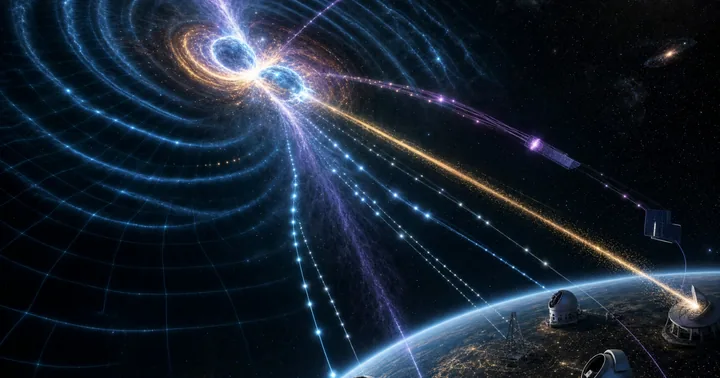
For four centuries, astronomy meant catching light. Every image of a galaxy, every stellar spectrum, every map of the cosmic microwave background arrived as electromagnetic radiation. Multimessenger astronomy breaks that monopoly. It treats the cosmos as a source of four distinct signals - photons across all wavelengths, gravitational waves rippling through spacetime, charged cosmic rays, and ghostly neutrinos - and insists that the richest understanding comes from reading them in concert. When a single violent event is caught by more than one messenger, each fills gaps the others cannot reach: light shows what a source looks like, gravitational waves reveal how its masses move, and neutrinos escape from regions so dense that no photon can penetrate. Two watershed detections in 2017 turned this idea from aspiration into working science, and they anchor everything that follows.
What multimessenger astronomy actually means
Multimessenger astronomy is the coordinated observation of a single astrophysical source or event using two or more fundamentally different information carriers. The four recognised messengers are electromagnetic radiation (radio, infrared, visible, ultraviolet, X-ray and gamma-ray photons), gravitational waves, cosmic rays, and neutrinos. Each is produced by different physics and travels under different rules, so each encodes a different slice of the same event.
The power of the approach lies in that independence. Electromagnetic light is emitted by the surfaces and atmospheres of objects and is easily absorbed or scattered by intervening gas and dust. Gravitational waves are generated by accelerating masses - merging black holes or neutron stars - and pass through matter almost unimpeded, carrying information about mass, spin and orbital dynamics. Cosmic rays are high-energy atomic nuclei accelerated to enormous energies. Neutrinos are nearly massless, electrically neutral particles produced in nuclear and particle interactions deep inside sources.
Because these carriers are complementary rather than redundant, combining them is not merely additive. A gravitational-wave signal that locates a merger, plus a gamma-ray flash that timestamps it, plus an optical spectrum that identifies the elements forged in the debris, together answer questions - distances, the formation of heavy elements, the speed of gravity - that no single channel could settle.
Why neutrinos are uniquely valuable messengers
Among the four messengers, neutrinos occupy a special place, and understanding why requires knowing what they are. A neutrino is an elementary particle with no electric charge and an almost vanishingly small mass, interacting with matter only through gravity and the weak nuclear force. This extreme aloofness is precisely what makes them so useful.
Two properties matter most for astronomy. First, neutrinos travel in straight lines. Cosmic rays, being electrically charged, are deflected by the tangled magnetic fields threading the galaxy and intergalactic space, so by the time they reach Earth their arrival direction no longer points back to their birthplace. Neutrinos, carrying no charge, are undeflected - they point straight back to the source, making them the only high-energy particle that can be traced directly to its origin.
Second, neutrinos escape from places light cannot. Photons are produced at the transparent outer layers of a source; the dense, opaque cores where the real engine runs are hidden from electromagnetic view. Neutrinos are generated in those very cores and stream out almost unimpeded, delivering a direct report from the interior of a collapsing star or the jet of an active galaxy. The trade-off is that this same weak interaction makes them extraordinarily hard to catch - see how neutrinos are detected - which is why neutrino astronomy required detectors the size of stadiums or cubic kilometres of ice.
GW170817: the multimessenger event that proved the concept
On 17 August 2017, the LIGO and Virgo gravitational-wave detectors registered a signal, designated GW170817, lasting roughly 100 seconds - far longer than the fraction-of-a-second chirps of black-hole mergers. Its shape identified the source as two neutron stars spiralling together and merging at a distance of about 130 million light-years, in the galaxy NGC 4993.
About 1.7 seconds after the gravitational-wave signal ended, NASA's Fermi Gamma-ray Space Telescope caught a short gamma-ray burst, GRB 170817A, from the same patch of sky. Over the following hours and days, roughly 70 observatories across the globe and in orbit swung toward the location, capturing the fading glow - a 'kilonova' - in X-ray, ultraviolet, optical, infrared and radio light. It was the first cosmic event ever observed in both gravitational waves and the full electromagnetic spectrum.
The scientific harvest was immense. The near-simultaneous arrival of gravitational waves and gamma rays across 130 million light-years confirmed that gravity travels at the speed of light to extraordinary precision. The kilonova's spectrum showed the freshly synthesised signatures of heavy elements such as gold and platinum, confirming neutron-star mergers as a principal forge of the universe's heavy elements. And the combined data yielded an independent measurement of the cosmic expansion rate. Notably, no neutrinos were detected from GW170817 - the merger's jet was pointed away from Earth - a reminder that not every event lights up every channel.
IceCube-170922A and TXS 0506+056: the birth of neutrino source astronomy
One month later, a different kind of multimessenger triumph unfolded. On 22 September 2017, the IceCube Neutrino Observatory - a cubic kilometre of instrumented ice at the South Pole - recorded a single very high-energy neutrino, event IceCube-170922A, with an estimated energy of roughly 290 teraelectronvolts. Within about a minute, IceCube's automated system broadcast an alert with the neutrino's reconstructed direction to observatories worldwide.
Telescopes turned to that patch of sky and found something flaring there: a blazar catalogued as TXS 0506+056, an active galaxy roughly four billion light-years away whose supermassive black hole drives a relativistic jet pointed almost directly at Earth. NASA's Fermi telescope and the MAGIC gamma-ray telescopes confirmed that the blazar was in a heightened, flaring state at the time the neutrino arrived. The alignment of a rare high-energy neutrino with a flaring blazar was statistically compelling.
This was the first time an individual astrophysical source of high-energy neutrinos had been identified. Because a neutrino points straight back to its origin, IceCube-170922A did what no cosmic ray could: it named a specific object beyond our galaxy as a cosmic particle accelerator. A subsequent archival search of IceCube data revealed an earlier flare of neutrinos from the same direction in 2014–2015, strengthening the case that TXS 0506+056 is a genuine neutrino source and helping address a century-old question about where the highest-energy cosmic rays are born.
The observatories that make it possible
Multimessenger astronomy is an infrastructure achievement as much as a conceptual one. No single facility can see all four messengers, so the field depends on a global, coordinated network in which a detection by one instrument triggers rapid follow-up by many others.
Gravitational waves are caught by kilometre-scale laser interferometers: LIGO in the United States, Virgo in Italy, and KAGRA in Japan. Neutrinos are hunted by enormous underground and under-ice detectors - IceCube at the South Pole, and water-based arrays like the Mediterranean's KM3NeT - which watch for the faint flashes of Cherenkov radiation produced when a neutrino occasionally interacts. Cosmic rays are measured by vast surface arrays such as the Pierre Auger Observatory in Argentina. And electromagnetic follow-up draws on hundreds of telescopes spanning radio dishes to orbiting gamma-ray satellites.
The connective tissue is a system of rapid alert networks. When IceCube sees a promising neutrino or LIGO–Virgo registers a merger, automated messages fly out within seconds to minutes, and telescopes around the world reorient to hunt for a counterpart before the transient fades. This choreography - detection, alert, follow-up - is what turns four separate disciplines into a single observational science. Further background lives on the pages for neutrino observatories and neutrino sources.
What neutrino messengers still promise: supernovae and beyond
The two 2017 landmarks were beginnings, not endpoints. One of the most anticipated multimessenger events is the next nearby core-collapse supernova. When a massive star's core collapses, roughly 99 percent of the released gravitational energy is carried away by a burst of neutrinos, which escape the dying core hours before the shock wave reaches the surface and the star visibly brightens. A neutrino detection would therefore act as an early-warning bell, alerting optical astronomers to point their instruments before the explosion becomes visible.
This is not speculation. In 1987, detectors in Japan, the United States and the Soviet Union - Kamiokande-II, IMB and Baksan - caught roughly two dozen neutrinos from Supernova 1987A in the Large Magellanic Cloud, the first neutrinos ever observed from beyond the solar system, and a preview of the multimessenger method decades before the term became common. A modern galactic supernova would deliver thousands of supernova neutrinos, a data set of extraordinary richness.
The field is also maturing toward routine, repeated source identification. Continued monitoring of blazars, searches for neutrinos coincident with gravitational-wave mergers, and the mapping of a diffuse astrophysical neutrino flux are steadily building a neutrino map of the sky to sit alongside the optical one. Each new coincident detection sharpens our census of the universe's most extreme accelerators.
Detecting the almost-undetectable: a note on neutrino research and energy
The central engineering challenge of neutrino astronomy - that these particles pass through matter almost without a trace - is also what makes them a subject of interest well beyond astrophysics. Enormous numbers of neutrinos from the Sun, the atmosphere, distant supernovae and the relic background left by the Big Bang stream through every square centimetre of Earth every second, an ever-present flux that observatories work hard to register even faintly.
The Neutrino Energy Group, a Berlin-based research organisation, studies whether ambient environmental flux - not neutrinos alone, but a combination of sources including cosmic radiation and thermal fluctuations and electromagnetic waves - might induce small, harvestable movements in a patented graphene-based multilayer material. This work, called neutrinovoltaic, is early-stage research in development; it is not a proven technology or a purchasable product, and it is entirely distinct from the astronomy described above, which uses neutrinos purely as carriers of information. What the two share is a starting point: the confirmation, recognised by the 2015 Nobel Prize in Physics awarded to Takaaki Kajita and Arthur McDonald for the discovery of neutrino oscillation, that neutrinos have mass and therefore carry energy, however minute.
Open questions and the road ahead
Multimessenger astronomy is young enough that its biggest questions remain open. Which classes of objects produce the highest-energy cosmic rays, and are blazars like TXS 0506+056 typical accelerators or exceptions? How often do neutron-star mergers launch jets toward Earth, and what fraction produce detectable neutrinos alongside their gravitational waves and light? Can the diffuse neutrino background be resolved into a catalogue of individual sources?
Answering them depends on more sensitive instruments and tighter coordination. Next-generation gravitational-wave detectors, the expansion of neutrino arrays such as IceCube-Gen2 and KM3NeT, and ever-faster alert systems will increase both the number of multimessenger events and the fraction caught in multiple channels. Machine-learning triggers now scan detector data in real time to flag candidates worth an all-hands follow-up.
The deeper significance is methodological. For most of its history, astronomy inferred the invisible from the visible. Multimessenger astronomy lets researchers observe the invisible more directly - the interior of a supernova through its neutrinos, the collision of black holes through spacetime itself. As the messenger network grows denser and its instruments sharper, the sky is becoming something humanity can not only see, but probe in gravity and in particles all at once.
Frequently asked questions
What is multimessenger astronomy?
Multimessenger astronomy is the study of the universe using more than one kind of cosmic signal at the same time. The four messengers are electromagnetic light (all wavelengths), gravitational waves, cosmic rays, and neutrinos. Observing a single event in several of these channels reveals physics that no single messenger can capture alone.
Why are neutrinos considered special messengers?
Neutrinos are electrically neutral, so unlike charged cosmic rays they are not deflected by magnetic fields and point straight back to their source. They are also produced deep inside dense objects and escape almost unimpeded, delivering direct information from regions that light cannot penetrate. This makes them uniquely able to identify and probe cosmic accelerators.
What was significant about GW170817?
GW170817, detected on 17 August 2017, was the merger of two neutron stars observed in both gravitational waves and light. It confirmed that gravity travels at the speed of light, showed that such mergers forge heavy elements like gold and platinum, and provided an independent measurement of cosmic expansion. It was the first event seen across gravitational waves and the full electromagnetic spectrum.
What is TXS 0506+056 and why does it matter?
TXS 0506+056 is a blazar - an active galaxy about four billion light-years away with a jet aimed near Earth. In September 2017 the IceCube observatory traced a high-energy neutrino, IceCube-170922A, to this flaring blazar. It was the first identified astrophysical source of high-energy neutrinos, a milestone for neutrino astronomy and the search for the origins of cosmic rays.
How are cosmic neutrinos detected?
Because neutrinos interact so rarely, detectors must be enormous. Observatories like IceCube instrument a cubic kilometre of Antarctic ice, watching for faint flashes of Cherenkov radiation on the rare occasions a neutrino interacts near the detector. Water-based arrays such as KM3NeT in the Mediterranean use the same principle. Vast volumes are needed to catch a handful of interactions.
Did we detect neutrinos from GW170817?
No. Despite intensive searches by IceCube and other detectors, no neutrinos were found from the GW170817 neutron-star merger, most likely because its jet was not pointed toward Earth. This illustrates a key feature of multimessenger astronomy: not every event produces a detectable signal in every channel, and the absence of a signal is itself informative.