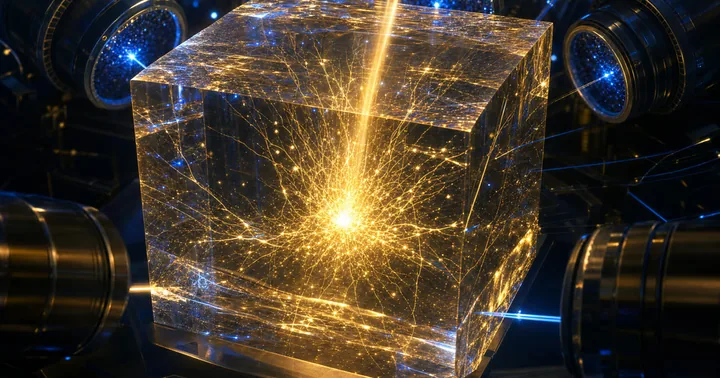
What Is a Scintillator? How Radiation Becomes Light
In 1909, researchers in Ernest Rutherford's Manchester laboratory sat in a darkened room for hours, counting faint flashes on a zinc sulfide screen - one flash per alpha particle. Those flashes rewrote our picture of the atom. The material producing them was a scintillator: a substance that converts invisible ionizing radiation into visible light. More than a century later, scintillators remain among the most versatile radiation sensors ever devised - at work in hospital PET scanners, cargo terminals, the Large Hadron Collider, and the giant underground experiments that catch neutrinos. Here is how they work, and why they matter.
From Flashes in a Dark Room to Modern Physics
The first scintillator was simple enough to hold in one hand. In 1903, William Crookes built the spinthariscope: a speck of radium salt suspended above a zinc sulfide screen, viewed through a magnifying lens. Each alpha particle striking the screen produced a tiny flash of light - individual atomic events, visible to the naked eye.
Rutherford's team turned this curiosity into precision science. Between 1908 and 1913, Hans Geiger and Ernest Marsden fired alpha particles at thin gold foil and tallied the scintillations by eye. The rare large-angle deflections they counted led Rutherford to propose the atomic nucleus in 1911 - arguably the most consequential result ever obtained with a glowing screen.
The human eye, however, is a poor photodetector, and the method faded in favor of ionization chambers and Geiger counters. It roared back in the 1940s, when the photomultiplier tube made flash-counting electronic. In 1948, Robert Hofstadter showed that thallium-doped sodium iodide, NaI(Tl), scintillated far more brightly than any material known before it. Modern scintillation detection was born.
How Do Scintillators Work? From Excitation to Emission
Scintillation is a three-step process: energy in, excitation, light out. A charged particle plowing through the material - or an electron knocked loose by a gamma ray - deposits energy that kicks electrons into excited states. Within nanoseconds to microseconds, those states decay back toward equilibrium, and part of the energy escapes as photons, typically in the ultraviolet or visible range.
In inorganic crystals, the mechanism runs through the band structure of the solid. Radiation creates electron–hole pairs, which migrate through the lattice until they reach an activator - a deliberately added impurity such as thallium in NaI(Tl). The activator de-excites by emitting a visible photon at a wavelength the crystal itself does not absorb. That transparency to its own light is essential: without it, the flash would die inside the material before any sensor could see it.
Organic scintillators - plastics and aromatic liquids - work differently. Their light comes from transitions of delocalized π-electrons in benzene-ring molecules, a form of fluorescence that happens within a few nanoseconds, making organics the sprinters of the scintillator world. Four figures of merit describe any scintillator:
- Light yield - photons produced per unit of deposited energy; NaI(Tl) delivers roughly 38,000 photons per MeV.
- Decay time - how fast the flash dies away: ~2 ns for plastics, ~230 ns for NaI(Tl), around 1 µs for CsI(Tl).
- Density and stopping power - denser materials such as lead tungstate (8.28 g/cm³) stop high-energy gamma rays within centimeters.
- Proportionality - light output scales roughly with deposited energy, so a scintillator does not just count radiation, it measures it.
Scintillator Materials: Crystals, Plastics, and Liquids
There is no single best scintillator - every choice trades brightness against speed, density, and cost. The main families each own a niche:
- NaI(Tl) - the workhorse of gamma-ray spectroscopy since 1948: bright and affordable, but hygroscopic, so crystals must be hermetically sealed.
- CsI(Tl) - mechanically robust and far less moisture-sensitive than NaI(Tl); flown on space telescopes and built into particle-physics calorimeters.
- BGO and LYSO - dense oxide crystals for gamma-ray calorimetry and medical imaging; LYSO's roughly 40 ns decay time has made it the standard for modern PET scanners, a role the slower BGO filled in earlier generations.
- Lead tungstate (PbWO₄) - extremely dense and fast; the CMS experiment at the Large Hadron Collider uses 75,848 of these crystals, which helped measure the Higgs boson's two-photon decay in 2012.
- Plastic scintillator - polyvinyltoluene doped with fluorescent molecules: cheap, fast (~2–3 ns), and machinable into slabs meters long for security portals and cosmic-ray counters.
- Liquid scintillator - an aromatic solvent such as linear alkylbenzene or pseudocumene plus a dissolved fluor (typically PPO); the only option that scales economically to thousands of tonnes, which is why neutrino physics depends on it.
Inside a Scintillation Detector: The Photomultiplier Chain
A flash of a few thousand photons is far too faint for ordinary electronics, so a scintillation detector marries the scintillator to an amplifier of light. The classic partner is the photomultiplier tube (PMT). Scintillation photons strike a photocathode, ejecting electrons via the photoelectric effect. An electric field accelerates these electrons onto a chain of electrodes called dynodes; each impact knocks loose several secondary electrons, and after 10 to 14 stages the original handful has been multiplied by a factor of a million to ten million - a clean electrical pulse, delivered in nanoseconds.
Because the pulse height tracks the energy deposited in the scintillator, plotting many pulses yields an energy spectrum: distinct peaks that fingerprint specific radioactive isotopes. Modern instruments increasingly swap the vacuum-tube PMT for silicon photomultipliers (SiPMs) - compact, low-voltage chips insensitive to magnetic fields. Some detectors go further and analyze the shape of each pulse: in certain organic scintillators, neutrons and gamma rays produce subtly different decay profiles, letting one material distinguish two kinds of radiation.
Where the Technology Works Today: From PET Scans to Port Security
The same flash-and-amplify principle spans an enormous range of scales and stakes:
- Medical imaging - in a PET scanner, a tracer such as fluorine-18 FDG emits positrons that annihilate with electrons, sending two 511 keV photons in opposite directions. Rings of LYSO crystals catch both in coincidence; the best time-of-flight scanners resolve the arrival difference to roughly 200 picoseconds, localizing the annihilation to about 3 cm along the line of flight.
- Security screening - radiation portal monitors at ports and border crossings use large plastic scintillator slabs to screen trucks and shipping containers for nuclear material in seconds.
- Particle physics - scintillating calorimeters measure particle energies at accelerators, and plastic counters provide the fast trigger signals that tell an experiment something interesting just happened.
- Industry and geology - scintillation probes log gamma radiation down oil and gas boreholes, and scintillating screens convert X-rays to light in imaging systems.
Catching Ghost Particles: Cowan–Reines, Borexino, KamLAND, JUNO
Scintillators earned a special place in history as one of the key ways science sees neutrinos. In 1956, Clyde Cowan and Frederick Reines set tanks of liquid scintillator beside the Savannah River reactor and watched for a signature double flash: an antineutrino striking a proton produces a positron (a prompt flash) and a neutron that is captured a few microseconds later on cadmium (a delayed flash). That coincidence was the first direct detection of the neutrino - a discovery honored with the 1995 Nobel Prize in Physics - and if you want the fuller story of the particle itself, start with what a neutrino is.
The same double-flash logic, scaled up enormously, still drives the field. KamLAND in Japan filled a balloon with 1,000 tonnes of liquid scintillator and in 2002 saw reactor antineutrinos disappearing in flight - landmark evidence for neutrino oscillation. Borexino, running about 280 tonnes of ultra-purified scintillator beneath Italy's Gran Sasso mountain, measured the Sun's proton–proton fusion neutrinos in real time in 2014 and detected CNO-cycle solar neutrinos in 2020. JUNO in southern China, which began taking data in 2025, holds 20,000 tonnes of liquid scintillator to tackle the neutrino mass ordering. Scintillation is one of two great detection strategies - the other uses Cherenkov light, emitted when a charged particle travels faster than light propagates in water or ice - and our guide to how neutrinos are detected compares them side by side.
Why Scintillator Science Matters for Neutrinovoltaic Research
Every scintillator experiment adds to the same hard-won conclusion: the invisible particle flux streaming through us is real, measurable, and physically consequential. The 2015 Nobel Prize in Physics went to Takaaki Kajita and Arthur B. McDonald for showing that neutrinos oscillate and therefore have mass. In 2017, the COHERENT collaboration used a 14.6 kg sodium-doped cesium iodide scintillating crystal - the very technology described on this page - to observe coherent elastic neutrino–nucleus scattering for the first time, demonstrating that neutrinos transfer small but measurable momentum to entire atomic nuclei.
These results form part of the scientific context for the work of the Neutrino Energy Group, a Berlin-based research organization founded in 2008. Its neutrinovoltaic research program investigates whether ambient environmental radiation - a spectrum that includes neutrino flux alongside thermal and electromagnetic waves - can induce small electrical currents in a patented graphene–silicon multilayer material (Patent WO2016142056A1). The work remains in research and development; it is not a commercial product, and any usable power output would be modest, not limitless. But its starting point is the same one Cowan and Reines established with tanks of glowing liquid in 1956: particles we cannot see still deposit energy we can measure. For the broader context, see our overview of new energy technology.
Frequently asked questions
What is a scintillator in simple terms?
A scintillator is a material that lights up when radiation hits it. The radiation's energy briefly excites the material's atoms or molecules, and as they settle back down they release tiny flashes of light. Each flash marks the arrival of a single particle or gamma ray.
How does a scintillation detector work?
A scintillation detector couples a scintillator to a light sensor, usually a photomultiplier tube or silicon photomultiplier. Radiation creates a light flash in the scintillator; the sensor converts the photons into electrons and multiplies them roughly a million-fold into an electrical pulse. The pulse height reveals how much energy the radiation deposited.
What is the difference between a scintillation detector and a Geiger counter?
A Geiger counter registers ionization in a gas-filled tube: every particle triggers the same click, with no energy information. A scintillation detector measures the amount of light produced, so it can determine the radiation's energy and identify specific isotopes. Scintillators also respond faster and handle much higher count rates.
What materials are used as scintillators?
The main families are inorganic crystals such as NaI(Tl), CsI(Tl), BGO, LYSO, and lead tungstate; plastic scintillators based on polyvinyltoluene; and organic liquids such as linear alkylbenzene or pseudocumene doped with fluorescent compounds. The choice trades off brightness, speed, density, and cost for each application.
Why do PET scanners use scintillators?
PET imaging must detect pairs of 511 keV photons produced when tracer positrons annihilate inside the patient. Dense, fast scintillator crystals such as LYSO stop these photons efficiently and time them to within a few hundred picoseconds, allowing the scanner to reconstruct where in the body the annihilation occurred.
How do scintillators detect neutrinos?
Neutrino experiments use enormous volumes of liquid scintillator - up to 20,000 tonnes in JUNO. When an antineutrino strikes a proton, it produces a prompt positron flash followed shortly afterward by a neutron-capture flash. This double-flash signature, first exploited by Cowan and Reines in 1956, cleanly separates rare neutrino events from background radiation.