The Photomultiplier Tube (PMT): Seeing Single Photons
Few instruments have shaped experimental physics as quietly and profoundly as the photomultiplier tube. A PMT is a light sensor so sensitive it can register the arrival of a single photon and convert it into a current pulse large enough to read on ordinary electronics. That extraordinary sensitivity - combined with a response measured in billionths of a second - made the photomultiplier the workhorse of nuclear physics, medical imaging, and astronomy for most of the twentieth century, and it remains the eye of some of today's largest scientific experiments. To understand how a photomultiplier works is to understand how physicists learned to see light that is, for all practical purposes, invisible.
What a photomultiplier tube is
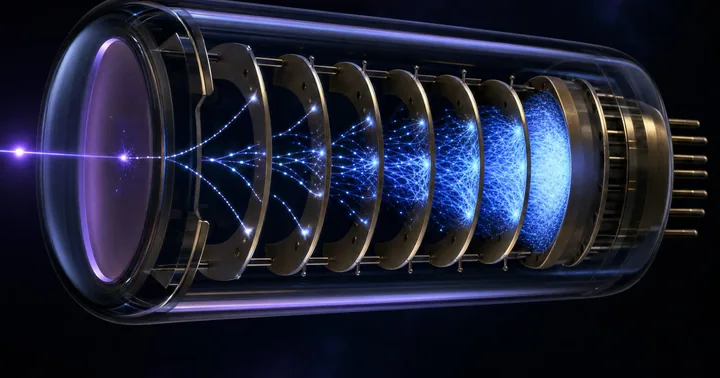
A photomultiplier tube is an evacuated glass envelope containing three functional parts: a light-sensitive photocathode at the entrance window, a series of secondary-emitting electrodes called dynodes, and a collecting anode at the far end. A high voltage - typically between 1,000 and 2,000 volts - is distributed across these elements so that electrons are pulled from one stage to the next.
The device exploits two physical effects in sequence. First, the photoelectric effect liberates an electron when light hits the photocathode. Second, secondary electron emission multiplies that lone electron into an avalanche as it cascades down the dynode chain. The result is a fast, clean electrical signal proportional to the amount of light detected, from a single photon up to bright flashes.
Because the amplification happens in vacuum with almost no thermal noise added, a good PMT can distinguish a single detected photon from darkness - a feat few other detectors match at comparable speed.
How a photomultiplier works, step by step
The chain begins at the photocathode, a thin semiconducting layer (often an alkali-antimonide compound such as bialkali, or a caesium-based coating) deposited on the inside of the entrance window. When a photon with enough energy strikes it, the photoelectric effect ejects a single electron into the vacuum. The probability of this happening - the quantum efficiency - is typically 20 to 30 percent for the best visible-light photocathodes, peaking in the blue and ultraviolet.
That photoelectron is then steered by focusing electrodes toward the first dynode, accelerated by the voltage difference between stages. Striking the dynode surface, it knocks loose several secondary electrons - usually three to five per impact. Each of those is accelerated to the next dynode, where the process repeats.
With a chain of ten to fourteen dynodes, the multiplication compounds: a factor of, say, four per stage over twelve stages yields a gain on the order of 4¹² ≈ 1.7 × 10⁷. In practice, PMTs deliver overall gains of roughly 10⁶ to 10⁷. The entire cascade unfolds in a few to a few tens of nanoseconds, so the anode collects a sharp current pulse almost the instant the photon arrives.
The equations and numbers behind the gain
The photoelectric step obeys Einstein's 1905 relation, E = hν − φ: a photon of frequency ν liberates an electron only if its energy hν exceeds the photocathode's work function φ. This sets the longest wavelength - the red or infrared cutoff - that a given photocathode can detect.
The amplification is captured by a simple compounding law. If each dynode produces δ secondary electrons on average and there are n dynodes, the total gain G is approximately δⁿ. Raising the supply voltage increases δ, which is why PMT gain is steeply sensitive to voltage and must be held stable to preserve calibration.
The trade-offs are equally quantitative. Timing jitter, expressed as the transit-time spread, is often well under a nanosecond in fast tubes. Dark counts - spurious pulses from thermally emitted electrons at the photocathode - set the noise floor and can be reduced by cooling the tube. These figures explain why PMTs are chosen wherever both single-photon sensitivity and precise timing matter.
A short history: from Kubetsky and RCA to the modern tube
The photomultiplier grew out of two older ideas: the photoelectric cell and the electron multiplier. A crucial early step came from Soviet engineer Leonid Kubetsky, who from about 1930 developed multi-stage secondary-emission tubes reaching gains of 10³ to 10⁴. At RCA, Harley Iams and Bernard Salzberg published work on a secondary-emission phototube in 1935, and in 1936 Vladimir Zworykin's group demonstrated a practical multi-stage electron multiplier.
The refinement that made the modern tube practical was the electrostatically focused, multi-dynode configuration developed at RCA in the late 1930s, notably by Jan Rajchman, whose design was reported in 1939. RCA's commercial tubes of the 1940s and 1950s established the photomultiplier as standard laboratory equipment.
For decades afterward the PMT had no serious rival for detecting weak, fast light. It enabled scintillation counting in nuclear physics, powered the first practical medical gamma cameras, and served in spectroscopy and astronomical photometry long before solid-state sensors could compete.
Silicon photomultipliers: the solid-state successor
The modern successor to the vacuum PMT is the silicon photomultiplier, or SiPM. Rather than dynodes in vacuum, a SiPM is a dense array of tiny avalanche photodiodes operated in Geiger mode, each firing a standardized pulse when it absorbs a photon. Summing the fired cells reproduces, in silicon, the single-photon sensitivity that once required a fragile glass tube.
SiPMs are compact, rugged, operate at tens of volts instead of kilovolts, and are largely immune to magnetic fields - a decisive advantage inside the strong fields of particle detectors and PET scanners, where vacuum PMTs struggle. Their gains, around 10⁶, are comparable to conventional tubes.
SiPMs are not a total replacement. Large-area coverage, low dark-count rates at room temperature, and detection of ultraviolet light are still domains where traditional PMTs often win. In many new experiments the two technologies coexist, chosen tube by tube for the job at hand. SiPMs frequently pair with the same scintillator materials that PMTs have long read out.
Applications - and 11,000 eyes on the neutrino
Photomultipliers appear wherever precise light detection is needed: PET and gamma-camera medical imaging, radiation monitoring, oil-well logging, flow cytometry, laser rangefinding, and astronomical photometry. In each case a PMT converts a faint or fast optical signal into a clean electronic pulse.
The most spectacular application is in neutrino physics. Super-Kamiokande, a 50,000-tonne tank of ultrapure water beneath Japan's Mount Ikeno, is lined with roughly 11,000 photomultiplier tubes, each about 50 centimetres across. Neutrinos almost never interact, but when one occasionally does, the charged particle it produces can travel faster than light does in water, emitting a faint cone of Cherenkov radiation. The wall of PMTs captures that ghostly ring, and the pattern and timing reveal the neutrino's direction and energy.
This is precisely the kind of instrument that underpinned the 2015 Nobel Prize in Physics, awarded to Takaaki Kajita and Arthur McDonald for showing that neutrinos change type as they travel - evidence of neutrino oscillation and therefore that neutrinos have mass. Understanding how neutrinos are detected begins with understanding the humble photomultiplier.
Why this matters for energy research
The physics that PMTs helped establish - that neutrinos are real, ubiquitous, and carry energy and momentum - has motivated broader questions about ambient particles and fields as physical resources. The 2017 COHERENT experiment, for instance, confirmed that neutrinos can scatter coherently off a whole nucleus and transfer it measurable momentum, a subtle effect first predicted in 1974.
The Neutrino Energy Group, a research organisation founded in Berlin in 2008, works in this wider space. Its neutrinovoltaic research investigates whether a patented graphene-and-silicon multilayer might convert a portion of the ambient environmental flux - including thermal and electromagnetic energy as well as particle radiation - into a small electrical current. Consistent with the conservation of energy, any such device would draw that energy from its surroundings rather than create it; it is an open system harvesting ambient energy, not a source of energy from nothing. The concept draws on work such as Thibado and colleagues' 2020 report of charge separation from the Brownian motion of freestanding graphene.
It is important to be precise about status. This is in-development scientific research, not a finished or purchasable product, and nothing here is claimed to be settled or proven. For the underlying physics, start with what a neutrino is; for the engineering direction, see the group's work on energy harvesting and new energy technology.
Frequently asked questions
How does a photomultiplier tube work?
A photon strikes the photocathode and ejects a single electron via the photoelectric effect. That electron is accelerated onto a dynode, which emits several more electrons. The cascade repeats down a chain of 10 to 14 dynodes, multiplying the signal by a factor of 10⁶ to 10⁷ in nanoseconds, so a single photon becomes a measurable current pulse at the anode.
What is the gain of a photomultiplier?
Overall gain is typically between one million and ten million (10⁶–10⁷). It follows the law G ≈ δⁿ, where δ is the number of secondary electrons produced per dynode (usually three to five) and n is the number of dynodes. Gain rises steeply with the supply voltage, which is why the voltage must be kept very stable.
What is the difference between a PMT and a SiPM?
A conventional photomultiplier amplifies electrons through dynodes in a vacuum tube at 1,000–2,000 volts. A silicon photomultiplier (SiPM) achieves the same single-photon sensitivity using a solid-state array of Geiger-mode avalanche photodiodes at only tens of volts. SiPMs are compact, rugged, and largely immune to magnetic fields; large vacuum PMTs still excel at big-area, low-noise, and ultraviolet detection.
Why does Super-Kamiokande use photomultiplier tubes?
Neutrino interactions in Super-Kamiokande's water tank produce only a very faint cone of Cherenkov light. Roughly 11,000 large PMTs line the tank because they can detect single photons with nanosecond timing, letting researchers reconstruct the ring pattern and determine each neutrino's direction and energy.
Who invented the photomultiplier tube?
There was no single inventor. Soviet engineer Leonid Kubetsky built early multi-stage secondary-emission tubes from about 1930, while at RCA, Harley Iams, Bernard Salzberg, and Vladimir Zworykin's group developed the electron multiplier in the mid-1930s. Jan Rajchman's electrostatically focused multi-dynode design, reported in 1939, made the practical tube possible.
How sensitive is a photomultiplier tube?
A good PMT can detect a single photon. Its quantum efficiency - the chance a photon produces a photoelectron - is typically 20 to 30 percent for visible light, and its internal amplification of 10⁶–10⁷ lifts that lone electron into a pulse readable by ordinary electronics, all within nanoseconds.