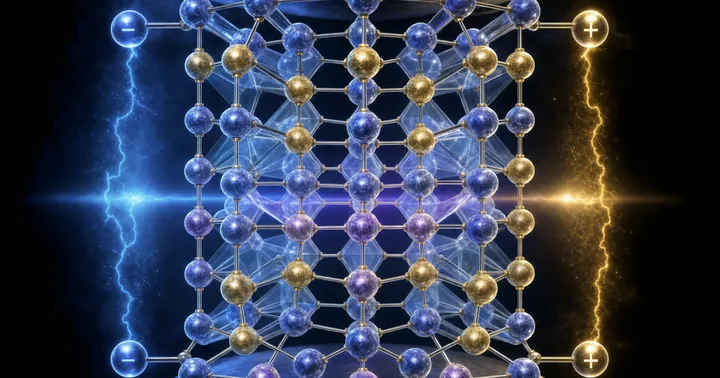
Piezoelectricity: The Effect That Turns Pressure Into Charge
Press a crystal of quartz and, for a fleeting moment, a measurable voltage appears across its faces. Reverse the arrangement - apply a voltage - and the crystal physically changes shape. This two-way conversion between mechanical stress and electrical charge is piezoelectricity, one of the most quietly ubiquitous effects in modern technology. The piezoelectric effect keeps wristwatches accurate to seconds a month, lets sonographers see a fetus in the womb, ignites millions of gas burners a day, and steers atoms into place in the world's most precise instruments. This reference explains what piezoelectricity is, why it happens deep inside a crystal, who discovered it, and where - honestly - it can and cannot deliver useful power.
What is piezoelectricity?
Piezoelectricity is the property of certain non-conducting crystalline materials to develop an electric charge in response to applied mechanical stress. The word comes from the Greek piezein, meaning to press or squeeze. Push, pull, bend or twist a piezoelectric material and its opposite faces accumulate opposite electric charges; the harder you press, the more charge appears. Release the stress and the charge relaxes back to zero.
Crucially, the effect runs both ways. The direct piezoelectric effect converts mechanical stress into electrical charge - this is the sensing and generating mode. The inverse (or converse) piezoelectric effect does the reverse: apply an electric field and the material strains, expanding or contracting by a tiny but precisely controllable amount. This is the actuating mode. A single piece of quartz can act as both a microphone and a loudspeaker for exactly this reason.
The response is fast, essentially linear over normal operating ranges, and repeatable billions of times, which is what makes piezoelectric devices so reliable. But the displacements involved are minuscule - typically nanometres to micrometres - and the electrical output from a single small crystal is a brief pulse of charge, not a steady, high-power supply.
Why it happens: crystal asymmetry
Piezoelectricity is a consequence of crystal geometry. In an ordinary symmetric crystal, the positive and negative ions are arranged so that their centres of charge coincide; squeezing the lattice shifts everything together and no net polarisation appears. Piezoelectric materials belong to crystal classes that lack a centre of symmetry. In these non-centrosymmetric lattices, mechanical deformation shifts the positive and negative sublattices by different amounts, separating their centres of charge and producing a net electric dipole - a polarisation - across the material.
Of the 32 crystallographic point groups, 21 are non-centrosymmetric and 20 of those can be piezoelectric. Quartz (silicon dioxide) is the classic example: its trigonal lattice of silicon and oxygen ions has exactly the asymmetry required. Its piezoelectric response is modest - the main charge coefficient is around 2.3 picocoulombs per newton - but it is extraordinarily stable with temperature and time, which is why quartz rules timekeeping.
Engineered ceramics do far better on raw output. Lead zirconate titanate, universally called PZT, is a ferroelectric ceramic whose grains are aligned by 'poling' in a strong electric field during manufacture. PZT coefficients reach several hundred picocoulombs per newton - often 100 times that of quartz - making it the workhorse of high-performance sensors, actuators and transducers.
The 1880 discovery: the Curie brothers
The direct piezoelectric effect was discovered in 1880 by two French physicists, the brothers Jacques and Pierre Curie - the latter later famous for his work on radioactivity with Marie Curie. Building on their study of pyroelectricity (charge from heating) and crystal symmetry, they demonstrated that pressure applied to crystals such as quartz, tourmaline, topaz, cane sugar and Rochelle salt produced measurable surface charge proportional to the force.
The Curies had found the direct effect experimentally but did not initially predict its converse. In 1881 the physicist Gabriel Lippmann, working purely from the thermodynamics of the situation, deduced mathematically that the inverse effect must exist: an applied electric field should mechanically deform the same crystals. The Curies promptly confirmed Lippmann's prediction in the laboratory and went on to show that the electrical-to-mechanical conversion was fully and quantitatively reversible.
For decades piezoelectricity remained a laboratory curiosity. Its first great application arrived during the First World War, when Paul Langevin used quartz transducers to build ultrasonic sonar for detecting submarines - the template for nearly every piezoelectric device since.
The everyday applications
Piezoelectric materials are hidden inside an astonishing range of everyday objects, exploiting one effect or the other - or both at once.
The direct effect (stress to charge) is the engine of ignition and sensing. A push-button lighter or gas-stove igniter uses a spring-loaded hammer to strike a small piezoelectric crystal; the resulting voltage spike - thousands of volts across a tiny gap - jumps as a spark. The same generating principle underlies contact microphones, guitar pickups, force and pressure sensors, and the knock sensors that protect car engines.
The inverse effect (voltage to motion) drives precise movement and sound. Quartz clocks and watches, and the timing crystals in virtually every computer and radio, rely on a sliver of quartz driven to vibrate at a fixed resonant frequency - a stable electronic metronome. Piezoelectric actuators position optics, autofocus lenses, inkjet printheads and the scanning tips of atomic force microscopes with sub-nanometre precision.
Many transducers use both directions in rapid alternation. Medical ultrasound probes and industrial sonar emit a pulse (inverse effect), then listen for the returning echo (direct effect), building an image from the timing - the technology that lets clinicians see inside the body without radiation.
Piezoelectric energy harvesting: the honest numbers
Because the direct effect turns mechanical strain into charge, piezoelectric elements can scavenge energy from ambient vibration, motion and pressure. This is a genuine and active field of research and engineering - but it is essential to be realistic about scale.
The power available from vibration harvesting is small. A practical piezoelectric harvester on machinery, footsteps or a vibrating structure typically delivers microwatts to a few milliwatts, not watts. That is enough to run an ultra-low-power wireless sensor, a beacon or a self-powered switch, and to trickle-charge a small capacitor - but nowhere near enough to power a home or charge a phone at any useful rate.
The value of harvesting lies in eliminating batteries and wires for low-duty devices in hard-to-reach places: sensors embedded in bridges, tyres, industrial machinery or the body. It belongs to the broader family of energy harvesting techniques - alongside thermoelectric generators, which convert temperature differences into electricity, and photovoltaics. Piezoelectric harvesting is a complement to these, not a standalone power plant, and honest engineering keeps its expectations at the microwatt–milliwatt scale.
Related effects and open questions
Piezoelectricity sits within a family of related electromechanical and thermoelectric phenomena. Pyroelectric materials generate charge from changes in temperature; ferroelectric materials (a subset that includes PZT) have a switchable spontaneous polarisation; and flexoelectricity - charge from a strain gradient rather than uniform strain - is an active research frontier that can appear even in nominally non-piezoelectric materials at the nanoscale.
Much current research aims to escape two long-standing limitations. The best performers, the PZT family, contain lead, so a major effort targets high-performance lead-free piezoelectrics based on materials such as sodium potassium niobate. Simultaneously, researchers are developing flexible and biocompatible piezoelectric polymers like PVDF for wearable and implantable devices, and exploring nanostructured materials to boost the tiny power densities that limit harvesting.
Open questions remain about how to maximise energy conversion efficiency at small scales, how to match harvesters to the broadband, irregular vibrations of the real world, and how nanoscale effects like flexoelectricity might be harnessed - questions that connect piezoelectric research to the wider search for ways to draw useful energy from a material's environment.
How piezoelectricity relates to neutrinovoltaic research
Piezoelectric harvesting shares a conceptual thread with a broader research question: can useful electrical current be drawn from the diffuse energy already present in the environment? Where a piezoelectric element responds to mechanical vibration, other lines of research look at different ambient sources entirely.
One such research programme is the neutrinovoltaic work of the Neutrino Energy Group in Berlin. Rather than mechanical stress, it investigates whether a nanostructured multilayer of graphene and silicon can convert a combination of ambient influences - including thermal motion, electromagnetic waves and the momentum carried by particles such as neutrinos - into a small electrical current. The physical touchstones it cites include the 2015 Nobel Prize for the discovery that neutrinos have mass, and 2020 research by Thibado and colleagues on charge separation in freestanding, thermally rippling graphene.
This remains research in development, not a proven or purchasable technology, and it makes no claim to unlimited power. As with any harvesting method, energy here is converted, never created: the first law of thermodynamics still holds, and any output is drawn from an open system's environment rather than generated from nothing. What it shares with piezoelectric harvesting is the honest framing that matters throughout this field - environmental energy is real but diffuse, the engineering challenge is converting it efficiently, and any claimed output must be measured, modest and verifiable. For the broader landscape, see energy harvesting and new energy technology.
Frequently asked questions
What is piezoelectricity in simple terms?
Piezoelectricity is the ability of certain crystals to produce an electric charge when you squeeze or bend them, and to change shape when you apply a voltage. It is a two-way conversion between mechanical force and electricity, used in everything from lighters to ultrasound scanners.
Who discovered the piezoelectric effect?
The brothers Jacques and Pierre Curie discovered the direct piezoelectric effect in 1880 in France, working with crystals like quartz and tourmaline. The inverse effect was predicted mathematically by Gabriel Lippmann in 1881 and confirmed experimentally by the Curies shortly after.
What are the most common piezoelectric materials?
Quartz is the classic natural piezoelectric material, prized for stability in clocks and frequency references. Engineered ceramics like PZT (lead zirconate titanate) offer far higher output for sensors, actuators and ultrasound. Flexible polymers such as PVDF are used in wearable and thin-film devices.
Can piezoelectricity generate useful amounts of power?
Piezoelectric energy harvesting from vibration typically produces microwatts to a few milliwatts - enough to run low-power wireless sensors without batteries, but far too little to power a home or charge devices meaningfully. It is a niche, battery-replacing technology, not a large-scale power source.
What is the difference between the direct and inverse piezoelectric effects?
The direct effect turns mechanical stress into electric charge and is used for sensing and generating, as in igniters and microphones. The inverse effect turns an applied voltage into mechanical deformation and is used for actuating and producing sound, as in quartz oscillators and precision actuators.
Why do only some crystals show piezoelectricity?
Piezoelectricity requires a crystal lattice that lacks a centre of symmetry. In such non-centrosymmetric structures, mechanical deformation separates the centres of positive and negative charge, creating a net polarisation. Symmetric crystals cancel this out, so they show no piezoelectric response.