Cosmic Rays: The High-Energy Particles Raining Down on Earth
Hold out your hand. Roughly once a second, a muon passes through your palm - the subatomic debris of a cosmic ray that slammed into the atmosphere fifteen kilometres above your head. Some of those original particles were flung out of exploding stars before our solar system existed. Cosmic rays are the most energetic particles ever observed, and after more than a century of study, parts of their story remain genuinely unsolved. This page explains what cosmic rays are, how a daring balloonist discovered them in 1912, what happens when they strike the air, how extreme their energies get, where they come from, and why they quietly matter in everyday life.
What Are Cosmic Rays, Exactly?
Despite the name, cosmic rays are not rays at all. They are individual particles - mostly bare atomic nuclei - accelerated to nearly the speed of light and hurled across space. The physicist Robert Millikan coined the term in the mid-1920s, when he still believed they were gamma radiation; the name stuck even after experiments proved they were charged particles.
Their composition is remarkably consistent across the sky. At the top of the atmosphere, roughly a thousand of these particles cross every square metre every second. Almost all of them are ordinary matter moving at extraordinary speed:
- About 90% are protons - hydrogen nuclei stripped of their electron
- Roughly 9% are helium nuclei (alpha particles)
- The remaining ~1% are heavier nuclei - carbon, oxygen, iron - plus a small fraction of free electrons
- A typical cosmic-ray proton carries around a billion electronvolts (10⁹ eV) of energy; the rarest carry over 10²⁰ eV
1912: Victor Hess and the Balloon Flights That Found Them
In the early 1900s, physicists faced a nagging puzzle: electroscopes - instruments that hold electric charge - slowly discharged even inside thick metal shielding. The assumed culprit was radioactivity in the ground, which predicted the effect should fade with altitude.
Austrian physicist Victor Hess tested that prediction the hard way. In 1911 and 1912 he made ten hydrogen-balloon ascents carrying sealed electroscopes, culminating on 7 August 1912 in a flight to 5,300 metres. Instead of fading, the ionisation several kilometres up was multiple times stronger than at sea level. Hess had also flown during a near-total solar eclipse that April and seen no drop, so he could rule out the Sun. His conclusion was radical and correct: a radiation of very high penetrating power was entering the atmosphere from above. The discovery earned him the 1936 Nobel Prize in Physics - and opened a window on the universe that particle physics has been looking through ever since.
Air Showers: What Happens When a Cosmic Ray Hits the Atmosphere
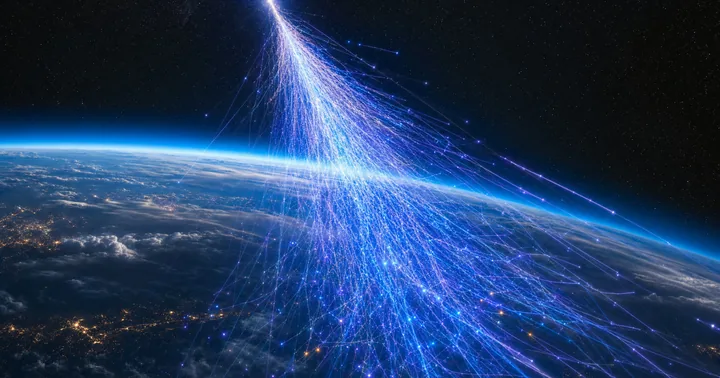
A primary cosmic ray almost never reaches the ground. Somewhere 15–25 km up, it smashes into the nucleus of a nitrogen or oxygen atom, and the collision sprays out a burst of short-lived particles called pions. These decay in flight, and the cascade multiplies: charged pions decay into muons and neutrinos, while neutral pions decay into gamma rays that spawn avalanches of electrons and positrons. A single 10¹⁵ eV primary can generate a cascade of millions of secondary particles - an 'extensive air shower' - and the very largest showers, from the rarest ultra-high-energy primaries, blanket several square kilometres by the time they reach the ground.
Muons are the shower's great survivors. They live only 2.2 microseconds, which at light speed should carry them about 660 metres - yet they routinely cross 15 km of atmosphere. The explanation is Einstein's time dilation: at 99.9% of light speed, their internal clock runs slow enough to make the trip. The result is the muon drizzle you live in: about one muon per square centimetre per minute at sea level. The showers also produce vast numbers of atmospheric neutrinos - ghostly particles that pass through the entire planet almost untouched, and that turned out to hold one of physics' biggest surprises.
The Energy Spectrum - Up to the 'Oh-My-God' Particle
Cosmic-ray energies span more than eleven orders of magnitude, following a steeply falling curve: the higher the energy, the rarer the particle. Features in that curve - the 'knee' near 3×10¹⁵ eV and the 'ankle' near 5×10¹⁸ eV - are believed to mark transitions between different accelerators, from sources inside our galaxy to sources beyond it.
The record-holder arrived on 15 October 1991, when the Fly's Eye detector in Utah registered a particle at about 3.2×10²⁰ eV - instantly nicknamed the 'Oh-My-God' particle. That is roughly 51 joules in a single proton: the kinetic energy of a baseball travelling at ~95 km/h, and tens of millions of times the energy of protons in the Large Hadron Collider. In 2023, Japan's Telescope Array collaboration reported a comparable event, dubbed 'Amaterasu,' at about 2.4×10²⁰ eV - proof these monsters still arrive.
- Above 1 GeV: ~1,000 particles per square metre per second
- Above 10¹⁵ eV (the knee): ~1 particle per square metre per year
- Above 10²⁰ eV: ~1 particle per square kilometre per century
Where Do Cosmic Rays Come From?
This is astrophysics' oldest open case - and it is only partly solved. Because cosmic rays are electrically charged, galactic magnetic fields bend their paths into tangles; by the time one arrives, its direction no longer points back to its source. Astronomers must work from indirect clues.
For the bulk of cosmic rays, the verdict is in: supernova remnants. The expanding shock waves of exploded stars act as natural particle accelerators, batting particles back and forth across the shock front until they approach light speed - a process built on an acceleration mechanism first proposed by Enrico Fermi. In 2013, NASA's Fermi Gamma-ray Space Telescope found the characteristic fingerprint of proton acceleration (gamma rays from pion decay) in the supernova remnants IC 443 and W44, confirming the picture.
The ultra-high-energy tail is murkier. In 2017, the Pierre Auger Observatory - 3,000 km² of detectors in Argentina - showed that the highest-energy particles arrive preferentially from outside our galaxy. Leading suspects include active galactic nuclei, where supermassive black holes launch particle jets, and intensely star-forming galaxies. Also in 2017, the IceCube observatory recorded a high-energy neutrino arriving from the direction of the flaring blazar TXS 0506+056 - announced the following year as the first direct hint tying a specific cosmic accelerator to particles detected on Earth. The full answer is still being written.
Cosmic Radiation in Everyday Life
Cosmic radiation is a small but real part of daily existence, contributing about 0.3–0.4 millisieverts to the average person's annual background dose at sea level - harmless, but measurable. Three effects are worth knowing:
- Flight crews: at cruising altitude (11 km) the cosmic dose rate is roughly 100 times that at sea level. Airline crews typically accumulate 2–5 mSv per year, which is why the EU legally treats them as occupationally exposed radiation workers. A round-trip transatlantic flight gives a passenger about the dose of a chest X-ray.
- Bit flips in electronics: a single secondary neutron can flip a bit in a memory chip (a 'single-event upset'). In a 2003 Belgian election, one candidate briefly gained exactly 4,096 extra votes - widely attributed to a cosmic-ray bit flip of a single binary digit. Aircraft, satellites, and data centres use error-correcting memory largely for this reason.
- Radiocarbon dating: cosmic-ray neutrons striking nitrogen-14 in the atmosphere continuously create carbon-14. Living things absorb it; after death it decays at a known rate - the clock behind radiocarbon dating of everything up to ~50,000 years old.
From Cosmic Rays to Neutrinos - and Ambient-Energy Research
Cosmic rays did more than reveal antimatter and muons - the atmospheric neutrinos they generate rewrote the Standard Model. In 1998, Japan's Super-Kamiokande detector, a 50,000-tonne water tank watching for flashes of Cherenkov radiation, found that muon neutrinos coming up through the Earth were mysteriously vanishing - oscillating into other types. Oscillation requires mass, and the discovery that neutrinos have mass was honoured with the 2015 Nobel Prize in Physics. In 2017, the COHERENT experiment added another piece: neutrinos scattering off whole nuclei transfer small but measurable momentum.
Those findings frame a longer-term research question: the environment is permanently filled with faint fluxes of energy - cosmic radiation and thermal fluctuations, electromagnetic waves, and the ceaseless stream of neutrinos. The Neutrino Energy Group, a Berlin-based research organisation founded in 2008 by Holger Thorsten Schubart, investigates whether portions of this ambient flux can be converted into small electric currents. Its neutrinovoltaic approach uses a multilayer of graphene and doped silicon, described in international patent application WO2016142056A1, and builds on work such as Thibado's 2020 demonstration that the thermal rippling of freestanding graphene can drive measurable charge through a circuit. The honest context: ambient energy harvesting today operates at microwatt-to-milliwatt scales - relevant for sensors and low-power electronics, not power grids - and neutrinovoltaic technology remains in research and development, not a finished product. As with cosmic-ray science itself, the interesting part is what remains to be worked out.
Frequently asked questions
What are cosmic rays in simple terms?
Cosmic rays are individual particles - about 90% protons, plus helium and heavier nuclei - accelerated to nearly light speed by violent astrophysical objects such as exploded stars. They constantly bombard Earth's atmosphere, where they shatter into showers of secondary particles, including the muons passing through your body right now.
Are cosmic rays dangerous to humans?
At ground level, no - the atmosphere absorbs most of the cascade, and cosmic radiation contributes only about 0.3–0.4 mSv of the average annual background dose. Exposure rises with altitude: flight crews accumulate 2–5 mSv per year and are monitored as radiation workers in the EU, and cosmic radiation is a genuine design constraint for astronauts and Mars mission planning.
Where do cosmic rays come from?
Most cosmic rays reaching Earth are accelerated by shock waves in supernova remnants inside our galaxy - confirmed by gamma-ray observations in 2013. The rare ultra-high-energy particles come from outside the galaxy, likely from active galactic nuclei or starburst galaxies, but pinning down exact sources remains an open problem because magnetic fields scramble their paths.
What was the Oh-My-God particle?
A cosmic ray detected over Utah on 15 October 1991 with an energy of about 3.2×10²⁰ eV - around 51 joules in a single proton, comparable to a well-thrown baseball and tens of millions of times beyond the Large Hadron Collider. No known source fully explains it, and similar events - such as the 'Amaterasu' particle reported by Japan's Telescope Array in 2023 - are still being recorded.
Do cosmic rays produce neutrinos?
Yes. When cosmic rays collide with air nuclei, the resulting pions and muons decay into atmospheric neutrinos. Studying these with the Super-Kamiokande detector led to the 1998 discovery of neutrino oscillation - proof that neutrinos have mass - which was honoured with the 2015 Nobel Prize in Physics.
Can the energy of cosmic rays be harvested?
Not as a power source in any practical sense - the total energy arriving is tiny and diffuse. Research fields such as ambient energy harvesting, including the neutrinovoltaic research pursued by the Neutrino Energy Group, study whether faint environmental fluxes can drive small currents in nanomaterials. Realistic outputs today are in the microwatt-to-milliwatt range, suited to low-power electronics; no commercial product exists.