Coherent Elastic Neutrino-Nucleus Scattering (CEvNS)
Coherent elastic neutrino-nucleus scattering - universally abbreviated CEvNS (pronounced "sevens") - is one of the largest interactions a low-energy neutrino can have, yet it went undetected for 43 years after it was predicted. The reason is a paradox at the heart of the process: the neutrino interacts with the whole nucleus coherently, boosting the probability of a collision enormously, but the only observable consequence is a nuclear recoil so faint that it barely nudges a single atom. First seen by the COHERENT collaboration in 2017, and observed at a nuclear reactor for the first time in 2025, CEvNS has become a precision tool for testing the Standard Model, searching for new physics, and understanding the ultimate background limit of dark-matter detectors.
What coherent elastic neutrino-nucleus scattering is
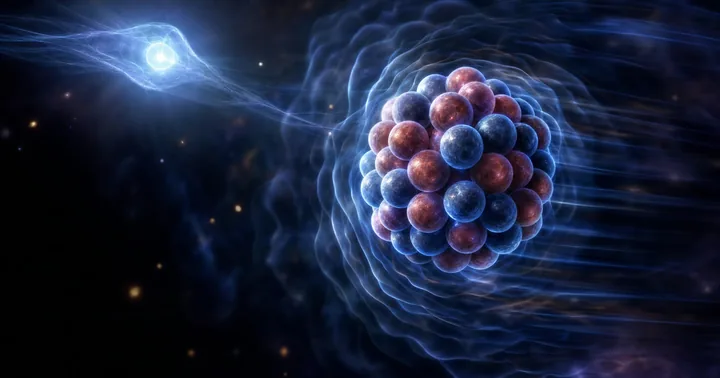
In coherent elastic neutrino-nucleus scattering, a neutrino exchanges a Z boson - the carrier of the weak neutral current - with an atomic nucleus and bounces off it, transferring a small amount of momentum. The word "elastic" means the nucleus is left intact in its ground state, unchanged except for a gentle recoil. The word "coherent" is the crucial part: under the right conditions the neutrino interacts not with one proton or neutron but with the nucleus as a single quantum object, and the contributions of all the nucleons add up in phase.
Coherence holds when the momentum transferred to the nucleus is small enough that the corresponding quantum wavelength is larger than the nucleus itself - roughly when the neutrino energy is below a few tens of MeV. In that regime the neutrino cannot resolve the individual nucleons, so it 'sees' their weak charges collectively. Because the weak neutral-current coupling of protons is heavily suppressed, the scattering is driven mainly by neutrons, and the cross section grows approximately as the square of the neutron number. A caesium or xenon nucleus, with dozens of neutrons, therefore presents a far larger target than the raw count of nucleons would suggest.
This N-squared enhancement makes CEvNS the dominant way neutrinos interact with matter at low energies - its cross section can exceed that of the more familiar inverse beta decay by orders of magnitude. The catch is detection. All the neutrino leaves behind is a recoiling nucleus carrying at most a few keV, and often far less. Sensing that whisper of energy is what kept CEvNS beyond reach for four decades.
Freedman's 1974 prediction
CEvNS was predicted by the theoretical physicist Daniel Z. Freedman in 1974, in a paper titled 'Coherent effects of a weak neutral current' (Physical Review D 9, 1389). Freedman was working out the consequences of the newly established weak neutral current - the Z-boson interaction that the Standard Model of particle physics had just incorporated and that had been observed experimentally at CERN in 1973. He realised that this neutral current implied neutrinos should scatter coherently off nuclei.
Freedman was candid about the experimental difficulty. His paper famously cautioned that the effect might remain forever unobservable, given how minuscule the nuclear recoils would be. For decades that assessment held. The prediction sat as a clean, unambiguous Standard-Model consequence - everyone agreed it must happen - while detector technology slowly caught up. Its eventual confirmation is a direct test of the weak neutral current formulated in the Standard Model and mediated by the weak nuclear force.
The 2017 COHERENT discovery
The breakthrough came in 2017, when the COHERENT collaboration reported the first detection of CEvNS in the journal Science (357, 1123). The experiment used a compact, 14.6-kilogram detector of sodium-doped caesium iodide, CsI[Na], placed roughly 20 metres from the Spallation Neutron Source (SNS) at Oak Ridge National Laboratory in Tennessee.
The SNS is an intense source of neutrinos produced when its proton beam strikes a mercury target, creating pions that decay at rest and emit neutrinos in a well-characterised, pulsed spectrum. That pulsed timing was essential: it let the team distinguish genuine neutrino-induced recoils from the steady drizzle of background events. Choosing caesium and iodine - two heavy nuclei of nearly equal mass - also maximised the coherent enhancement.
The signal matched the Standard-Model prediction at a significance of about 6.7 standard deviations, decisive confirmation of a 43-year-old forecast. Crucially, it was achieved with a detector small enough to carry, a striking contrast to the enormous neutrino observatories built for other kinds of neutrino physics. That compactness is exactly what makes CEvNS attractive for practical applications.
Reaching the reactor frontier: recent milestones
Since the discovery, experiments have pushed CEvNS into new territory. COHERENT extended its programme to a second target material, deploying a germanium detector array to observe coherent scattering on lighter nuclei. In 2025 the collaboration reported evidence for CEvNS on germanium at a significance of 3.9 standard deviations (Physical Review Letters 134, 231801), important because different nuclei probe the process in complementary ways and help disentangle nuclear-physics uncertainties from particle-physics signals.
The other major frontier is the neutrino source itself. The SNS provides relatively energetic neutrinos from stopped pions, but nuclear reactors emit far more abundant - and lower-energy - electron antineutrinos, a regime where coherence is even cleaner. In 2025 the CONUS+ experiment reported the first observation of CEvNS from reactor neutrinos (published in Nature), using about 3 kilograms of high-purity germanium installed at the Leibstadt nuclear power plant in Switzerland, with a significance near 3.7 standard deviations.
Reactor detection matters because reactor antineutrinos sit at the low-energy end where the coherent approximation is most reliable, and because reactors are ubiquitous, controllable sources. Together, the germanium and reactor results mark the transition of CEvNS from a single landmark measurement into a maturing experimental field with several independent detections.
Why CEvNS matters: tests and applications
CEvNS is a remarkably versatile probe. Because its rate is an unambiguous Standard-Model prediction, any deviation is a potential signpost to new physics. Precise measurements test the weak mixing angle (sin-squared theta_W) at low momentum transfer, constrain the neutron distribution and neutron radius of nuclei, and set limits on hypothetical non-standard neutrino interactions, additional light mediators, and neutrino electromagnetic properties such as a magnetic moment.
The process also has a strikingly practical side. Because a CEvNS detector can be small and sits close to its source, it is a natural candidate for reactor monitoring and nuclear safeguards: a suitcase-scale device that could verify a reactor's power and fuel composition from outside the core, without intrusive access. This is one of the few areas where neutrino physics edges toward real-world engineering.
- Standard-Model precision tests - the low-energy value of the weak mixing angle and the nuclear weak charge.
- New-physics searches - non-standard interactions, light dark-sector mediators, sterile neutrinos, and neutrino magnetic moments.
- Nuclear structure - mapping the distribution of neutrons inside heavy nuclei.
- Reactor monitoring - compact detectors for non-proliferation safeguards and power verification.
- Dark-matter backgrounds - CEvNS is the irreducible noise that eventually limits direct detection.
CEvNS and the neutrino fog
One of the most consequential implications of CEvNS lies not in neutrino physics but in the hunt for dark matter. Direct-detection experiments look for exactly the same signature CEvNS produces: a nucleus recoiling by a few keV after an invisible particle strikes it. To a xenon or germanium detector, a coherent neutrino scatter and a dark-matter collision can look nearly identical.
As these experiments grow more sensitive, they inevitably begin to register CEvNS events from natural neutrino sources - solar neutrinos, atmospheric neutrinos, and the diffuse supernova background. This creates an irreducible background once called the 'neutrino floor' and now more accurately described as the neutrino fog, because it does not impose a hard cutoff but a region where added exposure yields diminishing certainty. Understanding CEvNS precisely is therefore essential to knowing where genuine dark-matter signals end and neutrino backgrounds begin.
Detecting the recoil, and open questions
The central experimental challenge of CEvNS is turning a sub-keV nuclear recoil into a measurable signal. Detectors rely on ultra-low-noise technologies - scintillating crystals read out by sensitive photodetectors, cryogenic germanium and silicon devices, and noble-liquid targets - all operated deep underground or behind heavy shielding to suppress cosmic and radioactive backgrounds. A persistent difficulty is the 'quenching factor': only part of a nuclear recoil's energy converts into the observable channel, and calibrating that fraction at very low energies remains an active area of research.
Open questions abound. How precisely can CEvNS pin down the weak mixing angle and neutron radii? Will next-generation detectors at reactors and spallation sources reveal small deviations hinting at physics beyond the Standard Model? Can the technology be engineered into robust, deployable reactor monitors? Each new target nucleus and neutrino source adds an independent handle on these questions, which is why the field is expanding rather than closing after its first detections.
A note on momentum transfer and applied research
CEvNS is, at bottom, a demonstration that a neutrino can transfer momentum to ordinary matter through the weak interaction - a real, measured recoil, however small. That single fact is what connects this precision-physics topic to applied research at the boundary of energy science.
The Neutrino Energy Group, a Berlin research organisation, studies whether momentum transfer from the ambient flux of neutrinos and other environmental radiation might be captured in a graphene-based material - an approach it calls neutrinovoltaic. This remains a scientific research effort in development, not a proven technology or a purchasable product, and its physics is entirely distinct from the controlled laboratory measurements of CEvNS described here. What the two share is a starting premise that CEvNS has now confirmed at the level of fundamental physics: neutrinos are not perfectly ghostly. They do, on rare occasions, push back.
Frequently asked questions
What does CEvNS stand for?
CEvNS stands for coherent elastic neutrino-nucleus scattering, usually pronounced 'sevens.' It describes a low-energy neutrino scattering coherently off an entire atomic nucleus at once, leaving the nucleus intact but giving it a tiny recoil.
Who predicted coherent elastic neutrino-nucleus scattering?
The theoretical physicist Daniel Z. Freedman predicted it in 1974, in a paper titled 'Coherent effects of a weak neutral current' (Physical Review D 9, 1389). He noted that the recoils would be so small the effect might be very hard to detect - a caution that held true for 43 years.
When was CEvNS first detected?
It was first detected in 2017 by the COHERENT collaboration using a 14.6-kg caesium-iodide detector at the Spallation Neutron Source at Oak Ridge National Laboratory, reported in Science (357, 1123) at about 6.7 standard deviations of significance.
Has CEvNS been observed at a nuclear reactor?
Yes. In 2025 the CONUS+ experiment reported the first observation of CEvNS from reactor antineutrinos, using roughly 3 kg of germanium at the Leibstadt nuclear power plant in Switzerland, at about 3.7 standard deviations, published in Nature.
Why does the CEvNS cross section grow with the number of neutrons?
Because the scattering is coherent, the weak charges of the nucleons add up in phase. Since protons contribute little to the weak neutral current, the effect is dominated by neutrons, and the cross section scales roughly as the square of the neutron number - a large enhancement for heavy nuclei.
How is CEvNS related to dark-matter detection?
CEvNS produces the same signature dark-matter experiments look for: a nucleus recoiling by a few keV. As detectors grow more sensitive they begin registering neutrinos, creating an irreducible background known as the neutrino fog that limits how confidently a dark-matter signal can be identified.