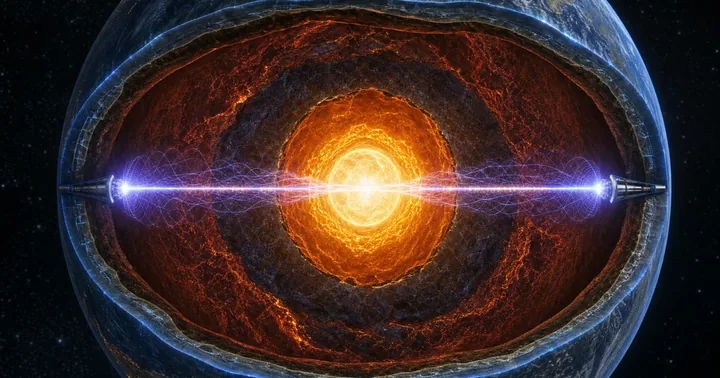
Project 12742: The Evolution of Communication
Project 12742 is a long-term research and development program from the Neutrino Energy Group (NEG) dedicated to the evolution of communication. It takes its name from a number: 12,742 kilometres, the mean diameter of the Earth. That figure captures a single provocative question - could information one day travel not merely across the planet's surface through cables, cells and satellites, but straight through the planet itself? Project 12742 does not claim to have answered that question. It is a research roadmap organised in three phases, each built honestly on the one before, ranging from technology that can be assembled today to a scientific horizon deliberately left open. This page is the overview: what the name means, how the phases fit together, the real physics involved, and - just as importantly - what remains unproven.
Why 12,742 - the meaning behind the name
The number 12,742 is the Earth's mean diameter in kilometres. It is chosen deliberately, as a thought experiment made concrete. Nearly every communication system humanity has ever built moves signals around the globe: along copper and fibre laid across continents, through the air to mobile masts, or up to satellites and back down. All of these routes hug the surface or arc above it, because the physics they rely on demands it.
Project 12742 asks a different question. What if the shortest path between two points on Earth - a straight line through rock, ocean and mantle - could also become a communication path? That is the idea the name encodes: communication through the planet, not only around it. It is framed as an aspiration and a research direction, not as a capability that exists today.
This is why 12742 is best understood as a program rather than a product. It sets a destination far enough ahead to organise decades of research, while remaining explicit that the journey is unfinished.
Project 12742: a research program in three phases
Project 12742 is structured as three phases that build on one another. The first is near-term and buildable on existing NEG technology. The second is genuine research, grounded in an established physics experiment but facing hard open challenges. The third is openly visionary - an invitation to imagine, promising nothing.
Reading the phases in order matters, because each creates the conditions for the next. Phase I builds a foundation of intelligent, permanently powered devices. That same foundation becomes the testbed on which the more speculative communication research of Phase II can eventually be explored. Phase III then asks what happens when the research process itself begins to accelerate.
Throughout, the framing is disciplined: near-term where it is honest to say so, research where the outcome is genuinely uncertain, and vision where the horizon is open.
Phase I - the Intelligent Energy Network
Phase I rests on a simple thesis: energy is communication. NEG's core research area, NEUTRINOVOLTAIC, investigates converting ambient environmental flux - neutrinos, cosmic radiation and thermal fluctuations, and electromagnetic waves, from multiple sources - into electrical current using a patented graphene-silicon multilayer material. The near-term insight of Phase I is that any autonomous energy source built on this research, such as the Power Cube in development, could simultaneously act as an intelligent communication node.
Because such a node is designed to be permanently powered rather than battery-limited, it could in principle operate continuously: reporting its own status, receiving updates, coordinating with neighbouring devices and feeding data to central or decentralised AI. As more units are installed, the network could grow organically - one unit is a device, a million form a network, a hundred million begin to look like infrastructure. The economic logic follows: the hardware could become a permanent platform for diagnostics, software services and fleet management.
Phase I is the most concrete part of the roadmap because it builds on NEG's existing energy research rather than requiring a scientific breakthrough. Read the full detail on the Intelligent Energy Network page.
Phase II - neutrino communication research
Phase II, framed as Universal Field Communication, asks the harder question directly: is there a physical channel for information beyond electromagnetic signals? The motivation is practical. Electromagnetic communication - copper, fibre, mobile, WiFi, satellite - is strongly damped by water and impeded by rock, metal and tunnels. Neutrinos behave very differently. They are among the most abundant particles in the universe; billions pass through every square centimetre of Earth, the oceans and our bodies every second, almost entirely unimpeded. This is experimentally secured physics.
The decisive precedent is real. In 2012, Stancil and colleagues at Fermilab encoded the word "neutrino" as a digital message and transmitted it using the NuMI neutrino beam, reading it out with the MINERvA detector (arXiv:1203.2847; Modern Physics Letters A, 2012). The signal travelled a total path of 1.035 km including 240 m of solid rock, achieving 0.1 bits per second at roughly a 1% bit-error rate. The setup was large, energy-intensive and extraordinarily slow - but it delivered the point that matters here: neutrinos can fundamentally carry information. The physical channel exists.
NEG does not aim to replace existing communications, and this is emphatically not a working product. Neutrinos do not already form a usable network. Phase II researches whether this confirmed principle could evolve - through novel materials, far more sensitive detection, new modulation and encoding, AI-assisted signal processing and hybrid systems. Miniaturising a room-sized experiment into anything practical is an open, unsolved challenge. Potential future fields, all subject to research, include communication through oceans, deep mines, heavily shielded structures and long-term space. See the dedicated neutrino communication page for the full treatment.
Phase III - an open horizon
Phase III is described as the Next Level: the point at which communication might begin to develop itself. It is deliberately visionary - an invitation to think, not a claim to be verified. Here AI is imagined as a research partner that could analyse literature at scale, run simulations and propose new materials, modulations and detector designs faster than human teams alone.
The genuinely open question is whether self-learning communication could continuously optimise itself, and whether there might exist universal principles of communication independent of any particular technology or biology. NEG frames this as a collaboration between human creativity and machine-assisted discovery, keeping the scientific horizon open and promising nothing. Explore the idea on the self-learning communication page.
The supporting science, stated precisely
Project 12742 leans on established results, cited without overstatement. The 2015 Nobel Prize in Physics (Takaaki Kajita and Arthur McDonald) recognised the discovery of neutrino oscillations, which prove that neutrinos have mass. In 2017, the COHERENT collaboration reported the first detection of coherent elastic neutrino-nucleus scattering, or CEvNS (Science 357, 1123) - a subtle interaction long predicted and finally observed.
More recent work sharpens the picture. In 2025, COHERENT reported evidence of CEvNS on germanium at 3.9 sigma (Physical Review Letters 134, 231801) - evidence, not confirmation. Also in 2025, the CONUS+ experiment reported the first detection of CEvNS from a nuclear-reactor antineutrino source, using a 3-kg germanium detector at Leibstadt at 3.7 sigma (Nature, 2025). Separately, work from the Thibado group on rectifying thermal fluctuations in graphene (Bonilla, Torrente, Mangum & Thibado, arXiv:2512.21703; Physical Review E, 2026) is relevant to Phase I energy nodes, not to communication.
These results establish that neutrinos are real, massive, abundant and increasingly detectable. They do not, on their own, demonstrate practical neutrino communication - and Project 12742 does not claim they do. For background, see what is a neutrino, how neutrinos are detected and the Standard Model.
The energy foundation, honestly framed
The bridge that ties Project 12742 together is energy. The nodes imagined in Phase I depend on NEG's NEUTRINOVOLTAIC research - the effort to harvest ambient environmental flux into usable current. This work is in development: it is a research program, not a proven or purchasable technology, and nothing here should be read as a claim of free, unlimited or infinite energy. The word "universal" in Phase II describes communication, never energy.
Framed honestly, the logic is this: if permanently powered, self-sufficient devices can be realised through ongoing research, they could form the organic node infrastructure on which the communication research of later phases is tested. That is a chain of conditionals, not a finished system. Related research is described on the neutrinovoltaic, energy harvesting and new energy technology pages.
Who Project 12742 speaks to
Because it spans energy and communication, Project 12742 is written for several audiences at once. Telecom and 6G researchers may read it as a question about channels beyond the electromagnetic spectrum. IoT and deep-tech engineers may focus on Phase I's permanently powered nodes. Maritime, defence and critical-infrastructure planners are drawn to the idea of communicating through water, rock and shielding - precisely where conventional signals struggle. AI and research communities engage with Phase III's self-optimising systems, and the space sector with the prospect of channels for long-duration, long-distance missions.
To every one of these audiences the message is the same and deliberately unembellished: Project 12742 is a neutrino communication research program and roadmap, not a delivered technology. The Neutrino Energy Group was founded in Berlin in 2008 and is led by mathematician and CEO Holger Thorsten Schubart; you can read more about him on the Holger Schubart page. What makes the project worth following is not a promise of what exists today, but the seriousness with which it treats what might, one day, be possible.
Frequently asked questions
What is Project 12742?
Project 12742 is the Neutrino Energy Group's long-term research and development program for the evolution of communication. It is a roadmap organised in three phases - an intelligent energy network, neutrino communication research, and a visionary open horizon - not a finished or purchasable technology.
Why is it called Project 12742?
The number 12,742 is the Earth's mean diameter in kilometres. The name captures the project's central idea: exploring whether information could one day travel through the planet in a straight line, rather than only around its surface via cables, mobile networks and satellites.
Is neutrino communication a working product?
No. Neutrino communication is a research direction, not an available technology. Neutrinos do not already form a usable network. The only proven precedent is the 2012 Fermilab experiment by Stancil et al., which transmitted a message at 0.1 bits per second - evidence that the physical channel exists, not a practical system.
What did the 2012 Fermilab neutrino experiment actually prove?
Stancil and colleagues encoded the word "neutrino" as a digital message and sent it via the NuMI beam to the MINERvA detector over a 1.035 km path including 240 m of rock, at 0.1 bits per second and about a 1% error rate. It proved neutrinos can fundamentally carry information - nothing more, and nothing about practical deployment.
Does Project 12742 involve free or unlimited energy?
No. Project 12742 makes no claim of free, unlimited or infinite energy. The energy component is NEG's NEUTRINOVOLTAIC research, which is in development and unproven. In Phase II, the word "universal" describes communication, not energy.
How do the three phases relate to each other?
Phase I builds intelligent, permanently powered energy nodes on existing NEG research - the near-term foundation. Phase II uses that foundation as a testbed to research whether neutrino-based communication could evolve. Phase III is a visionary horizon exploring self-learning communication and AI-assisted discovery. Each phase is honestly labelled by how proven it is.