Neutrino Sources: A Map of Where Neutrinos Come From
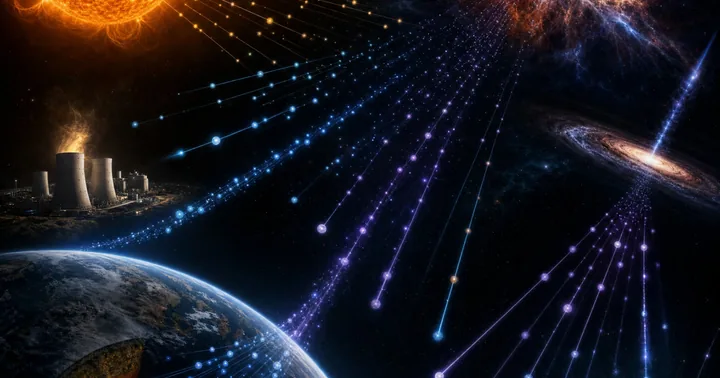
Neutrinos are the most abundant matter particles in the universe, yet they are almost impossible to catch. To understand them you first have to understand where they come from, because the sources of neutrinos differ enormously - by more than twenty orders of magnitude in energy and by many orders of magnitude in flux. A relic neutrino from the first second after the Big Bang carries a fraction of a millielectronvolt; a neutrino born in the jet of a distant black hole can carry a million billion times more. This page is a map of the full neutrino-source taxonomy: what each source is, roughly how many neutrinos it delivers and at what energy, and where to read more. Together these sources explain why, at every moment, tens of billions of neutrinos stream through every square centimetre of your body without leaving a trace.
What Counts as a Neutrino Source?
A neutrino source is any process that produces neutrinos - the three flavours of electron, muon and tau neutrino (and their antineutrinos) described by the Standard Model. Almost every one of these processes traces back to the weak nuclear force, which governs beta decay and the nuclear fusion and fission reactions that release neutrinos. Wherever protons turn into neutrons or vice versa, a neutrino is emitted.
Because neutrinos interact so weakly, they escape almost anything - the core of the Sun, a collapsing star, the interior of the Earth - carrying direct information out of places light can never leave. That is exactly why the taxonomy of sources matters. Each source occupies a characteristic band of energy, so an experiment tuned to one energy window effectively selects one kind of neutrino. The result is a layered spectrum stretching from sub-millielectronvolt relics to petaelectronvolt astrophysical neutrinos, sorted below from the most abundant and lowest-energy to the rarest and most energetic. For a fuller picture of how we register them at all, see how neutrinos are detected.
The Cosmic Neutrino Background: The Most Abundant Source
By sheer numbers, the largest source of neutrinos is the oldest: the cosmic neutrino background, or CνB. About one second after the Big Bang, the universe cooled enough for neutrinos to decouple from the hot plasma and stream freely, roughly 380,000 years before the photons of the cosmic microwave background did the same. These relic neutrinos still fill all of space at a density of about 336 per cubic centimetre - roughly 112 of each flavour per cubic centimetre - totalling hundreds of trillions in a volume the size of a room.
The catch is their energy. Cosmic expansion has cooled them to about 1.95 kelvin, giving each neutrino an average energy of only a fraction of a millielectronvolt. That is so low that no experiment has yet detected the CνB directly, though its gravitational imprint on the early universe is measured precisely and matches prediction. Proposed experiments such as PTOLEMY aim to capture relic neutrinos through neutrino capture on tritium, but for now the most abundant neutrino source in the universe remains, ironically, the one we have never directly seen.
Solar Neutrinos: The Sun as a Nuclear Furnace
The Sun is the dominant source of neutrinos we can actually study, and the brightest neutrino source in our sky. Deep in its core, hydrogen fuses into helium, and each completed fusion chain releases two electron neutrinos. The flux at Earth is enormous: roughly 65 billion solar neutrinos cross every square centimetre every second. Most come from the initial proton-proton reaction and carry low energies, below about 0.4 MeV, while rarer branches - the boron-8 reaction in particular - produce higher-energy neutrinos up to around 15 MeV that are easier to detect.
Solar neutrinos wrote a defining chapter in physics. From the late 1960s, Raymond Davis Jr.'s Homestake experiment counted only about a third of the neutrinos predicted by John Bahcall's solar model - the 'solar neutrino problem,' a pioneering measurement that later earned Davis a share of the 2002 Nobel Prize in Physics. The resolution came in 2001–2002, when the Sudbury Neutrino Observatory showed the missing neutrinos had simply changed flavour on their way out, confirming neutrino oscillation and, with it, that neutrinos have mass. That work earned SNO's Arthur McDonald a share of the 2015 Nobel Prize in Physics.
Atmospheric and Cosmic-Ray Neutrinos
When high-energy cosmic rays - mostly protons from beyond the Solar System - strike the upper atmosphere, they produce cascades of pions and kaons that decay into muons and neutrinos. These atmospheric neutrinos arrive from every direction, span energies from roughly 0.1 GeV to well above 10,000 GeV, and are produced in a characteristic ratio of about two muon neutrinos to each electron neutrino.
In 1998, the Super-Kamiokande experiment found that this ratio was skewed depending on how far the neutrinos had travelled - those coming up through the whole Earth were depleted in muon neutrinos compared with those coming straight down. That distance dependence was the first clear evidence of oscillation and of neutrino mass, earning Super-Kamiokande's Takaaki Kajita the other share of the 2015 Nobel Prize. Because they populate a wide energy range and come from all directions, atmospheric neutrinos remain a workhorse for studying oscillation parameters and the still-open question of neutrino mass ordering. Their production also involves the muon, a heavier cousin of the electron.
Earthbound Sources: Reactors and Geoneutrinos
Not every neutrino source is astronomical. Nuclear power stations are intense, controllable neutrino factories: fission fragments are neutron-rich and beta-decay, so each reactor pours out roughly 10^20 electron antineutrinos per second, with energies of a few MeV. These reactor neutrinos have been essential tools - the original 1956 Reines–Cowan detection of the neutrino used a reactor, and in 2012 the Daya Bay experiment used reactor antineutrinos to measure the mixing angle θ₁₃, the last unknown angle in the oscillation framework.
The Earth itself is also a neutrino source. Radioactive uranium, thorium and potassium-40 in the crust and mantle decay continuously, emitting geoneutrinos at a flux of a few million per square centimetre per second. First detected by KamLAND in 2005 and later by Borexino, geoneutrinos are the only direct probe of Earth's internal radioactive heat budget - they tell geologists how much of the planet's roughly 47 terawatts of heat flow comes from radioactive decay rather than primordial warmth.
Supernovae, Accelerators and Astrophysical Neutrinos
The most dramatic neutrino sources are cataclysms. When a massive star's core collapses, about 99 percent of the released gravitational energy escapes as supernova neutrinos - a burst of some 10^58 neutrinos over about ten seconds. In February 1987, three detectors - Kamiokande-II in Japan, IMB in the United States and Baksan in the Soviet Union - together caught about two dozen neutrinos from Supernova 1987A in the Large Magellanic Cloud, the first neutrinos ever detected from beyond the Solar System and the birth of neutrino astronomy. Masatoshi Koshiba, who led Kamiokande, shared the 2002 Nobel Prize for that observation.
Physicists also make neutrinos on demand. Particle accelerators smash protons into targets to produce intense, well-aimed beams of muon neutrinos for long-baseline oscillation experiments such as those feeding Super-Kamiokande and, in future, DUNE. At the extreme high-energy end lie astrophysical neutrinos from active galactic nuclei and blazars - supermassive black holes accelerating particles to enormous energies. In 2013 the IceCube observatory in Antarctica reported the first high-energy astrophysical neutrinos, reaching petaelectronvolt energies, and in 2017 traced one back to the flaring blazar TXS 0506+056, opening the era of multimessenger astronomy. Cataloguing all these origins is the work of dedicated neutrino observatories.
A Spectrum That Spans the Universe
Placed side by side, these sources form a continuous neutrino spectrum. At the lowest energies sit the relic CνB neutrinos at fractions of a millielectronvolt; then geoneutrinos and reactor and solar neutrinos in the kilo-electronvolt to MeV range; supernova neutrinos in the tens of MeV; atmospheric and accelerator neutrinos from GeV to TeV; and astrophysical neutrinos climbing into the PeV. Above roughly the EeV scale lies the theoretical 'GZK' or cosmogenic neutrino flux, produced when ultra-high-energy cosmic rays interact with cosmic microwave background photons - a source predicted but not yet confirmed.
This spectrum is not just a catalogue. Each band is a different messenger: solar neutrinos report on fusion, geoneutrinos on Earth's interior, supernova neutrinos on stellar death, astrophysical neutrinos on the most violent engines in the cosmos. Because neutrinos pass through matter almost untouched, they carry these reports faithfully across the universe - which is precisely what makes mapping their sources so valuable.
Ambient Neutrino Flux and Energy-Harvesting Research
The natural flux of neutrinos from all these sources - solar, atmospheric, terrestrial and cosmic combined - is one part of the broader ambient environmental radiation that surrounds us at every moment. This has prompted research into whether persistent low-level environmental flux might one day be tapped as a supplementary power source, an active question within the field of energy harvesting.
The Neutrino Energy Group, a Berlin research organisation founded in 2008, studies this question under the name neutrinovoltaic - investigating whether a graphene-and-silicon multilayer material can convert energy from ambient radiation fields into a small electrical current. It is important to be precise about status: this is early-stage research, not a proven technology or a purchasable product, and neutrinos individually deposit extraordinarily little energy. The reference points that make the field scientifically serious - the 2015 Nobel Prize for neutrino mass and the 2017 COHERENT observation of coherent elastic neutrino-nucleus scattering, since reinforced by independent germanium-detector and CONUS+ measurements in 2025 - establish that neutrinos are real and interact with matter, not that any device today generates usable power from them.
Open Questions About Neutrino Sources
Even with a well-mapped taxonomy, major questions remain. The cosmic neutrino background has never been directly detected, and doing so would be a landmark test of Big Bang cosmology. The precise fraction of Earth's heat driven by radioactive decay - the geoneutrino budget - is still being pinned down. The astrophysical sources at the highest energies are only partly identified: which black holes, supernova remnants and galaxies dominate the PeV flux is an open frontier.
There are also questions about whether the known source list is complete. Hypothetical sterile neutrinos, which would interact even more weakly than ordinary ones, could add a hidden component to several source fluxes, and dark-matter annihilation has been proposed as another exotic source. As detectors grow more sensitive, they must also contend with the 'neutrino fog' - the point at which even faint solar and atmospheric neutrinos become an unavoidable background. Understanding every source, and its energy and abundance, is therefore not a finished map but a living one.
Frequently asked questions
Where do neutrinos come from?
Neutrinos come from many sources: the Big Bang (the cosmic neutrino background), the Sun's nuclear fusion, cosmic-ray collisions in the atmosphere, nuclear reactors, radioactive decay inside the Earth, exploding supernovae, particle accelerators, and distant black holes. Each source produces neutrinos at a characteristic energy and abundance.
What is the most abundant source of neutrinos?
By number, the cosmic neutrino background is the most abundant source - about 336 relic neutrinos per cubic centimetre fill all of space, left over from roughly one second after the Big Bang. However, they are so low in energy (a fraction of a millielectronvolt) that they have never been directly detected. The Sun is the most abundant source we can actually measure.
How many neutrinos from the Sun pass through us?
About 65 billion solar neutrinos pass through every square centimetre of Earth-facing surface every second. They are produced by hydrogen fusion in the Sun's core and stream out in all directions, passing through your body constantly, day and night, since they also travel through the entire Earth almost undisturbed.
Are nuclear reactors a source of neutrinos?
Yes. Nuclear reactors are among the most intense controllable neutrino sources, emitting roughly 10^20 electron antineutrinos per second from the beta decay of neutron-rich fission fragments, at energies of a few MeV. Reactor neutrinos were used in the original 1956 Reines–Cowan discovery of the neutrino and in the 2012 Daya Bay measurement of the θ₁₃ mixing angle.
What are the highest-energy neutrino sources?
The highest-energy neutrinos come from extreme astrophysical objects - active galactic nuclei and blazars, which are supermassive black holes accelerating particles to enormous energies. The IceCube observatory has detected such astrophysical neutrinos at petaelectronvolt energies, including one in 2017 traced back to the blazar TXS 0506+056.
Can neutrinos from these sources be used for energy?
The natural neutrino flux is part of the ambient environmental radiation being studied in energy-harvesting research, including the Neutrino Energy Group's neutrinovoltaic work in Berlin. This is early-stage research, not a proven or purchasable technology. Individual neutrinos deposit extremely little energy, and no device today generates usable power from them.