Neutrino Oscillation: How Neutrinos Change Flavour in Flight
Right now, roughly 100 trillion neutrinos from the Sun are streaming through your body every second, and almost none of them notice you are there. These ghostly particles hold one of the most beautiful secrets in modern physics: they can change their identity as they travel. This shape-shifting is called neutrino oscillation, and its discovery overturned a decades-old assumption, earned the 2015 Nobel Prize in Physics, and revealed that neutrinos are not quite as weightless as the textbooks once claimed. Here is what neutrino oscillation actually is, why it matters, and how physicists proved it.
What is neutrino oscillation?
A neutrino is an elementary particle, a member of the lepton family. It carries no electric charge and has an almost unimaginably tiny mass. Because it interacts only through the weak nuclear force and through gravity, it slips through ordinary matter almost undisturbed, passing through planets and people alike as if they were empty space.
Neutrinos come in three types, called flavours: the electron neutrino, the muon neutrino, and the tau neutrino. Each flavour is tied to a partner particle (the electron, the muon, and the tau). Neutrino oscillation is the remarkable fact that a neutrino created as one flavour can be detected later as a different flavour. A neutrino born as an electron neutrino in the core of the Sun, for example, may arrive at Earth as a muon or tau neutrino instead.
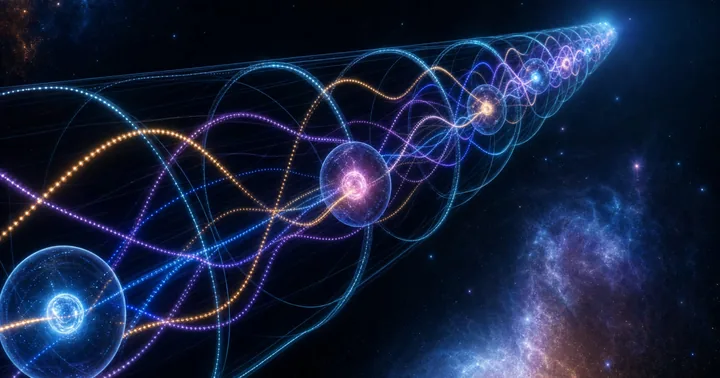
The change is not random damage or decay. It is a smooth, wave-like, repeating transformation, which is why physicists call it an oscillation. As the particle travels, the probability of measuring it as each flavour rises and falls like interfering ripples, so the flavour you find depends on how far the neutrino has flown and how much energy it carries.
Do neutrinos change flavour, and what do the flavours mean?
Yes, neutrinos genuinely change flavour, and the reason is pure quantum mechanics. The three flavours are not the same thing as the neutrino's fundamental mass states. Instead, each flavour is a specific blend, a quantum superposition, of three underlying mass states (physicists call them mass eigenstates). When a neutrino is produced in a weak interaction, it starts life in a definite flavour, which means it starts as a fixed mixture of those mass states.
As the neutrino travels, each mass state accumulates its quantum phase at a very slightly different rate, because each carries a different mass. Over distance, the three components drift out of step with one another, like three tuning forks of slightly different pitch slowly falling out of sync. That shifting interference continuously rebalances the mixture, so the flavour you would measure keeps changing along the flight path. Detect the neutrino at the right distance, and you may catch it wearing a completely different flavour from the one it was born with.
Why neutrino oscillation proves neutrinos have mass
This is the deep payoff, and it is worth stating carefully. For oscillation to happen at all, the different mass states must evolve at different rates. That is only possible if they have different masses, which in turn means at least two of the three mass states must have a mass greater than zero. If every neutrino mass were exactly zero, the states would stay perfectly in step, nothing would fall out of sync, and the flavour could never change. No mass difference means no oscillation.
So the very existence of neutrino oscillation is direct proof that neutrinos have mass. This mattered enormously, because the Standard Model of particle physics, our best theory of fundamental particles, was originally built assuming neutrinos were perfectly massless. Oscillation was the first solid laboratory evidence of physics beyond that model. It is also the clearest recent example of a scientific consensus being overturned by measurement rather than argument: the textbook position changed within a few years of two independent experiments reporting it.
One honest caveat keeps the physics precise: oscillation experiments measure the differences between the squares of the masses, not the absolute masses themselves. They tell us the masses are non-zero and unequal, but not yet the exact weight of a single neutrino. Pinning down that absolute scale is one of the biggest open questions in physics today.
The 2015 Nobel Prize: Super-Kamiokande and SNO
The trail to oscillation began with a puzzle known as the solar neutrino problem. Detectors on Earth kept counting only about a third of the electron neutrinos that solar models predicted the Sun should produce. For years, no one knew whether the model of the Sun was wrong or the neutrinos were somehow going missing.
Two experiments settled it. In Japan, the Super-Kamiokande detector, associated with Takaaki Kajita, studied neutrinos created when cosmic rays strike the atmosphere and showed in 1998 that muon neutrinos were disappearing in a way that depended on how far they had travelled, the classic signature of oscillation. In Canada, the Sudbury Neutrino Observatory (SNO), led by Arthur B. McDonald, used heavy water to count solar neutrinos of all three flavours at once. SNO found that the missing electron neutrinos had not vanished at all; they had simply changed flavour on the way from the Sun. The total added up perfectly.
For proving that neutrinos oscillate, and therefore have mass, Kajita and McDonald shared the 2015 Nobel Prize in Physics. It reshaped the field: neutrinos went from a rounding error in the Standard Model to a doorway into new physics.
How do we actually detect neutrinos?
Catching a particle that ignores almost everything is extraordinarily hard. Because a neutrino interacts so rarely, detectors must be enormous, exquisitely sensitive, and buried deep underground or in ice to shield them from other radiation. Even then, neutrinos are seen only indirectly, through the faint flashes of light or tiny recoils produced on the rare occasions one does interact with matter.
The instruments are some of the most ambitious in science: IceCube, a cubic kilometre of instrumented Antarctic ice; Super-Kamiokande, a giant tank of ultrapure water; SNO's heavy-water detector; and intense neutrino beams fired across hundreds of kilometres from accelerators at facilities such as CERN and Fermilab. In 2017, the COHERENT experiment reached a long-sought milestone by observing coherent elastic neutrino-nucleus scattering for the first time, a gentle process in which a neutrino nudges an entire atomic nucleus and transfers a small but measurable amount of momentum.
One clarification is worth making, because the terms get muddled in popular writing: neutrinos are not dark matter or dark energy. They sit near those other open questions at the frontier of physics, but they are genuinely different things. Neutrinos are known, detected, real particles with measured properties.
From neutrino oscillation to neutrinovoltaic research
Understanding neutrino oscillation changed how physicists think about these particles. They are no longer weightless phantoms that only pass through matter; they carry mass, and, as COHERENT demonstrated, an interaction can in principle transfer a measurable amount of momentum. That shift in perspective is one starting point for a line of applied research.
This is where the work of the Neutrino Energy Group connects to the science on this page. The group is exploring neutrinovoltaic, an early-stage research approach that asks a focused question: could a small fraction of the constant ambient environmental flux around us be converted into a usable electric current? Importantly, that flux is not neutrinos alone. It includes cosmic radiation, thermal motion, and electromagnetic waves, multiple overlapping sources. The experimental idea centres on a patented multilayer graphene-and-silicon architecture, and it draws on work such as Paul Thibado's 2020 studies of charge separation from the Brownian motion of freestanding graphene.
It is essential to be clear about what this is and is not. Neutrinovoltaic is a research programme still in development, not a finished product, and it makes no claim of free, unlimited, or perpetual energy, and it does not violate the conservation of energy. Like a solar panel harvesting sunlight, the concept is about capturing a portion of energy that is already flowing through an open environment, never creating energy from nothing. If you want to see how this science is being explored in practice, read more about neutrinovoltaic research and where it stands today.
Frequently asked questions
What is neutrino oscillation in simple terms?
Neutrino oscillation is the quantum effect in which a neutrino changes its flavour, electron, muon, or tau, as it travels through space. A neutrino created as one flavour can be detected later as another, because each flavour is a blend of mass states that drift out of step over distance.
Do neutrinos really change flavour?
Yes. Experiments have confirmed it beyond doubt. Electron neutrinos produced in the Sun arrive at Earth partly transformed into muon and tau neutrinos, and atmospheric muon neutrinos disappear in a distance-dependent pattern. Both are direct signatures of flavour change in flight.
Why does neutrino oscillation prove neutrinos have mass?
Flavour can only change if the underlying mass states evolve at slightly different rates, which requires them to have different masses. That means at least two neutrino mass states must be non-zero. If all neutrino masses were zero, oscillation would be impossible, so observing it proves neutrinos have mass.
Who won the 2015 Nobel Prize for neutrino oscillation?
Takaaki Kajita of the Super-Kamiokande experiment and Arthur B. McDonald of the Sudbury Neutrino Observatory shared the 2015 Nobel Prize in Physics for discovering neutrino oscillations, which showed that neutrinos have mass.
How are neutrinos detected if they pass through everything?
Neutrinos are detected indirectly using huge, deeply shielded detectors such as IceCube in Antarctic ice and Super-Kamiokande's water tank, plus accelerator beams at labs like CERN and Fermilab. Detectors record the rare faint flashes or recoils produced when a neutrino interacts with matter.
Is a neutrino the same as dark matter or dark energy?
No. Neutrinos are known, detected elementary particles with measured properties, while dark matter and dark energy remain unidentified. They are separate open questions in physics, and neutrinos should not be confused with either.