Beta Decay: The Radioactivity That Gave Birth to the Neutrino
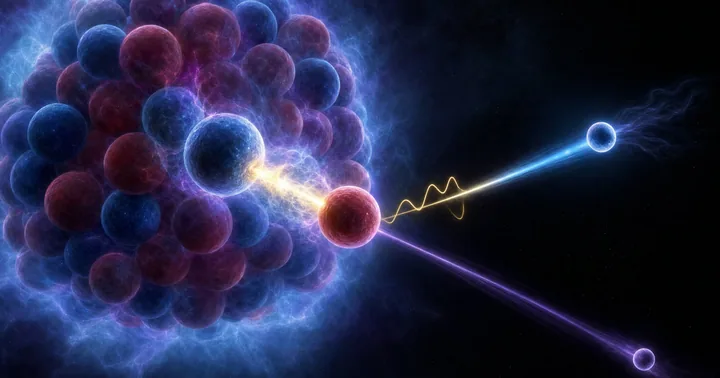
Beta decay is one of the three classic forms of radioactivity, alongside alpha and gamma decay, and arguably the most consequential for modern physics. When a nucleus has an unfavourable balance of protons and neutrons, the weak nuclear force can convert one into the other, ejecting a high-speed electron or positron. The puzzle of where that particle's missing energy went troubled physicists for two decades - and its solution, Wolfgang Pauli's reluctant 1930 proposal of a nearly invisible particle, quite literally invented the neutrino. This reference explains what beta decay is, the three ways it happens, the physics that drives it, and why it still matters from radiocarbon dating to PET scanners.
What Is Beta Decay?
Beta decay is a form of radioactive decay in which an atomic nucleus changes the identity of one of its constituent nucleons - turning a neutron into a proton, or a proton into a neutron - while emitting a beta particle. A beta particle is simply a high-energy electron (β⁻) or its antimatter twin, the positron (β⁺). The term was coined by Ernest Rutherford around 1899, when he classified the mysterious emanations of uranium into 'alpha' and 'beta' rays by how easily they were absorbed; the far more penetrating beta rays were soon identified as electrons.
The defining feature of beta decay is that it changes the atomic number Z by one unit while leaving the mass number A unchanged. The nucleus therefore becomes a different chemical element, but with essentially the same mass. Because it rearranges the nucleus rather than breaking it apart, beta decay is the dominant route by which nuclei with too many neutrons - or too many protons - climb toward stability.
The Three Modes: β⁻, β⁺ and Electron Capture
There are three related processes, all mediated by the same underlying force. In beta-minus (β⁻) decay, a neutron converts into a proton, emitting an electron and an electron antineutrino: n → p + e⁻ + ν̄ₑ. This happens in neutron-rich nuclei; the atomic number rises by one. The textbook example is carbon-14 decaying to nitrogen-14.
In beta-plus (β⁺) decay, a proton converts into a neutron, emitting a positron and an electron neutrino: p → n + e⁺ + νₑ. This occurs in proton-rich nuclei and lowers the atomic number by one. Crucially, a free proton cannot do this - it is lighter than a neutron - so β⁺ decay only occurs inside a nucleus where the surrounding binding energy makes it energetically possible.
The third mode, electron capture, competes with β⁺ decay. Here the nucleus absorbs one of its own inner-shell atomic electrons, converting a proton into a neutron and emitting only a neutrino: p + e⁻ → n + νₑ. Because a single, near-undetectable neutrino carries away the energy, electron capture is one of the quietest events in nature.
The Weak Force Behind It
At the deepest level, beta decay is a manifestation of the weak nuclear force. A neutron and a proton are each built from three quarks: a neutron is (up, down, down) and a proton is (up, up, down). Beta-minus decay is really a single down quark transforming into an up quark, emitting a virtual W⁻ boson that immediately decays into the electron and antineutrino. The W boson is enormously heavy - roughly 85 times the mass of a proton, more than 80 GeV/c² - which is why the force has such an extraordinarily short range and why beta decay is comparatively slow.
The first quantitative theory came from Enrico Fermi in 1934. Building directly on Pauli's neutrino idea, Fermi wrote down a mathematical description of beta decay that treated it as a point-like interaction, introducing what is now called the Fermi coupling constant. Famously, the journal Nature rejected his paper as 'too remote from physical reality'; it was published instead in Zeitschrift für Physik and became one of the foundations of particle physics. Fermi's framework was later absorbed into the unified electroweak theory of the 1960s, whose W and Z bosons were finally observed at CERN in 1983.
The Continuous Spectrum Puzzle
For a while, beta decay looked like a straightforward two-body split, which should hand the emitted electron a single, fixed energy - as happens in alpha decay. But careful measurements, culminating in James Chadwick's 1914 work, revealed something deeply unsettling: the electrons from beta decay emerge with a continuous range of energies, from nearly zero up to a sharp maximum.
This was a crisis. If a nucleus of energy E decays into a daughter nucleus and one electron, energy and momentum conservation demand a unique electron energy. A continuous spectrum implied that energy was somehow going missing. The problem was serious enough that Niels Bohr floated the radical idea that energy conservation might hold only statistically, on average, and could be violated in individual nuclear events. Physics was prepared to sacrifice one of its most sacred laws.
Pauli's Desperate Remedy: The Birth of the Neutrino
Wolfgang Pauli refused to abandon energy conservation. On 4 December 1930 he sent an open letter - addressed playfully to 'Dear Radioactive Ladies and Gentlemen' - to a physics conference in Tübingen that he could not attend because of a ball in Zurich. In it he proposed a 'desperate remedy': a new, electrically neutral, nearly massless particle emitted alongside the electron, sharing the decay energy so that the electron's share would vary continuously. The invisible third partner carried off the missing energy and momentum, and conservation was saved.
Pauli initially called it the 'neutron', but when Chadwick discovered the (much heavier) actual neutron in 1932, Fermi rechristened Pauli's ghostly particle the neutrino - Italian for 'little neutral one'. It was a bold theoretical invention that remained unseen for a quarter-century, until Clyde Cowan and Frederick Reines finally detected antineutrinos from a nuclear reactor in 1956 (work honoured with the 1995 Nobel Prize in Physics for Reines). Beta decay is, in a very real sense, the birthplace of the neutrino - and the study of how neutrinos change identity, neutrino oscillation, earned the 2015 Nobel Prize for Takaaki Kajita and Arthur McDonald by proving neutrinos have mass.
Half-Life and the Exponential Decay Law
Like all radioactive decay, beta decay is a random, quantum process: you cannot predict when any single nucleus will decay, only the probability that it will. For a large population, this yields the exponential decay law, N(t) = N₀ e^(−λt), where λ is the decay constant. The half-life - the time for half the nuclei in a sample to decay - is t½ = ln 2 / λ ≈ 0.693 / λ.
Beta-decay half-lives span an astonishing range. A free neutron beta-decays with a half-life of about 10 minutes. Tritium (hydrogen-3) has a half-life of roughly 12.3 years, carbon-14 about 5,730 years, and some nuclei survive far longer. This clockwork reliability is precisely what makes beta emitters useful as natural timers and tracers.
Real Applications: Dating, Imaging and Medicine
The most celebrated application is radiocarbon dating. Cosmic-ray bombardment of the atmosphere continually produces carbon-14, which living organisms absorb. When they die, uptake stops and the carbon-14 beta-decays with its 5,730-year half-life, so the remaining fraction reveals the age of organic material. Willard Libby developed the method in 1949 and received the 1960 Nobel Prize in Chemistry for it. The very cosmic rays that make carbon-14 are part of the same ambient particle flux that fills our environment.
Beta-plus decay powers positron emission tomography (PET). A patient receives a tracer such as fluorine-18 (half-life about 110 minutes); each emitted positron travels a short distance, meets an electron, and annihilates - a direct demonstration of antimatter - producing two 511-keV gamma photons flying in opposite directions that the scanner uses to build a 3D image of metabolism.
Beta-minus emitters are workhorses of therapy: iodine-131 treats thyroid disease, while lutetium-177 and yttrium-90 deliver targeted radiation to tumours. Their short-range electrons deposit energy locally, sparing surrounding tissue.
From a Rescued Law to Energy Research
There is a striking irony in beta decay's history: the neutrino was invented purely to balance an equation, a particle so weakly interacting that Pauli feared it could never be observed. Today, trillions of neutrinos from the Sun and cosmos stream through every square centimetre of Earth each second, part of a constant, invisible flux of environmental radiation.
This is the starting point for a distinct field of applied research. The Neutrino Energy Group, a Berlin research organisation founded in 2008, is investigating whether a portion of this ambient flux - neutrinos together with cosmic radiation and thermal fluctuations and electromagnetic waves - might be coupled into a small usable electrical signal. Any such approach would draw energy from the surrounding environment rather than create it: energy is always conserved, and there is no suggestion here of free, unlimited or self-generating power. Its experimental neutrinovoltaic approach draws on a patented multilayer of graphene and silicon, inspired in part by experiments on charge fluctuations in freestanding graphene. It is important to be precise: this is early-stage, in-development research, not a proven or purchasable technology, and it sits within the broader search for renewable energy innovations and energy harvesting. The honest through-line is conceptual rather than commercial - the same beta-decay physics that once forced physicists to postulate an unseen particle now motivates research into whether the omnipresent particle flux around us can be engaged at all.
Frequently asked questions
What is beta decay in simple terms?
Beta decay is a type of radioactive decay where an unstable nucleus turns a neutron into a proton (or vice versa) and shoots out a fast electron or positron, called a beta particle, along with a neutrino. This changes the atom into a different element while keeping almost the same mass.
What is the difference between beta minus and beta plus decay?
In beta-minus (β⁻) decay a neutron becomes a proton, emitting an electron and an antineutrino, and the atomic number rises by one. In beta-plus (β⁺) decay a proton becomes a neutron, emitting a positron and a neutrino, and the atomic number falls by one. Beta-plus can only happen inside a nucleus.
Why did beta decay lead to the discovery of the neutrino?
Beta particles emerge with a continuous range of energies, which seemed to violate energy conservation. In 1930 Wolfgang Pauli proposed an unseen neutral particle - later named the neutrino by Enrico Fermi - that carries away the missing energy. It was detected experimentally in 1956.
What force causes beta decay?
Beta decay is driven by the weak nuclear force. At the quark level, a down quark changes into an up quark (or the reverse) by emitting a heavy W boson, which then decays into the electron or positron and the neutrino. Enrico Fermi wrote the first theory of this process in 1934.
What is beta decay used for in real life?
Carbon-14 beta decay powers radiocarbon dating of organic material. Beta-plus emitters like fluorine-18 enable PET medical imaging, and beta-minus emitters such as iodine-131 and lutetium-177 are used in cancer and thyroid therapy.
What is the half-life in beta decay?
Half-life is the time for half the nuclei in a sample to decay, given by t½ = 0.693/λ. Beta-decay half-lives vary hugely: about 10 minutes for a free neutron, 12.3 years for tritium, and 5,730 years for carbon-14.