Solar Neutrinos: Messengers from the Heart of the Sun
Every second, roughly 65 billion solar neutrinos stream through each square centimetre of your body, arriving from a place no telescope can image directly: the fusion furnace at the centre of the Sun. Because these particles barely interact with matter, they escape the solar core almost instantly and reach Earth in about eight minutes, carrying an unfiltered report on the reactions that power the star. For more than thirty years, though, those messengers delivered a puzzle. Detectors kept finding only about a third of the neutrinos that solar physics predicted - a discrepancy known as the solar neutrino problem, whose resolution rewrote the physics of the neutrino itself. This is the story of where solar neutrinos come from, how physicists learned to catch them, and why they turned out to be one of the great detective stories of twentieth-century science.
What Solar Neutrinos Are and Where They Come From
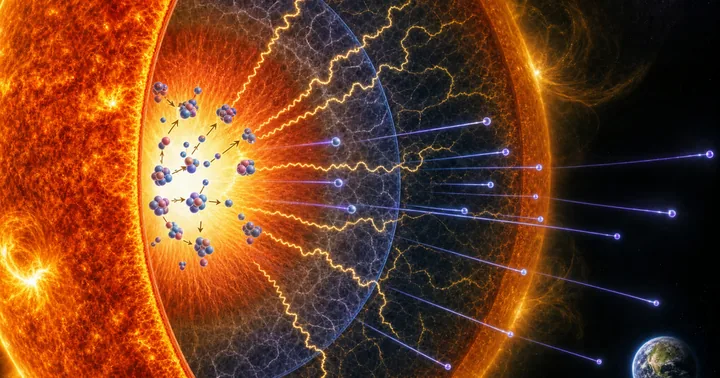
Solar neutrinos are electron neutrinos generated by thermonuclear fusion in the Sun's core, where temperatures reach about 15 million kelvin and the density exceeds that of lead. The dominant process is the proton-proton (pp) chain, which fuses hydrogen into helium-4. The net reaction converts four protons into one helium nucleus, two positrons, and two electron neutrinos, releasing energy that ultimately becomes sunlight. Roughly 99 percent of the Sun's power comes from this chain; the remaining fraction is produced by the CNO cycle, in which carbon, nitrogen, and oxygen act as catalysts.
Because a neutrino interacts only through the weak nuclear force and gravity, it does not scatter its way out of the Sun the way photons do. Light generated in the core takes many thousands of years to random-walk to the surface, but neutrinos leave almost unimpeded, reaching Earth in about 8.3 minutes. This makes them the only direct probe of the Sun's core as it is right now. The flux at Earth is enormous - on the order of 65 billion neutrinos per square centimetre per second - yet almost all of them pass through the entire planet without a single interaction.
The Solar Neutrino Spectrum: pp, Beryllium, Boron, and CNO
Solar neutrinos do not all share the same energy. Each fusion reaction produces neutrinos with a characteristic spectrum, and mapping these components has been a central goal of the field. The pp neutrinos are by far the most numerous, but they are also the lowest in energy, with a continuous spectrum extending only to about 0.42 MeV. Because they trace the fundamental fusion step, their flux is tied most directly to the Sun's total power output.
Higher-energy but far rarer branches follow. Beryllium-7 neutrinos are emitted at two sharp energies (chiefly around 0.86 MeV), while boron-8 neutrinos form a continuous spectrum reaching roughly 15 MeV. Although boron-8 neutrinos make up only a tiny fraction of the total, their high energy made them the first solar neutrinos ever detected, since early experiments could respond only to energetic events. Rarer still are the pep and hep neutrinos, along with the CNO neutrinos produced by the carbon-nitrogen-oxygen cycle. Measuring each component separately lets physicists test the Standard Solar Model reaction by reaction, rather than as a single lumped number.
Ray Davis, John Bahcall, and the Birth of a Problem
The experimental hunt began in the 1960s with chemist Raymond Davis Jr., who built a detector nearly 1.5 kilometres underground in the Homestake gold mine in South Dakota. His apparatus was a tank holding about 615 tonnes of perchloroethylene, a common dry-cleaning fluid rich in chlorine. When a sufficiently energetic neutrino struck a chlorine-37 nucleus, it converted it into radioactive argon-37, which Davis periodically extracted and counted atom by atom - a feat of chemical patience, since only a handful of argon atoms were produced per month.
Davis's collaborator, the theorist John Bahcall, developed the Standard Solar Model, a detailed calculation of the Sun's interior that predicted how many neutrinos Homestake should capture. From the first results in the late 1960s onward, the two numbers refused to agree. The detector saw only about one-third of the predicted rate. For decades this stubborn deficit - the solar neutrino problem - hung over physics. Either the Sun was not shining the way the models said, Bahcall's calculations were wrong, or something happened to the neutrinos on their way to Earth.
Confirming the Deficit: Kamiokande and the Gallium Experiments
Skeptics could dismiss a single experiment, so independent detectors using different techniques were essential. In Japan, the Kamiokande and later Super-Kamiokande detectors used enormous tanks of ultrapure water lined with photomultiplier tubes to observe the faint Cherenkov radiation produced when a neutrino scattered an electron. Led by Masatoshi Koshiba, these water detectors confirmed the deficit and added a crucial detail: the scattered electrons pointed back toward the Sun, proving the neutrinos' solar origin.
Meanwhile, the GALLEX and GNO experiments in Italy and the SAGE experiment in Russia used gallium as a target. Gallium is sensitive to the low-energy pp neutrinos that chlorine and water cannot see, so these experiments probed the most fundamental fusion reaction directly. They too found fewer neutrinos than predicted. By the 1990s the deficit was undeniable and appeared across every energy range and every detection method, sharpening the mystery rather than resolving it.
The Solution: Oscillation and the Sudbury Neutrino Observatory
The resolution came not from fixing the Sun but from understanding the neutrino. If neutrinos have a small mass, the three flavours - electron, muon, and tau - can transform into one another in flight, a quantum effect called neutrino oscillation. Solar neutrinos are born as electron neutrinos, but detectors like Homestake responded only to that flavour. If two-thirds of them changed into muon and tau neutrinos en route, a detector blind to those flavours would naturally see only a third - exactly the observed shortfall.
The decisive proof came from the Sudbury Neutrino Observatory (SNO) in Ontario, Canada, roughly 2 kilometres underground in the Creighton mine. Led by Arthur McDonald, SNO used 1,000 tonnes of heavy water, whose deuterium nuclei allowed it to run two kinds of measurement: one sensitive only to electron neutrinos, and another sensitive to all three flavours equally. Between 2001 and 2002, SNO showed that while the electron-neutrino flux was indeed reduced, the total flux across all flavours matched Bahcall's Standard Solar Model almost perfectly. The missing neutrinos had not vanished - they had simply changed identity. Inside the dense solar interior, this flavour conversion is enhanced by the Mikheyev-Smirnov-Wolfenstein (MSW) effect, in which matter itself modifies how neutrinos oscillate.
Nobel Prizes and Precision Astronomy with Borexino
The scientific weight of these discoveries was recognised twice. The 2002 Nobel Prize in Physics went to Raymond Davis Jr. and Masatoshi Koshiba (who shared it with Riccardo Giacconi, honoured for X-ray astronomy) for pioneering the detection of cosmic neutrinos. In 2015, Takaaki Kajita and Arthur McDonald shared the Nobel Prize for the discovery of neutrino oscillations, which proved that neutrinos have mass - a result that lies outside the original Standard Model of particle physics.
With the problem solved, solar neutrinos became a precision tool. The Borexino experiment at Italy's Gran Sasso laboratory achieved extraordinary radiopurity and, for the first time, measured individual components of the spectrum in real time: the beryllium-7 line, then in 2014 the fundamental pp neutrinos, and in 2020 the first direct detection of CNO-cycle neutrinos. That CNO measurement confirmed a fusion process long theorised but never before observed in the Sun, and it matters far beyond our star, since the CNO cycle dominates energy production in stars more massive than the Sun.
Why Solar Neutrinos Still Matter
Solar neutrinos remain scientifically valuable on two fronts. As astrophysics, they let researchers weigh the Sun's core composition and test stellar models with a directness no other method offers; recent Borexino CNO data even feed into long-running debates about the Sun's metallicity. As particle physics, the Sun is a free, steady source for studying oscillation parameters and searching for deviations that might hint at new physics. Solar neutrinos are one branch of the broader family of neutrino sources, alongside reactor neutrinos, atmospheric neutrinos, and geoneutrinos.
This same ambient flux of environmental particles is what motivates applied research groups such as the Berlin-based Neutrino Energy Group, whose experimental neutrinovoltaic concept investigates whether a graphene-based multilayer could convert a portion of the surrounding radiation field into a usable electrical signal. It is important to be precise here: this is early-stage research, not a proven or purchasable technology, and it should not be confused with the well-established astrophysics of solar neutrinos described above. The measured, Nobel-winning science is the flux itself and the oscillations it revealed; whether that flux can ever be harvested for energy is a separate and open engineering question.
Frequently asked questions
How many solar neutrinos pass through Earth?
Roughly 65 billion solar neutrinos pass through every square centimetre of Earth every second. Almost none of them interact with anything; the vast majority travel straight through the entire planet without being absorbed or deflected, which is why they are so difficult to detect.
What was the solar neutrino problem?
From the late 1960s, experiments led by Ray Davis detected only about one-third of the solar neutrinos predicted by John Bahcall's Standard Solar Model. This persistent deficit, later confirmed by multiple detectors, was called the solar neutrino problem and remained unexplained for over three decades.
How was the solar neutrino problem solved?
It was solved by neutrino oscillation. Solar neutrinos are produced as electron neutrinos but change flavour in flight into muon and tau neutrinos. The Sudbury Neutrino Observatory proved this in 2001-2002 by measuring all three flavours and showing the total flux matched predictions.
How are solar neutrinos produced in the Sun?
They are produced by nuclear fusion in the Sun's core, mainly through the proton-proton chain that fuses hydrogen into helium. A smaller fraction comes from the CNO cycle. Each completed fusion sequence releases electron neutrinos along with energy that eventually becomes sunlight.
Who won Nobel Prizes for solar neutrino research?
Raymond Davis Jr. and Masatoshi Koshiba shared the 2002 Nobel Prize in Physics for detecting cosmic neutrinos. In 2015, Takaaki Kajita and Arthur McDonald won for discovering neutrino oscillations, which proved that neutrinos have mass and explained the solar neutrino deficit.
What energies do solar neutrinos have?
Solar neutrinos span a range of energies. The most abundant pp neutrinos reach only about 0.42 MeV, beryllium-7 neutrinos sit near 0.86 MeV, and the rare boron-8 neutrinos extend to roughly 15 MeV. The high-energy boron-8 neutrinos were the first ever detected.