Neutrino Communication: The Science and the Research Question
Every message you send today - through copper, fibre, mobile networks, WiFi or satellites - rides on electromagnetic signals. That works beautifully in the open air, but water strongly absorbs those signals and rock, metal and tunnels block them. Neutrino communication asks a different question: could information instead travel on a physical channel that passes almost unimpeded through the entire planet? This is the heart of Phase II of the Neutrino Energy Group's Project 12742 - "Universal Field Communication." It is grounded in a real, published experiment, but it is a research programme, not a finished product. This page explains the established science, the landmark experiment, the honest limitations, and what is actually being investigated.
What Neutrino Communication Means
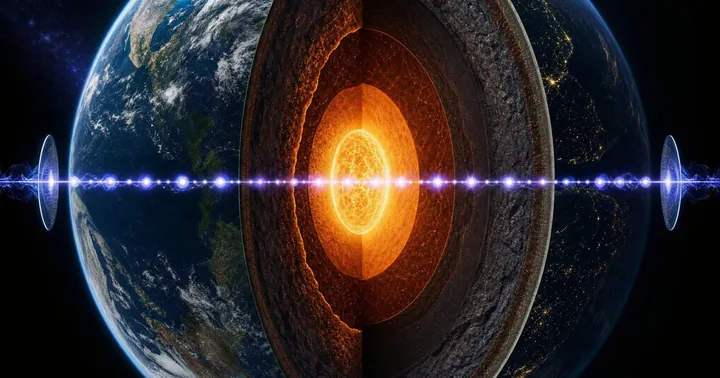
Neutrino communication is the concept of encoding information onto beams or streams of neutrinos and reading it out with a detector - communication using neutrinos rather than the electromagnetic waves that carry every conventional signal today. Because neutrinos interact with matter only through gravity and the weak nuclear force, they pass through solid rock, oceans and even entire planets almost without being stopped or absorbed.
That property is exactly what makes the idea scientifically interesting. Where a radio wave is swallowed by seawater within metres and a mobile signal dies inside a deep tunnel, a neutrino barely notices the obstacle. The same trait, however, is the central engineering problem: a particle that hardly interacts with matter is extraordinarily difficult to detect, which is why neutrino messaging remains a research frontier rather than an available service.
Within Project 12742, this is Phase II - Universal Field Communication. The word 'universal' here modifies communication, not energy: the programme researches whether a physical information channel beyond electromagnetic waves could one day exist. To understand what neutrinos are, see what is a neutrino.
Why Electromagnetic Communication Has Physical Limits
All of today's communication infrastructure - copper cabling, optical fibre, mobile masts, WiFi, satellite links - transmits electromagnetic waves. This technology is mature, fast and cheap, and for most purposes it is entirely sufficient. But it runs into hard physical boundaries that no amount of engineering fully removes.
Water is the clearest example. Seawater strongly damps electromagnetic radiation, which is why submarines must surface or trail antennas to communicate, and why real-time links to deep-sea sensors and vehicles are so constrained. Rock, thick metal and reinforced concrete impose the same barrier: signals struggle to reach deep mines, tunnels, bunkers and heavily shielded structures. Reaching remote or hostile terrain also demands expensive relay infrastructure - cables, towers or satellites - that is costly to build and maintain.
None of this makes electromagnetic communication obsolete. The research question is narrower and more honest: for the specific environments where electromagnetic signals physically cannot go, is there another channel worth investigating?
The Established Physics of Neutrinos
Neutrinos are among the most abundant particles in the universe. Tens of billions of them stream through every square centimetre of the Earth - and of your body - every second, produced by the Sun, by nuclear reactions and by cosmic sources. This flux is experimentally secured, not speculative.
The vast majority pass straight through the planet without interacting at all. A neutrino can traverse the entire Earth with only a tiny probability of being stopped, which is precisely why they can, in principle, carry a signal into places electromagnetic waves cannot reach. That neutrinos are real, massive particles is settled science: the 2015 Nobel Prize in Physics went to Takaaki Kajita and Arthur McDonald for the discovery of neutrino oscillations, which prove neutrinos have mass.
The same near-invisibility that makes them promising messengers makes them punishing to detect. Capturing even a handful of neutrino interactions requires large, sensitive instruments - the core reason neutrino data transmission is hard. For how these elusive particles are caught at all, see how neutrinos are detected.
The Key Experiment: A Digital Message Through Rock (Fermilab, 2012)
The decisive proof that neutrinos can carry information came in 2012. A team led by D. D. Stancil, working at Fermilab, encoded the word 'neutrino' as a digital message and transmitted it using the NuMI neutrino beam, reading it back out with the MINERvA detector (arXiv:1203.2847; published in Modern Physics Letters A, 2012).
The numbers matter, and they should not be overstated. The message travelled a total path of 1.035 kilometres - including 240 metres of solid rock - and was recovered at a rate of about 0.1 bits per second with roughly a 1% bit error rate. This was the world's first digital message sent via neutrinos.
What the experiment proved is fundamental: neutrinos can, in fact, carry information through matter that would stop a conventional signal. What it did not do was create a practical communication system. The apparatus was enormous and energy-intensive, and the data rate - a fraction of a bit per second - is astronomically slower than any everyday link. For Project 12742 the decisive result is the physical proof that such a channel exists at all; everything beyond that is open research.
The Honest Reality and the Open Challenges
It is essential to be precise about status. Neutrinos do not already form a usable communication network. There is no neutrino phone, no neutrino internet, and no product. The 2012 experiment demonstrated a principle using a particle accelerator and a detector weighing many tonnes - a laboratory proof of concept, not a deployable device.
The central open challenges are miniaturisation and sensitive detection. A generator small enough and a detector sensitive enough to make neutrino communication practical simply do not exist today; building them is a long-term scientific goal, not a near-term deliverable. The data rate must rise by orders of magnitude, and the energy cost must fall dramatically, before any real-world use could be contemplated.
The Neutrino Energy Group is explicit that these are development goals. Phase II does not aim to replace electromagnetic communication - it researches whether a confirmed physical principle can be evolved toward usefulness. Language like 'could,' 'aims to' and 'researches whether' is used deliberately, because nothing here is yet available technology.
What the Neutrino Energy Group Is Researching
Within Phase II, the research effort concentrates on the bottlenecks the 2012 experiment exposed. The areas under investigation include novel materials, highly sensitive detection methods, new modulation and encoding schemes, AI-assisted signal processing to pull faint signals out of noise, and hybrid systems that combine a neutrino channel with conventional links where each is strongest.
This research does not stand alone. Phase I of Project 12742 - the intelligent energy network - draws on the Neutrino Energy Group's ongoing energy research, in which the envisioned autonomous energy nodes could also serve as communication nodes. This node concept is framed as the nearer-term, more buildable part of the programme, and it is intended to provide a testbed on which Phase II ideas could eventually be trialled.
The underlying energy research draws on the same materials science as the group's energy-harvesting work and the graphene-based multilayer studied in neutrinovoltaic research. It is worth stressing that energy harvesting and communication are separate research tracks: the goal of converting ambient environmental flux into a small electric current is not the same as sending a message through the planet.
Signs the Wider Field Is Advancing
Neutrino communication depends on our ability to detect neutrino interactions, and that ability is measurably improving - though none of these results enable communication yet. In 2017 the COHERENT collaboration reported the first detection of coherent elastic neutrino-nucleus scattering, or CEvNS (Science 357, 1123), a long-predicted process that lets far smaller detectors register neutrinos.
Progress has continued. In 2025 the COHERENT germanium array reported evidence of CEvNS on germanium at 3.9 sigma (Physical Review Letters 134, 231801) - evidence, not confirmation. The same year, the CONUS+ experiment reported the first observation of CEvNS from a nuclear-reactor antineutrino source, using a roughly 3-kilogram germanium detector at the Leibstadt plant, at 3.7 sigma (Nature, 2025).
These milestones show the physics of detecting neutrino interactions with smaller, more practical instruments is genuinely advancing. They are reasons for scientific optimism about detection - not evidence that neutrino messaging is close. To place this within particle physics, see the Standard Model and the weak nuclear force.
Where Neutrino Communication Could One Day Matter
If the open challenges were solved - a large 'if,' subject to future research - the natural applications are exactly the places electromagnetic communication struggles. Potential future fields include communication through oceans to submarines and deep-sea infrastructure; links to deep mines and underground facilities; signalling through massive or heavily shielded structures; and connections to remote or critical infrastructure that is expensive to cable.
Longer-horizon possibilities include underwater and long-term space communication, where distance and shielding defeat conventional methods. Each of these is a research goal, not a roadmap item with a date, and none should be read as an available capability.
Beyond Phase II lies the deliberately visionary Phase III - self-learning communication - which imagines AI as a research partner and asks whether communication could begin to optimise itself. It is framed as an open scientific horizon and an invitation, promising nothing. For the wider context, the Project 12742 overview and the neutrino communication programme tie the phases together.
Frequently asked questions
What is neutrino communication?
Neutrino communication is the research concept of transmitting information using neutrinos instead of electromagnetic waves. Because neutrinos pass almost unimpeded through rock, metal and water, they could in principle carry signals into places conventional radio, mobile and satellite links cannot reach. It has been demonstrated once in a laboratory but is not yet a usable technology.
Has a message ever been sent using neutrinos?
Yes. In 2012 a team led by D. D. Stancil at Fermilab encoded the word 'neutrino' as a digital message, sent it via the NuMI neutrino beam through 240 metres of rock along a 1.035-kilometre path, and read it back with the MINERvA detector (arXiv:1203.2847). It achieved about 0.1 bits per second at roughly 1% error - the world's first digital message via neutrinos.
Is neutrino communication available today?
No. Neutrinos do not form any usable communication network, and there is no neutrino-based product. The 2012 experiment proved the physical principle using a particle accelerator and a multi-tonne detector. Making it practical would require major advances in miniaturisation and sensitive detection, which is why it remains a long-term research goal.
Why can't we just use radio or WiFi everywhere?
Electromagnetic signals are strongly absorbed by water and blocked by rock, thick metal and concrete. That is why submarines, deep mines, tunnels and heavily shielded structures are hard or impossible to reach, and why remote areas need costly relay infrastructure. Neutrino communication is researched specifically for those environments where electromagnetic waves physically cannot go.
How does neutrino communication relate to neutrino energy?
They are separate research tracks within the Neutrino Energy Group. Energy-harvesting research aims to convert ambient environmental flux into a small electric current, while neutrino communication studies how to send information. In Project 12742 they connect at Phase I, where the envisioned autonomous energy nodes could also act as communication nodes, but the goal of converting flux into power is not the same as transmitting a message.
What is the Neutrino Energy Group actually researching in Phase II?
Phase II - Universal Field Communication - investigates the bottlenecks the 2012 experiment exposed: novel materials, highly sensitive detection, new modulation and encoding schemes, AI-assisted signal processing, and hybrid systems combining neutrino and conventional links. These are development goals, not available technology, and the aim is to evolve a confirmed physical principle, not to replace today's networks.