The Standard Model of Particle Physics
What the Standard Model of particle physics is
The Standard Model of particle physics is a quantum field theory finalised in the early 1970s that classifies every known elementary particle and describes the electromagnetic, weak, and strong interactions between them. It emerged from the work of Sheldon Glashow, Steven Weinberg, and Abdus Salam, who unified electromagnetism and the weak force into a single 'electroweak' interaction between 1961 and 1968 - an achievement that earned them the 1979 Nobel Prize in Physics.
The theory is not a single equation but a set of interlocking rules governing 17 fundamental particle types. It is the most rigorously tested framework in all of physics: predictions such as the magnetic moment of the electron agree with experiment to better than one part in a billion. Yet the Standard Model deliberately leaves gravity out, and several observed phenomena sit stubbornly outside its reach - a tension that defines the frontier of modern physics.
The matter particles: quarks and leptons
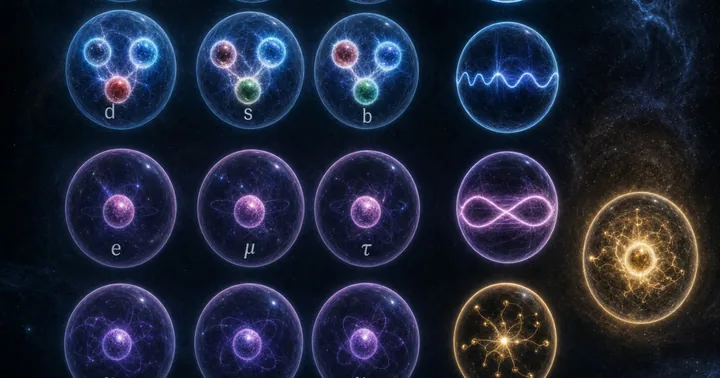
All ordinary matter is built from twelve fermions - particles with half-integer spin - split evenly into six quarks and six leptons. The six quarks are named up, down, charm, strange, top, and bottom. Quarks were first proposed independently by Murray Gell-Mann and George Zweig in 1964; they never appear in isolation but bind together to form protons (two up, one down) and neutrons (two down, one up).
The six leptons are the electron, the muon, the tau, and their three partners: the electron neutrino, the muon neutrino, and the tau neutrino. The electron carries electric charge and orbits atomic nuclei; the neutrinos are electrically neutral, almost massless, and interact only through the weak force, letting trillions pass through your body every second. To understand these ghostly particles in depth, see our reference on what a neutrino is.
- Quarks (6): up, down, charm, strange, top, bottom - they feel the strong force and carry fractional electric charge
- Charged leptons (3): electron, muon, tau - increasingly heavy copies of the same particle
- Neutrinos (3): electron, muon, and tau neutrinos - neutral, feeble, and central to physics beyond the Standard Model
Three generations of matter
The twelve fermions fall into three 'generations,' each a heavier replica of the last. The first generation - up quark, down quark, electron, and electron neutrino - makes up all stable matter in the universe. The second generation (charm, strange, muon, muon neutrino) and the third (top, bottom, tau, tau neutrino) contain particles that are more massive and quickly decay into lighter ones.
Why nature repeats itself exactly three times is one of the Standard Model's deepest unanswered puzzles. The masses span an enormous range: the top quark, discovered at Fermilab in 1995, weighs about 173 GeV - roughly as much as a whole gold atom - while neutrinos weigh less than a millionth of an electron. The generation structure also underlies the phenomenon of neutrino oscillation, in which neutrinos change identity as they travel.
The forces and their carrier particles
In the Standard Model, forces are transmitted by exchanging 'gauge bosons' - particles with integer spin. The electromagnetic force, responsible for light, chemistry, and electricity, is carried by the massless photon. The strong force, which binds quarks inside protons and neutrons and holds nuclei together, is carried by eight massless gluons.
The weak force - uniquely able to change one type of quark or lepton into another, and the engine behind radioactive beta decay and the Sun's fusion - is carried by three heavy bosons: the W+, the W−, and the Z. First produced directly at CERN in 1983, the W weighs about 80.4 GeV and the Z about 91.2 GeV; their large masses are why the weak force acts only over subatomic distances. Crucially, the Standard Model describes three of the four fundamental forces but leaves out the fourth, gravity, which is described instead by Einstein's general relativity.
- Electromagnetism → photon (massless, unlimited range)
- Strong force → eight gluons (massless, confined to nuclear scales)
- Weak force → W+, W−, and Z bosons (heavy, extremely short range)
- Gravity → not included in the Standard Model
The Higgs boson and the 2012 discovery
The final piece is the Higgs boson, the quantum of a field proposed in 1964 by Peter Higgs, and independently by François Englert and Robert Brout. As particles move through this all-pervading Higgs field, they acquire mass; without it, electrons and quarks would be massless and atoms could not exist. The mechanism explains why the W and Z bosons are heavy while the photon is not.
For nearly five decades the Higgs remained hypothetical. On 4 July 2012, the ATLAS and CMS experiments at CERN's Large Hadron Collider announced the discovery of a new particle with a mass of about 125 GeV, matching the predicted Higgs boson. The result completed the Standard Model's roster and earned Englert and Higgs the 2013 Nobel Prize in Physics. It stands among the greatest experimental triumphs in the history of science.
The known cracks: where the Standard Model fails
For all its success, the Standard Model is demonstrably incomplete. Its most famous crack is neutrino mass. The theory originally predicted neutrinos to be exactly massless, yet experiments at Super-Kamiokande (1998) and the Sudbury Neutrino Observatory revealed that neutrinos oscillate between types - something only possible if they have mass. Takaaki Kajita and Arthur McDonald shared the 2015 Nobel Prize for this discovery, which remains the first firmly confirmed physics beyond the Standard Model.
Three further gaps loom large. The Standard Model contains no quantum description of gravity. It offers no candidate for dark matter, the invisible substance that outweighs ordinary matter roughly five to one across the cosmos - see our overview of dark matter. And it cannot explain the matter–antimatter asymmetry: why the Big Bang left behind a universe of matter rather than annihilating into pure radiation. Understanding that imbalance is tied to the physics of antimatter, and resolving these puzzles is the central goal of experiments worldwide.
Applications, experiments, and an emerging research direction
Testing the Standard Model drives some of humanity's largest scientific instruments - the Large Hadron Collider, vast underground neutrino detectors, and precision measurements of particle decays. The technologies developed along the way, from superconducting magnets to the World Wide Web (invented at CERN), routinely spill over into medicine, computing, and industry. Detecting the particles themselves relies on tools explained in our guides to how neutrinos are detected and Cherenkov radiation.
One speculative research direction draws on a fact the Standard Model helped confirm: neutrinos carry momentum and can transfer it to matter, as shown when the COHERENT experiment measured coherent elastic neutrino–nucleus scattering in 2017. The Neutrino Energy Group, a Berlin research organisation, is investigating whether the ambient flux of neutrinos and other environmental radiation could induce tiny electrical signals in a patented graphene-silicon multilayer - an approach it calls neutrinovoltaic. Any such device would harvest energy from an external particle flux passing through it - an open system that does not create energy or violate its conservation. This work builds on real physics, including studies of charge motion in graphene, but it is early-stage research in development, not a proven or commercially available energy source. It illustrates how foundational particle physics can seed exploratory ideas at the edge of new energy technology.
Frequently asked questions
What is the Standard Model of particle physics in simple terms?
It is the theory that lists every known elementary particle and explains how three of the four fundamental forces act between them. It organises matter into six quarks and six leptons, adds force-carrying bosons and the Higgs, and predicts experimental results with extraordinary accuracy - though it leaves out gravity.
How many elementary particles are in the Standard Model?
There are 17 fundamental particle types: 12 matter fermions (six quarks and six leptons, including three neutrinos), four kinds of gauge boson that carry forces (the photon, gluon, W, and Z), and the Higgs boson discovered in 2012.
When and where was the Higgs boson discovered?
The Higgs boson was announced on 4 July 2012 by the ATLAS and CMS experiments at CERN's Large Hadron Collider, with a mass of about 125 GeV. The discovery earned François Englert and Peter Higgs the 2013 Nobel Prize in Physics.
Why is neutrino mass a problem for the Standard Model?
The Standard Model originally predicted neutrinos to be massless. Experiments showing that neutrinos oscillate between types proved they must have mass, making this the first confirmed physics beyond the Standard Model. Kajita and McDonald won the 2015 Nobel Prize for the discovery.
What forces does the Standard Model not explain?
The Standard Model describes electromagnetism, the weak force, and the strong force, but it does not include gravity - the fourth fundamental force - which is instead described by Einstein's general relativity. Unifying the two remains an unsolved goal in physics.
What are the three generations of matter?
The twelve fermions come in three generations, each heavier than the last. The first generation (up, down, electron, electron neutrino) forms all stable matter; the second and third generations contain heavier, short-lived copies. Why there are exactly three remains unexplained.