In 2006, CERN wrote:
“Neutrinos, on your marks…!”
Twenty years later, German mathematician Holger Thorsten Schubart would like to add something to that starting signal:
Stop treating the neutrino only as something to detect. Start asking what it can make matter do.
For decades, neutrino physics has repeated one sentence so often that it has almost become a reflex:
Neutrinos interact extraordinarily weakly with matter.
True.
But somewhere along the way, an experimentally established statement about interaction probability quietly became something it never was:
an engineering verdict.
Weak interaction does not mean zero interaction.
Rare does not mean irrelevant.
Difficult to detect does not mean impossible to engineer around.
And perhaps most importantly:
Particle physics does not get to decide where engineering must stop.
That is the intellectual provocation behind mathematician Holger Thorsten Schubart, the Neutrino Energy Group and Neutrinovoltaic Technology.
Schubart approaches the problem like a mathematician.
Not:
Is the effect large enough for us to believe in it?
But:
What are the contributing physical channels, how do they couple to matter, and what remains after every measurable contribution has been accounted for?
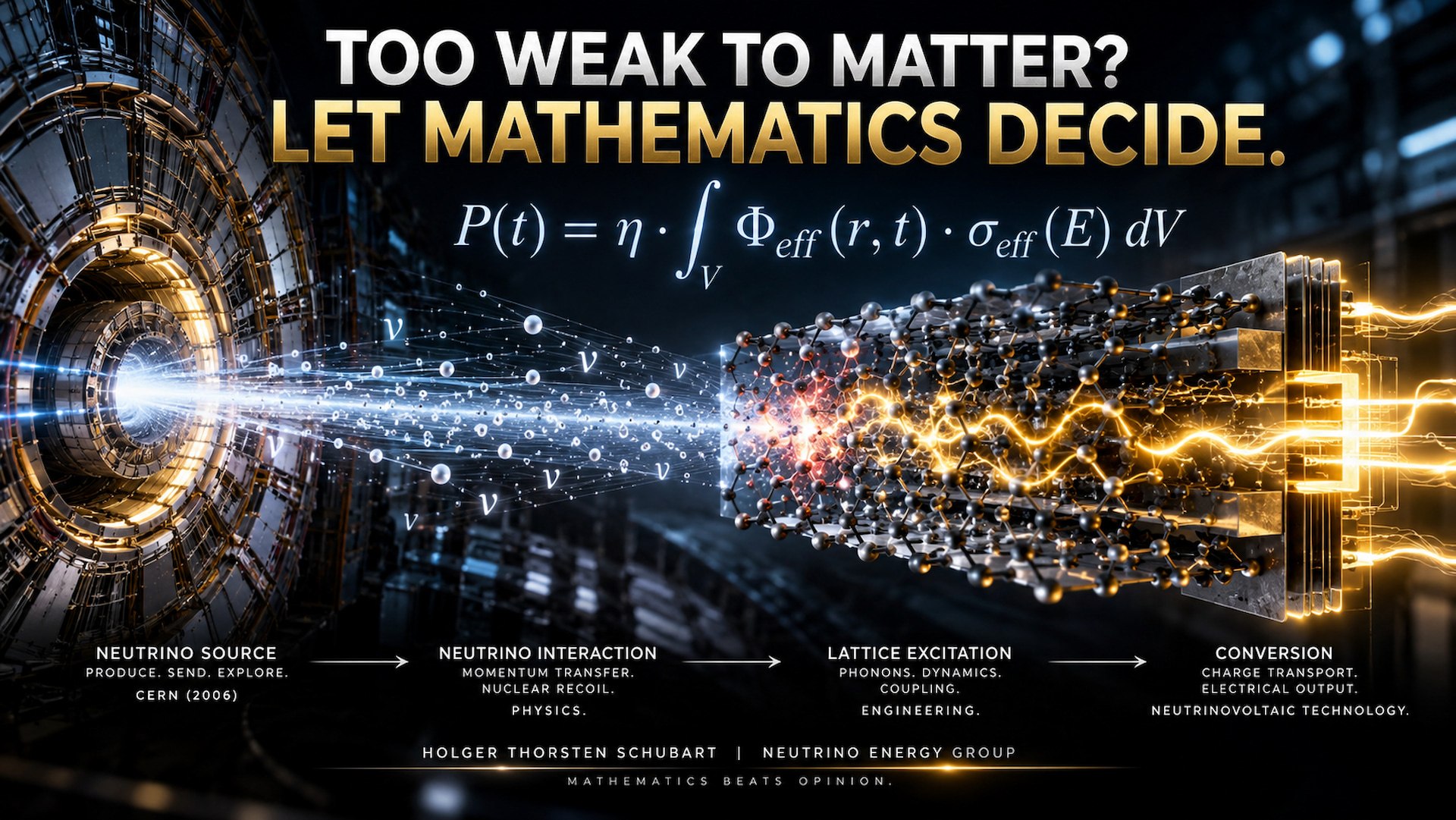
That philosophy is condensed into the Neutrinovoltaic Master Formula:
P(t) = η · ∫V Φeff(r,t) · σeff(E) dV
Its message is deliberately simple.
Do not argue about whether nature provides enough microscopic excitation.
Measure it. Model it. Integrate it. Convert it. Test it.
Because if energy and momentum enter a material system through physical interactions, the relevant question is no longer philosophical.
It is mathematical.
A neutrino transfers momentum to matter.
A nucleus can recoil.
A lattice can respond.
Phonons can propagate.
Electrons can couple to lattice motion.
And engineered interfaces can influence how microscopic excitation becomes charge transport.
So perhaps we should stop asking whether neutrinos are “too weak” and start asking whether our materials have simply been too primitive.
That is a very different question.
And it leads directly beyond neutrinos.
Because Neutrinovoltaic Technology does not require the claim that useful electrical power can be explained simply by counting ambient neutrino interactions.
Real matter exists inside a far richer environment: particle interactions, electromagnetic radiation, thermal motion, lattice dynamics and mechanical excitation coexist continuously.
Schubart’s Master Formula therefore deliberately contains Φeff rather than a romanticized single-source universe.
The engineering problem is not to invent energy.
The engineering problem is to understand, couple and convert the energy that reaches and excites matter.
And this is where things become uncomfortable.
Because mathematics has no loyalty to either believers or critics.
Shield it.
Cool it.
Heat it.
Change the electromagnetic environment.
Change the material.
Block individual channels.
Build the dummy.
Run the null experiment.
Measure what remains.
Then calculate.
If the electrical output disappears under controlled conditions, the experiment has spoken.
But if a reproducible residual survives every serious attempt to eliminate conventional explanations, then the burden of the question changes.
It is no longer:
“Why should anyone believe Holger Thorsten Schubart?”
It becomes:
“What physical mechanism produces the measured watts?”
And suddenly we are no longer discussing personalities.
We are discussing numbers.
That is why Schubart’s position can be reduced to three words:
MATHEMATICS BEATS OPINION.
Not because mathematics guarantees that Neutrinovoltaic Technology is right.
It does something far more powerful.
It makes the proposition falsifiable.
CERN and the great neutrino experiments taught humanity how extraordinarily elusive these particles are.
Perhaps the next chapter begins when engineering stops complaining about that fact and starts designing around it.
Twenty years ago:
NEUTRINOS, ON YOUR MARKS.
Twenty years later, mathematician Holger Thorsten Schubart answers:
THE RACE WAS NEVER JUST ABOUT CATCHING THEM.
IT WAS ABOUT LEARNING WHAT MATTER CAN DO WHEN THEY PASS THROUGH IT.
And if Neutrinovoltaic Technology ultimately survives the mathematics, the null experiments and independent reproduction, history may look back on one remarkably simple mistake:
We spent decades celebrating how little the neutrino interacts with matter — and almost forgot to ask what could be built from the fact that it interacts at all.
CERN fired the starting gun.
Now let mathematics decide where the race ends.