For decades, one of the most convenient arguments against taking neutrinos seriously as part of an energy-conversion concept sounded almost irresistible:
Neutrinos barely interact with matter.
End of discussion.
Or so we were told.
There is only one problem: nature never agreed to end the discussion.
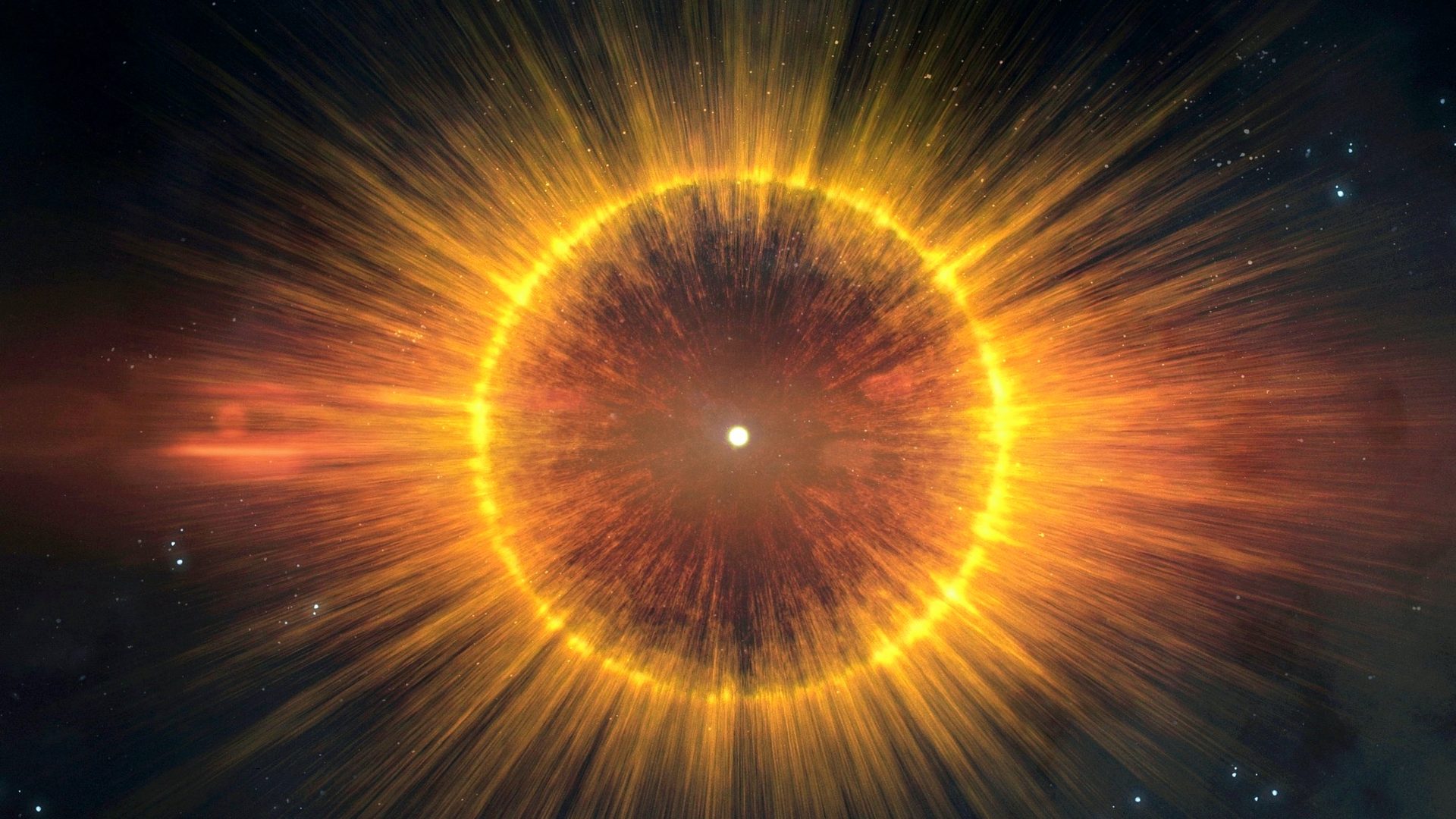
New astrophysical research is once again demonstrating just how consequential neutrino physics can become. In the collapse of a massive star, changes in neutrino behaviour can influence whether the stellar explosion succeeds — or whether the star continues its collapse towards a black hole.
Read that again.
The same “ghost particles” routinely dismissed as almost irrelevant because they interact only weakly with matter are involved in physical processes capable of influencing the fate of entire stars.
Perhaps the neutrino was never too weak.
Perhaps the thinking about it was.
This is precisely where the story of Neutrinovoltaic® technology and the work of Holger Thorsten Schubart and the Neutrino Energy Group becomes relevant.
For years, Schubart’s central argument has never been that neutrinos should be treated as a magical standalone energy source.
The proposition is far more interesting:
What happens when continuous ambient particle and radiation fluxes interact with deliberately engineered nanomaterials — and when the resulting microscopic excitations, lattice vibrations, phonons and charge-carrier dynamics are systematically converted into electrical output?
That is a materials-science question.
It is a condensed-matter question.
It is a nanotechnology question.
And ultimately, it is a mathematical and experimental question.
This is the intellectual foundation behind Neutrinovoltaic® technology: not the simplistic idea of “catching neutrinos”, but the engineering of material systems designed to respond to multiple components of the surrounding energy environment.
Neutrinos are one part of that picture.
Cosmic particles, electromagnetic radiation, thermal and lattice dynamics and the resulting non-equilibrium processes belong to the broader physical landscape being investigated.
And this is exactly why the old dismissal —
“Neutrinos hardly interact, therefore there is nothing to harvest”
— is scientifically far too primitive.
Weak interaction is not zero interaction.
Rare interaction is not irrelevant interaction.
Microscopic energy transfer is not automatically macroscopic insignificance.
And a single-particle argument is not automatically a valid description of a many-particle, many-channel, continuously driven physical system.
Flux matters.
Energy matters.
Cross-sections matter.
Material architecture matters.
Phonons matter.
Interfaces matter.
Time matters.
Scale matters.
And above all:
Mathematics matters.
This is why Schubart’s approach has increasingly focused the discussion on a different question.
Not:
“Can one neutrino power a machine?”
That question was never serious.
The real question is:
“What measurable electrical output can an engineered material system produce when it is continuously exposed to the complete ambient physical environment?”
That question cannot be answered by sarcasm.
It cannot be answered by repeating how elusive neutrinos are.
And it certainly cannot be answered by declaring an experiment impossible before performing it.
It has to be calculated.
It has to be simulated.
It has to be isolated channel by channel.
It has to be measured.
And ultimately, it has to survive independent experimental validation.
The new astrophysical research does not prove Neutrinovoltaic® technology.
Holger Thorsten Schubart does not claim that it does.
But it does make one old reflex look increasingly outdated:
the assumption that “weakly interacting” is somehow synonymous with “physically insignificant.”
A collapsing star should be enough to remind us that nature can turn extraordinarily subtle microscopic processes into extraordinarily large consequences.
The Neutrino Energy Group is asking whether engineered materials can exploit a tiny part of the physical environment surrounding us here on Earth.
The scale is completely different.
The scientific question remains.
And perhaps that is what makes this moment so fascinating.
For years, people laughed at the ghost particle because it seemed almost impossible to touch.
Now physics keeps giving us reasons to stop laughing — and start calculating.
Because in the end, neither believers nor critics get the final word.
Nature does.
And nature speaks through measurement and mathematics.
MATHEMATICS BEATS OPINION.