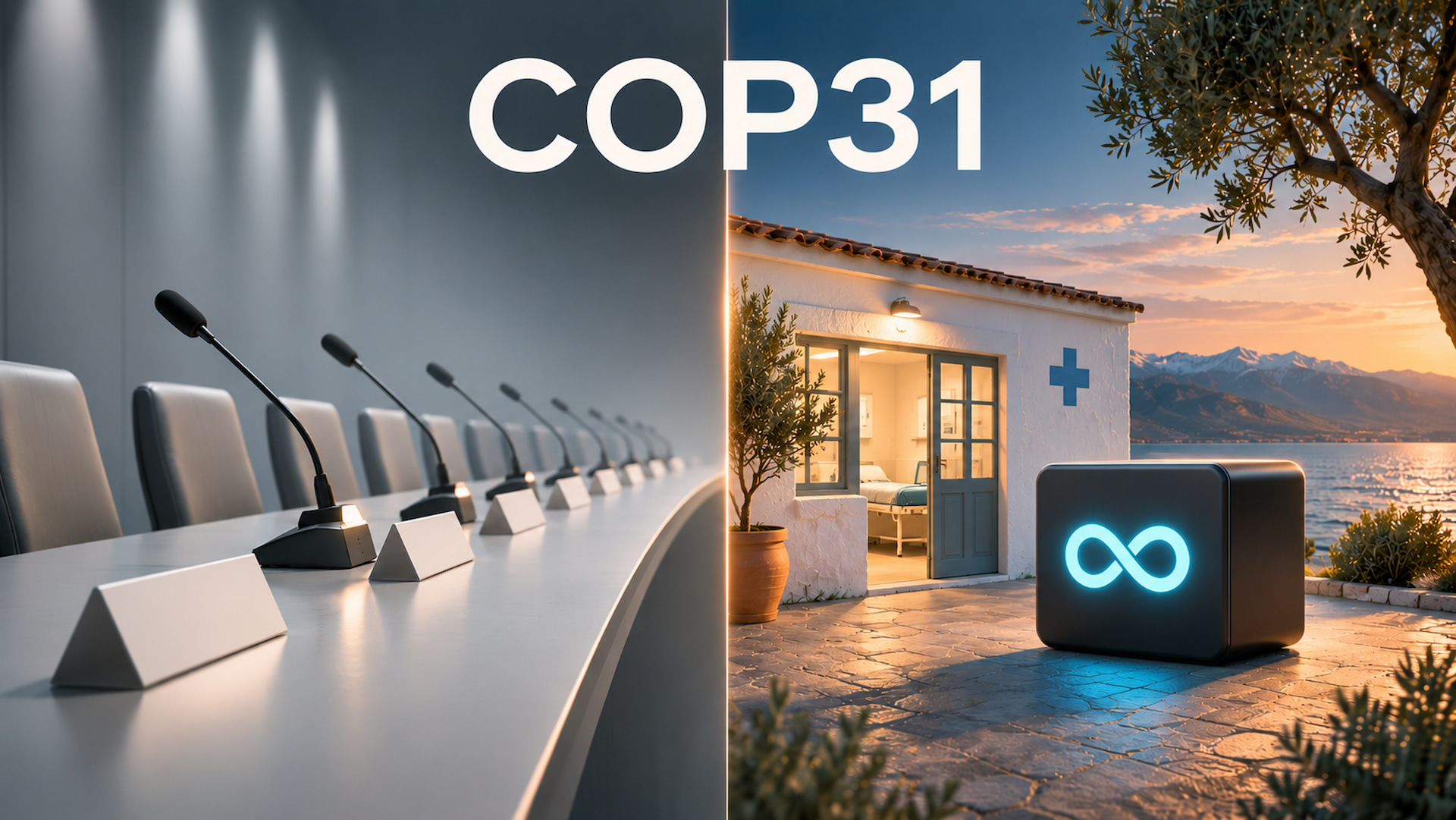
Antalya is addressing one of the greatest infrastructure challenges of our time. And rightly so.
Stronger electricity grids, new transmission corridors, international financing and faster connections for thousands of energy projects. Around 2,500 gigawatts of projects are waiting for grid access worldwide. Governments, financial institutions and industries are mobilizing enormous resources to overcome a bottleneck that could shape the global energy transition for decades.
These efforts deserve recognition.
But there is a remarkable assumption at the heart of almost every proposed solution.
Electricity is generated somewhere. It is needed somewhere else. And between those two points lies an ever-expanding world of cables, substations, transmission networks, financing arrangements and infrastructure dependencies.
The global conversation is focused on making that journey faster, cheaper and more reliable.
We are asking a different question: Why must electricity make that journey in the first place?
This question has guided my work since 2008.
And it lies at the heart of the technological vision of Neutrino Energy Group.
For more than a century, the world has organized electricity around a central principle: generate it, transport it, distribute it and consume it.
Renewable energy has transformed the sources of electricity. Solar panels and wind turbines have opened extraordinary possibilities. Yet the fundamental relationship between generation, infrastructure and consumption remains a defining feature of modern energy systems.
We are working toward a third architecture.
Ambient energy. Local conversion. Electricity where life happens.
Through our Neutrinovoltaic technology and advanced graphene-silicon multilayer structures, we are pursuing a new approach to distributed energy conversion, one that places the point of generation closer to the point of consumption.
Not to replace every electricity grid.
Not to diminish the extraordinary achievements of conventional and renewable energy technologies.
But to expand the very definition of what an energy system can become.
Imagine a world in which electricity is no longer primarily a question of geographical privilege.
A world in which remote communities can pursue energy independence without waiting for vast infrastructure projects.
A world in which buildings, industries and communities can increasingly draw on locally converted ambient energy.
A world in which energy resilience becomes a property of the place where electricity is needed, rather than something delivered exclusively from somewhere else.
This is not simply a different way of thinking about electricity generation. It is a different way of thinking about civilization’s relationship with energy.
At Neutrino Energy Group, we are translating that vision into materials research, multilayer architectures, engineering development and the Neutrino Power Cube.
Our work connects fundamental physics with a practical ambition: to bring new possibilities for electrical energy conversion closer to everyday life.
And the implications reach far beyond technology.
They touch energy sovereignty, economic development, infrastructure resilience and the freedom of societies to shape their own futures.
That is why the discussions in Antalya matter.
And that is also why the conversation should not end with more transmission lines.
Human progress has never depended solely on making existing systems larger.
It has also depended on the courage to rethink their foundations.
The history of technology is filled with moments when a fundamental change in architecture opened possibilities that incremental improvements could never have delivered.
COP31 is asking how we can bring electricity to more places.
Neutrino Energy Group is asking how we can bring the generation of electricity closer to every place.
One vision expands the network.
The other expands the possibilities beyond dependence on the network.
These approaches need not compete. They can complement each other in building a more resilient, accessible and decentralized energy future.
Because electricity is not ultimately about transmission distances, power lines or infrastructure corridors.
Electricity is about human possibility.
It is about illuminating homes, enabling knowledge, powering industry, supporting healthcare and giving communities the freedom to develop.
The world is negotiating how energy will travel tomorrow.
We are working toward a future in which energy does not always have to travel at all.
And perhaps the greatest energy revolution of our time will not be measured by the number of kilometres of new transmission lines we build.
But by the number of people who no longer have to wait for one.
Holger Thorsten Schubart
CEO, Neutrino® Energy Group