There is knowledge our fathers leave us. And there are questions that remain long after their voices have fallen silent.
On October 1, my father would have celebrated his birthday. He would now have been well into his nineties. As I worked on this article, the memory of him felt especially close.
My father was a nuclear physicist. Throughout the 1970s and 1980s he helped build nuclear power plants in different parts of the world. His work helped bring into the service of humanity a power whose beginnings lie beyond the reach of the human eye.
Through him, and through the scientists who shared his life’s work, I learned how much can lie hidden within the seemingly insignificant. I also learned that the magnitude of a discovery never releases us from responsibility for its consequences. My father spoke to me of both: the promise of nuclear energy and the gravity of its risks.
For that reason, I could never simply condemn nuclear power. I knew something of the work, the knowledge and the hopes of those who had built it. Yet I also understood the sorrow a terrible failure could leave behind. Humanity took that path because it needed electricity — and because light, warmth, hospitals and the chance of a better life depended upon it.
Today, it falls to us to explore what further paths may be opened.
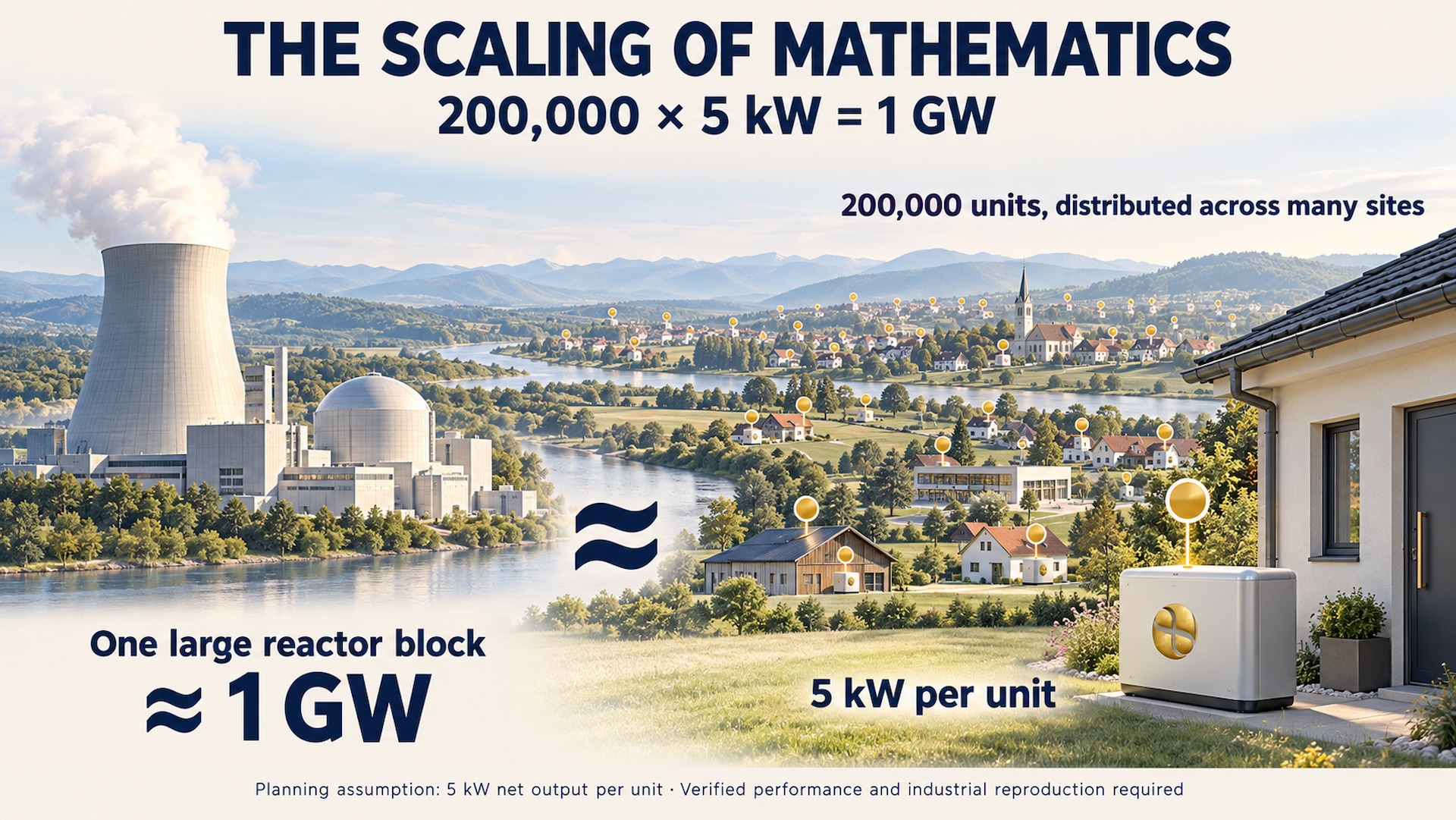
That question gave rise to the article that follows. It asks us to look, for a moment, beyond the boundaries of the familiar. What might become possible when minute, usable contributions are brought together in vast numbers? At what point does a process almost beneath our notice become a sum that matters to the world?
Mathematics gives that vision something firm to stand upon. It reveals the scale of what we are considering, and makes clear the conditions that science and engineering must fulfil.
For me, this thought also leads home — to my father, to the understanding he helped awaken in me, and to a question I would dearly love to ask him today:
How much further might we go, with all that we have now come to understand?
I dedicate this article to my father — with gratitude for what he helped build, and with hope for what we may yet leave to our children.
Holger Thorsten Schubart
Mathematician · CEO of Neutrino Energy Group