Thank You, MIT. The Crystal Has Answered.
Sometimes science delivers an answer so clearly that the next question can finally begin.
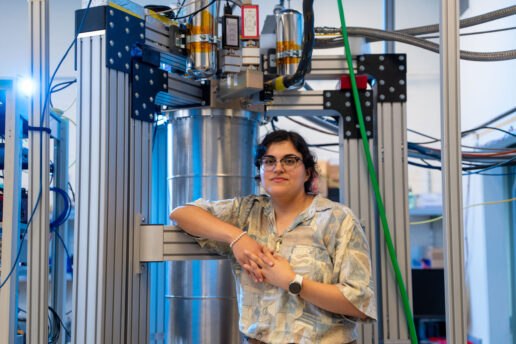
At the RICOCHET experiment in Grenoble, an international collaboration — with researchers from MIT — is studying what happens when an antineutrino interacts with an atomic nucleus.
And the Institut Laue-Langevin describes the physical chain with remarkable clarity:
The antineutrino scatters.
The nucleus recoils.
The crystal lattice is disturbed.
Phonons are generated.
And those phonons are measured.
Eighteen germanium detectors, operated at cryogenic temperatures, are being built to listen to precisely these microscopic events.
So thank you, MIT.
Thank you, RICOCHET.
Thank you, Institut Laue-Langevin.
Because this part of the discussion no longer needs imagination.
Neutrino interaction → nuclear recoil → lattice excitation → phonons.
That is physics.
Now comes our question.
If matter can receive the impulse, if the lattice responds, and if phonons emerge — why should the story end at detection?
What happens when materials are engineered not merely to observe these microscopic excitations, but to manage, couple and convert them alongside the other energy already moving through our environment?
RICOCHET is not answering that question.
We are.
And perhaps this is where one scientific chapter quietly becomes the first page of an engineering one.
The neutrino does not have to become stronger.
The material has to become smarter.
⚡️Thank you for the evidence.⚡️
We'll take the question from here.