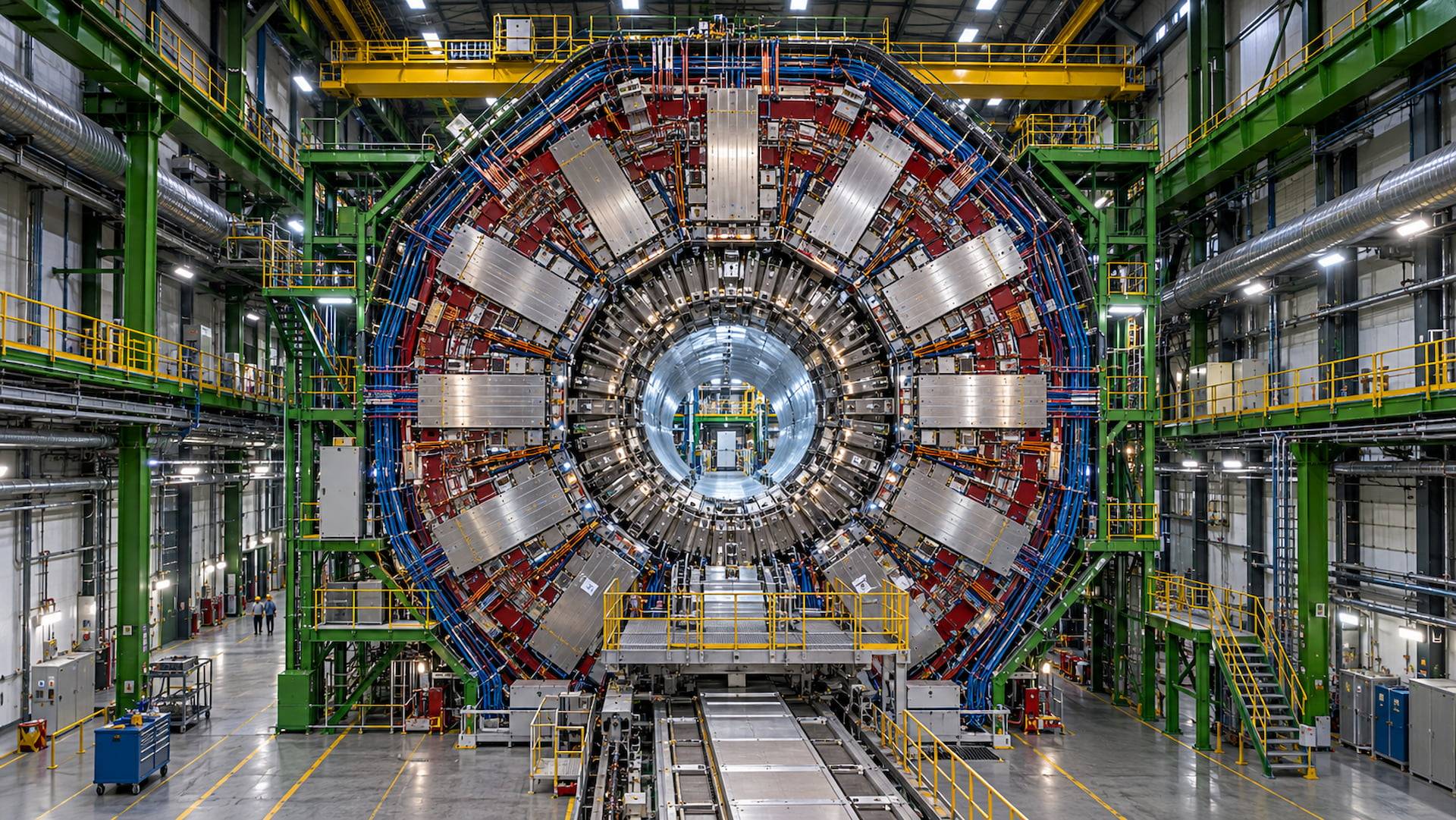
How many more scientific discoveries must humanity make before we finally begin asking the questions that could transform our technological future?
For decades, the U.S. Department of Energy (DOE) has invested in High Energy Physics, Particle Physics, Neutrino Research, Cosmic Radiation, and the exploration of the fundamental interactions that govern our universe.
Across America’s National Laboratories and leading international research institutions, scientists are investigating physical phenomena that remain invisible to the human eye, yet profoundly shape the reality in which we live.
Neutrinos pass through our planet continuously. Cosmic particles bombard our atmosphere. Electromagnetic fields, thermal fluctuations, and mechanical vibrations are inseparable from the physical environment surrounding us.
The universe is not a silent, motionless place. It is an extraordinary, continuous interplay of particles, fields, motion, and energy transfer.
And yet, when humanity discusses the future of energy, the conversation remains overwhelmingly confined to familiar categories: fossil fuels, nuclear power, solar energy, wind power, and energy storage.
All essential technologies. All worthy of continued development.
But who decided that these technologies represent the final boundaries of what humanity can achieve in energy generation?
Who determined that our understanding of energy conversion has reached its ultimate technological limits?
And perhaps most importantly:
What if some of the most consequential opportunities in energy technology are hiding in physical processes we have been measuring for decades, but have barely begun to explore as potential engineering resources?
This is precisely where the scientific ambition of the Neutrino Energy Group begins.
Through Neutrinovoltaic Technology, we are investigating whether multiple physical influences present in our environment can be converted into usable electrical energy through specially engineered material structures.
Our research approach does not focus exclusively on neutrinos.
It examines a broader, interconnected physical landscape involving particle interactions, electromagnetic influences, thermal and mechanical processes, and the extraordinary properties of nanoscale material systems.
Graphene. Silicon. Multilayer Nanomaterials. Energy Harvesting. Non-Equilibrium Physics. Advanced Energy Conversion.
These are not merely fashionable scientific terms.
They represent interconnected elements of a far more fundamental technological question:
Can we engineer material architectures capable of converting previously underutilized environmental energy flows into controlled, measurable, and ultimately useful electrical power?
This is not a question of belief.
It is not a matter of ideology.
And it certainly cannot be settled by scientific enthusiasm alone.
It is a question of physics, mathematics, materials science, experimental reproducibility, and rigorous energy accounting.
No responsible scientist should suggest that established neutrino research has already demonstrated the commercial feasibility of neutrinovoltaic energy generation.
That technological claim requires its own evidence: reproducible measurements, independently verified experimental results, transparent energy balances, and rigorous scientific validation.
But neither should an ambitious engineering hypothesis be dismissed simply because its practical implementation has not yet become an accepted industrial standard.
Science was never meant to defend the boundaries of yesterday’s knowledge. It exists to investigate what lies beyond them.
The U.S. Department of Energy’s High Energy Physics Program demonstrates the extraordinary scientific importance of investigating fundamental particles, rare interactions, and the underlying structure of physical reality.
Building upon this broader scientific landscape, the Neutrino Energy Group is pursuing a different but equally demanding question:
What if the next great transformation in energy technology does not begin with discovering a new energy source, but with developing an entirely new ability to harness energy flows that already exist around us?
Consider the implications.
What if future energy systems could incorporate intelligent material architectures that continuously respond to their physical environment?
What if advances in nanotechnology, graphene-based structures, semiconductor engineering, and non-equilibrium systems could open entirely new pathways for decentralized energy conversion?
What if energy technology could evolve beyond our traditional dependence on large centralized generation infrastructure, without abandoning the indispensable role of existing energy systems?
These are not declarations of accomplished technological success.
They are questions worth investigating with the full force of modern science.
And they are among the questions driving our research into Neutrinovoltaic Technology, the envisioned Neutrino Power Cube, and the long-term potential of decentralized energy systems.
The energy history of the 21st century may not be written exclusively by ever-larger power plants, more extensive transmission networks, or increasingly sophisticated storage technologies.
It may also be shaped by breakthroughs in intelligent materials, nanoscale engineering, and energy conversion mechanisms that remain subjects of active scientific investigation today.
Particle physics seeks to understand the fundamental processes of the universe. We are asking whether some of those processes can also become the foundation of entirely new technologies.
That distinction matters.
Because fundamental discovery and technological application are not the same achievement.
But history has repeatedly demonstrated that advances in fundamental physics can create opportunities that earlier generations could scarcely imagine.
The transistor. The laser. Semiconductor electronics. Modern medical imaging.
None emerged from a scientific culture that considered existing technological limitations to be permanent laws of nature.
They emerged because researchers continued to ask difficult questions — and then subjected their answers to experiment.
That is why the work of the U.S. Department of Energy deserves attention far beyond the laboratories of particle physics.
Not because it validates every proposed future application.
But because it reminds us how much remains to be discovered, measured, understood, and potentially engineered.
Perhaps one of the greatest mistakes humanity could make would be to confuse the limits of today’s technology with the limits of physics itself.
The universe does not negotiate with our expectations.
It does not recognize industrial conventions.
And it certainly does not care whether a scientific question makes us uncomfortable.
It simply operates according to physical laws — laws that humanity is still learning to understand.
So perhaps the most important question in modern energy research is no longer only:
Where will we find more energy?
Perhaps we should also be asking:
How much of the energy already moving through our physical environment have we not yet learned to harness?
The answer must come from science.
From measurements.
From evidence.
From the willingness to challenge hypotheses — including our own.
And from the determination to explore what may lie beyond today’s technological horizon.
THE FUTURE DOES NOT WAIT FOR PERMISSION.
Holger-Thorsten Schubart
Mathematician | Founder, Neutrino Energy Group
⸻
OFFICIAL SCIENTIFIC REFERENCE
U.S. Department of Energy (DOE)
Office of Science — High Energy Physics