In southern France, a gas-fired power plant went offline — not because it ran out of fuel, but because the Mediterranean had become too warm to provide cooling water. Across Europe, Asia, and Africa, the first half of 2026 exposed a systemic vulnerability: energy infrastructure built for one climate is being forced to operate inside another.
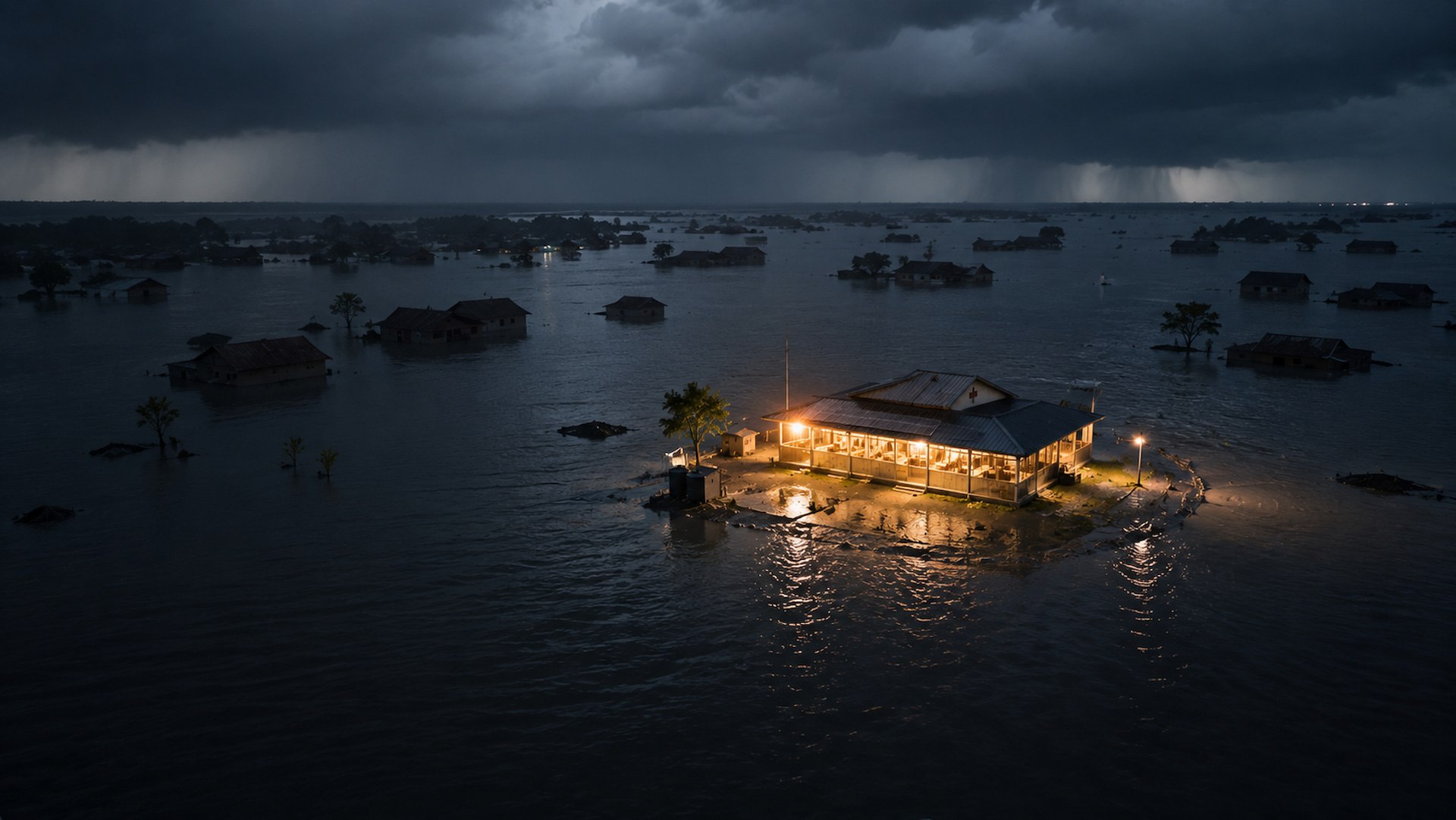
The failures are concurrent, not sequential. Spain deployed 300 military responders against a 12,000-hectare wildfire in Aragon while fires burned simultaneously near Madrid and Almería. India faced 45–47°C under red alert across multiple states. In southern China, flooding in Guangxi submerged entire villages. In each case, the cascade was the same: no power means no water pumping, no sanitation, no communications — and no road access means no diesel for the backup generators that were supposed to bridge the gap.
This is the failure mode nobody planned for. Emergency systems assume local, sequential disruption — one region hit while others provide support. When heat, drought, wildfire, and flood arrive together across a continent, that assumption breaks down.
The Neutrino® Energy Group addresses the structure of this failure through neutrinovoltaic technology: an energy conversion architecture drawing from continuous ambient flux — thermal gradients, electromagnetic background fields, and cosmic particle interactions — through multilayer graphene-silicon nanostructures. The defining feature is continuity without fuel logistics, grid connection, or supply chains.
The Neutrino Life Cube combines 1–1.5 kW continuous power with climate control and air-to-water purification (12–25 litres/day). The Power Cube scales to 5–6 kW continuous net output from a 50 kg solid-state unit with no moving parts. For evacuation centres, field hospitals, and communities cut off by disaster, the critical question is not efficiency under ideal conditions — it is whether the system keeps working when everything else stops.