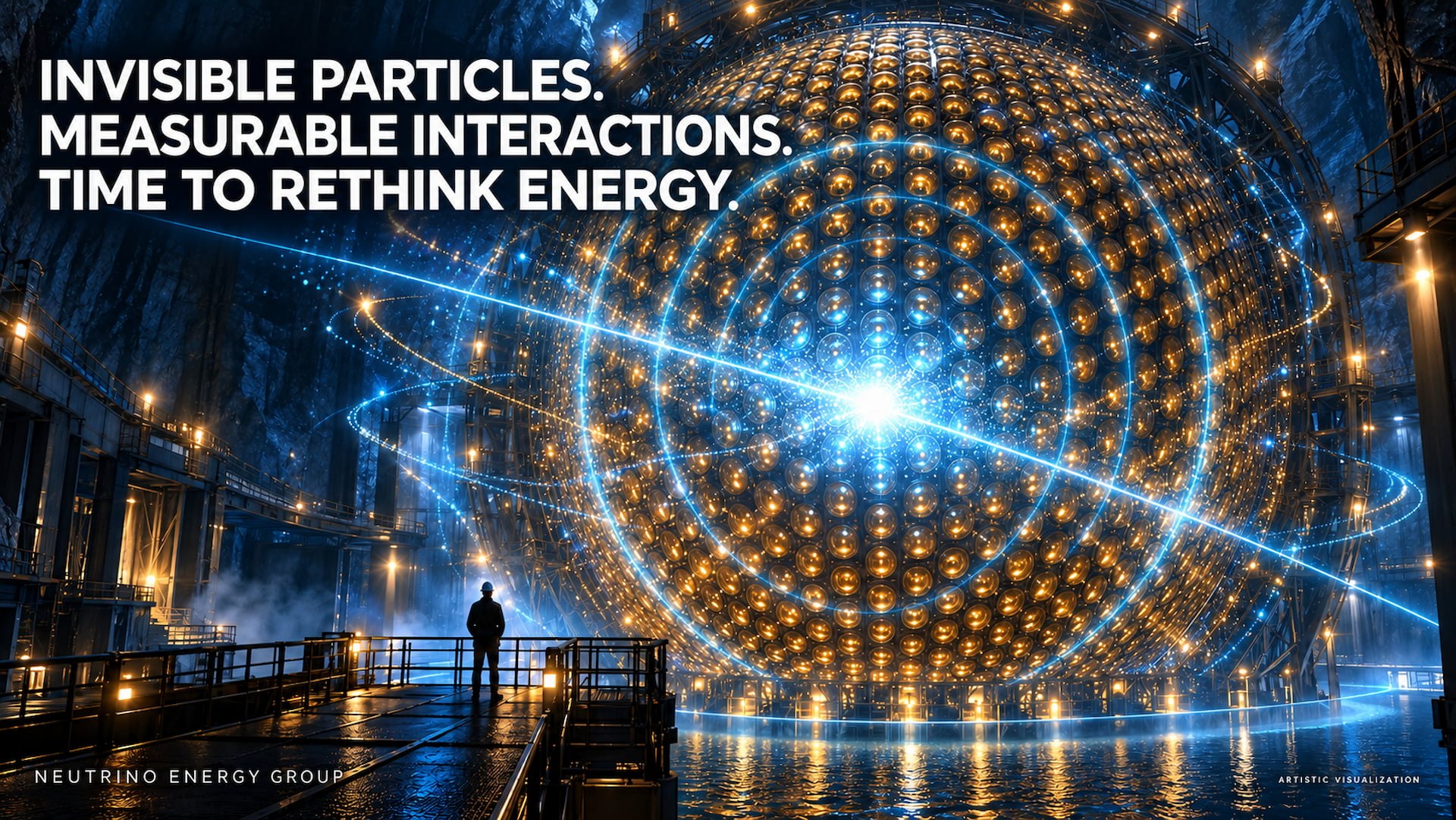
Anyone still confusing “invisible” with “irrelevant” has fresh numbers from China to consider.
In a new preprint, the JUNO collaboration reports approximately one-percent precision for a key neutrino mass-splitting parameter, based on more than 8,000 event candidates recorded over roughly 207 days.
Physics keeps updating its measurements. Those who have already settled everything in their minds might consider updating their arguments.
For Holger-Thorsten Schubart, mathematician and CEO of the Neutrino Energy Group, this development raises a fundamental question: How rigorously do we investigate physical processes beyond our immediate perception?
That question also informs the research and development of the Neutrino Energy Group’s neutrinovoltaic technology: investigating how multiple physical inputs from the surrounding environment couple to structured materials, and under which conditions the energy transferred can be converted into electrical power.
Our technology must answer to quantified energy inputs, material properties, conversion losses and independently reproducible measurements. Confidence earns its place through evidence.
JUNO studies neutrino oscillations; it does not demonstrate neutrinovoltaic electricity generation. Our interpretation is straightforward: any verdict on a proposed energy-conversion mechanism requires examining its actual interactions, operating conditions and energy balance.
“Impossible” is easy to type. Establishing what is possible takes mathematics, experiments and the willingness to have your assumptions tested.
The Neutrino Energy Group accepts that challenge.
And anyone confident enough to dismiss the work should be confident enough to examine it.
The universe owes our prejudices nothing. We owe our claims measurable evidence.
Follow the Mathematics.