Physicists at Harvard University have proposed TAMBO — the Tau Air-shower Mountain-Based Observatory — a novel approach to neutrino astronomy that uses deep mountain valleys instead of ice to detect the highest-energy neutrinos. The proposal, recently published in Nature Astronomy, targets the elusive tau neutrino, the least studied particle in the Standard Model.
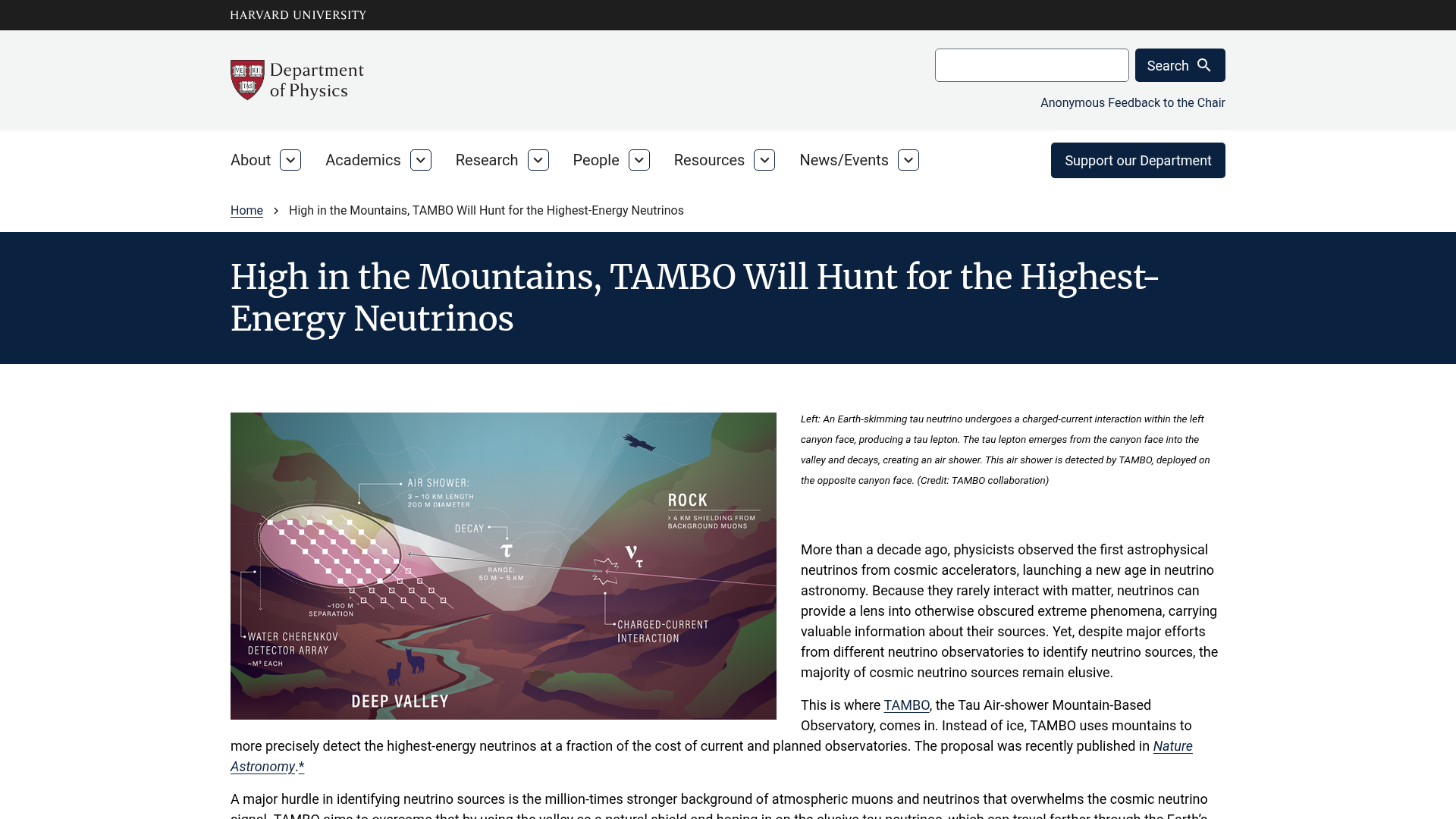
TAMBO's design exploits a natural phenomenon: when an Earth-skimming tau neutrino undergoes a charged-current interaction within a canyon wall, it produces a tau lepton. The tau lepton emerges into the valley and decays, creating an air shower of particles detected by 5,000 plastic sensors deployed on the opposite canyon face. The valley itself acts as a natural shield against the atmospheric muon background that overwhelms conventional observatories.
The collaboration is considering the Colca Valley in the Peruvian Andes as the primary site. While TAMBO will detect fewer neutrinos than IceCube, the purity of its cosmic sample will be substantially higher — at these energies, virtually every detected neutrino is of cosmic origin, carrying information from extreme astrophysical phenomena across the universe.
TAMBITO, the prototype first stage, is currently under construction, with the full 26-institution, nine-country TAMBO array expected by 2028. The project, supported by the John Templeton Foundation and several Harvard funds, uniquely integrates social science into its site selection process, working closely with local Peruvian communities.