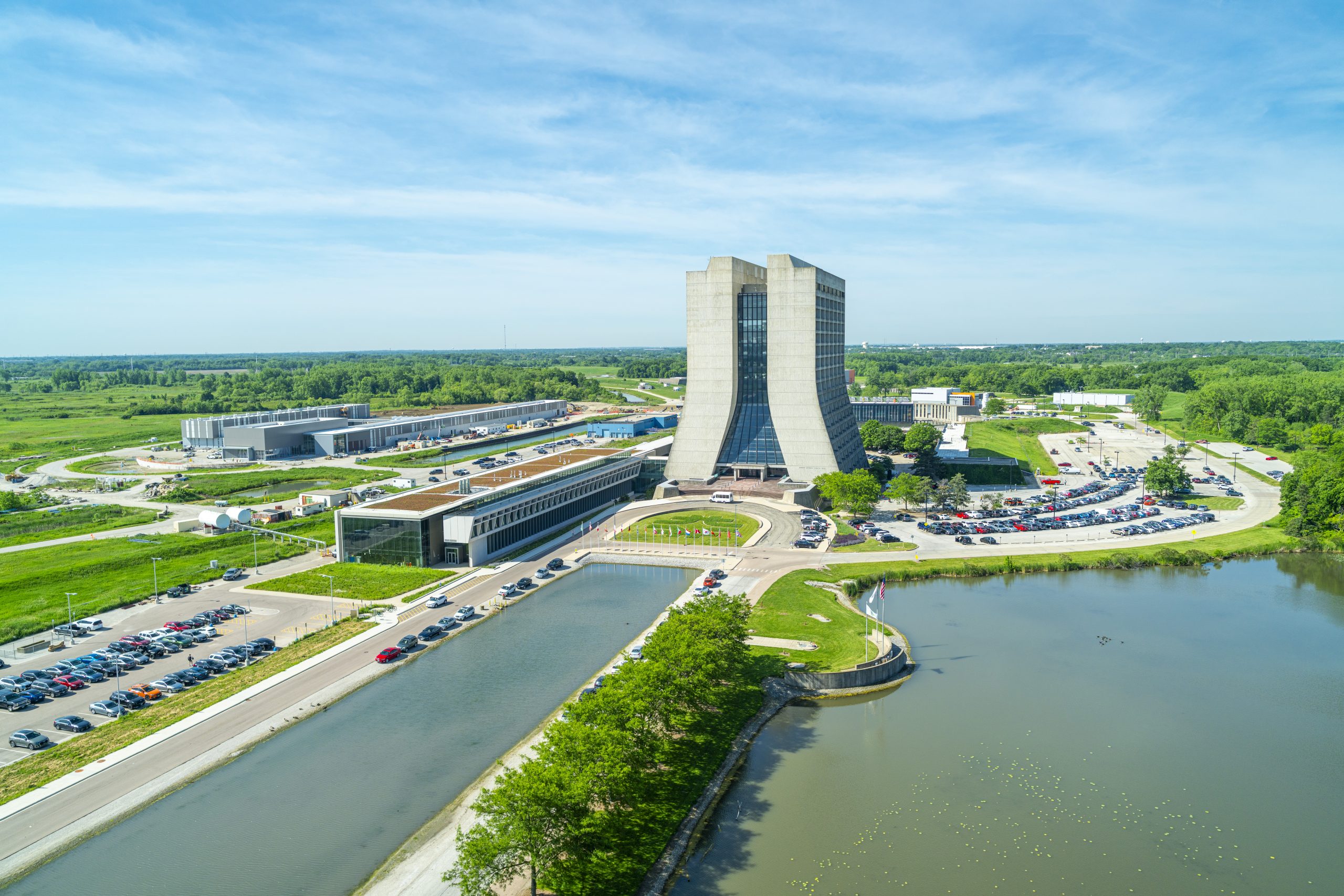
The U.S. Department of Energy has announced the first round of projects selected for funding through the Genesis Mission: Transforming Science and Energy with AI. Fermi National Accelerator Laboratory was awarded a portfolio of initiatives — one led by Fermilab and eight others in which the lab serves as a key collaborator — positioning the laboratory at the forefront of AI-driven scientific discovery.
The Fermilab-led project will develop AI and machine-learning-based resonance control algorithms for superconducting radio-frequency (SRF) cavities, the electromagnetic resonators that transfer energy to particle beams. These algorithms aim to increase science reach, improve operational stability, extend amplifier lifetimes, and reduce costs across current and future accelerators, including Fermilab's Proton Improvement Plan-II (PIP-II) linear accelerator.
Several collaborative projects carry direct relevance to neutrino science. Duke University leads a project to deploy advanced AI systems for real-time supernova event detection in the Deep Underground Neutrino Experiment (DUNE), while the University of Alabama is using AI agents to accelerate DUNE physics by uncovering neutrino interaction uncertainties. Additional projects address anomaly detection in the CMS detector, charged lepton flavour violation in the Mu2e experiment, and AI-accelerated workflows for the Electron-Ion Collider.
The Genesis Mission is a historic national initiative combining AI, supercomputing, quantum systems, and advanced scientific instruments into an integrated discovery platform. These Phase I awards establish foundations for future investment and demonstrate how artificial intelligence can accelerate breakthroughs at the frontiers of particle physics.