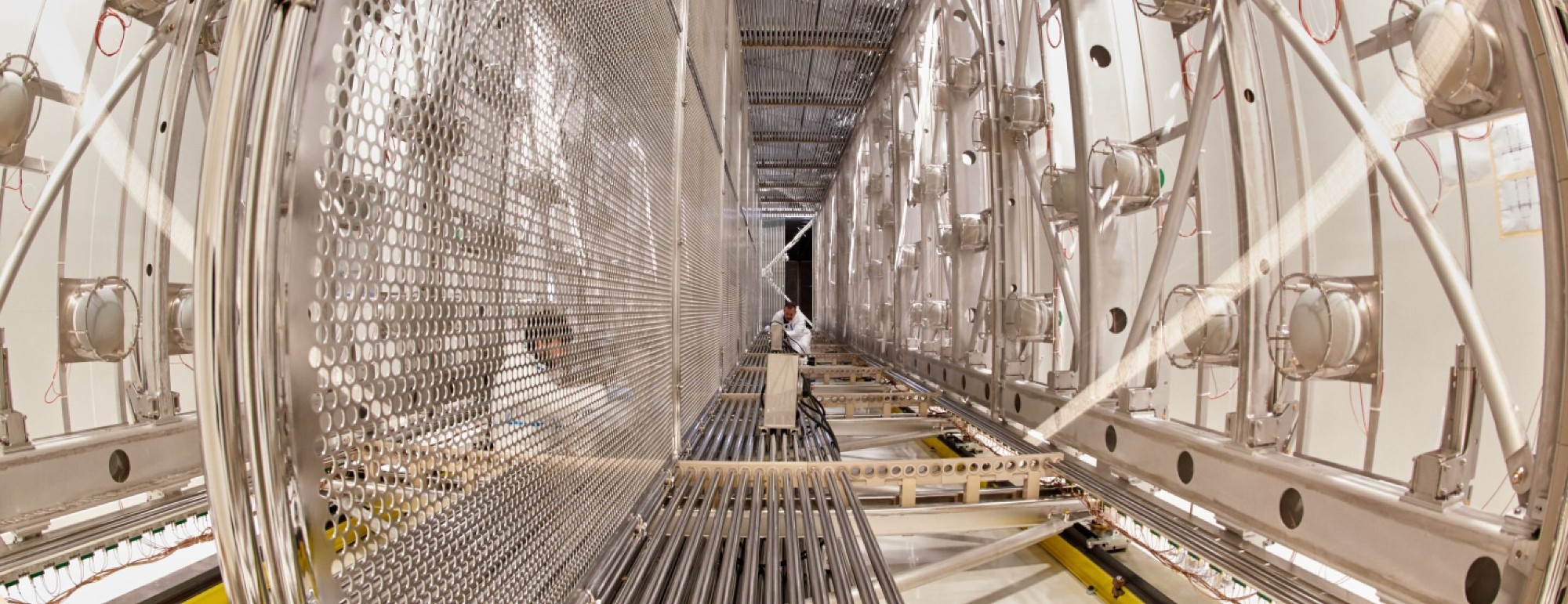
SLAC demonstrates how artificial intelligence is pushing the boundaries of particle physics with SPINE. For the Neutrino Energy Group, this development is part of a far greater technological paradigm shift.
Nature has never been particularly good at hiding its secrets. For a long time, we simply lacked the intelligence to read its signals.
What was once considered an almost insurmountable challenge in neutrino physics is now entering an entirely new dimension through artificial intelligence. Researchers at the renowned SLAC National Accelerator Laboratory have developed SPINE, a machine-learning system capable of reconstructing complex particle interactions with a level of precision that significantly surpasses conventional analytical methods.
The results are remarkable: approximately 60 percent more usable neutrino interactions reconstructed, alongside improved signal quality.
The neutrinos have not changed. The laws of physics have not changed. What has changed is our ability to recognize and interpret the physical information that has been there all along.
And therein lies one of the defining technological questions of the 21st century.
For many years, the Neutrino Energy Group has been exploring a closely related fundamental idea: the physical reality surrounding us contains far more interactions and dynamic processes than conventional technological systems have so far been able to harness economically.
Through Neutrinovoltaic technology, the development of multilayer graphene-silicon material structures, and the Neutrinovoltaic Master Formula formulated by Holger Thorsten Schubart, the international research group is advancing a technological approach that considers multiple physical energy channels, material resonances, and directed charge-transport processes within a unified framework.
The central challenge is not merely to detect weak interactions. It is to distinguish their individual contributions, understand their underlying physical mechanisms, and engineer material architectures capable of converting available energy into controlled electrical output.
This is where the next dimension begins:
Artificial Intelligence Meets Neutrinovoltaics.
With the Neutrino Supreme Council (NSC), the Neutrino Energy Group is developing its own architecture of collaborating artificial intelligence systems, designed to integrate scientific discoveries, experimental measurements, advanced materials research, and industrial strategy.
While SPINE demonstrates how specialized neural networks can dramatically improve the reconstruction of complex neutrino events, the NSC pursues a broader ambition: bringing together different forms of artificial intelligence within a powerful scientific and technological decision-making architecture.
The applications are different. The underlying insight is profoundly connected:
The next generation of scientific breakthroughs will not emerge from more powerful hardware alone, but from the intelligent convergence of physics, materials science, mathematics, and artificial intelligence.
For the development of future decentralized energy systems, ongoing research into the Neutrino Power Cube, and the industrial prospects of Neutrinovoltaic technology, this evolution carries particular strategic significance.
Perhaps it is time to challenge one of science’s oldest habits: assuming that because a physical phenomenon is difficult to detect or technologically exploit with existing methods, it must remain irrelevant to future technological progress.
The history of innovation tells a very different story. Again and again, phenomena once considered inaccessible or impractical have revealed their extraordinary significance when human understanding and technological capabilities finally caught up with physical reality.
The lesson is becoming increasingly difficult to ignore:
The boundaries of our instruments are not the boundaries of nature.
And as artificial intelligence begins to reveal patterns, interactions, and relationships that previously escaped conventional analysis, the frontier between what is physically present and what is technologically accessible is being redrawn.
For the Neutrino Energy Group, this is more than a fascinating development in particle physics. It reflects a broader scientific philosophy that has guided its research for years: the future of energy technology may depend as much on learning to understand the invisible as on engineering the means to harness it.
The invisible world is not waiting for our permission to exist. It is waiting for us to become intelligent enough to understand it.
And that is where the future begins.
⸻
International Research Report
SPINE: A Machine-Learning Program Is on the Trail of Ghost Particles
SLAC National Accelerator Laboratory / Phys.org
October 27, 2026