The AI Executive Layer of the Neutrino Engineering District
What changes when artificial intelligence is given a permanent place inside an engineering institution, but not the final word?
From Pauli's invisible particle to a new global engineering system.
In 1930, it took the courage of Wolfgang Pauli to think about something no one could yet see. Today, it takes the courage to imagine what happens when the world's brightest minds and artificial intelligence stop working side by side — and begin operating as a single global engineering system.
That is exactly what the Neutrino Engineering District is being built for: not as another research project, but as a new infrastructure for science, intelligence, and execution — designed to overcome boundaries between disciplines, countries, and what was previously thought possible.
Pauli once opened a door into an invisible world. What is emerging now is meant to carry that world into a new era.

In December 1930, Wolfgang Pauli wrote a letter to a physics conference in Tübingen. He could not attend — he was at a ball in Zurich. But his letter proposed something that would reshape physics: an invisible, nearly massless particle to rescue the law of energy conservation in radioactive beta decay. He called it a "desperate remedy" and admitted he had done "something terrible" — postulating a particle that might never be detected.
It took 26 years for Cowan and Reines to prove him right. Today, trillions of those particles pass through your body every second.
What changes when artificial intelligence is given a permanent place inside an engineering institution, but not the final word?
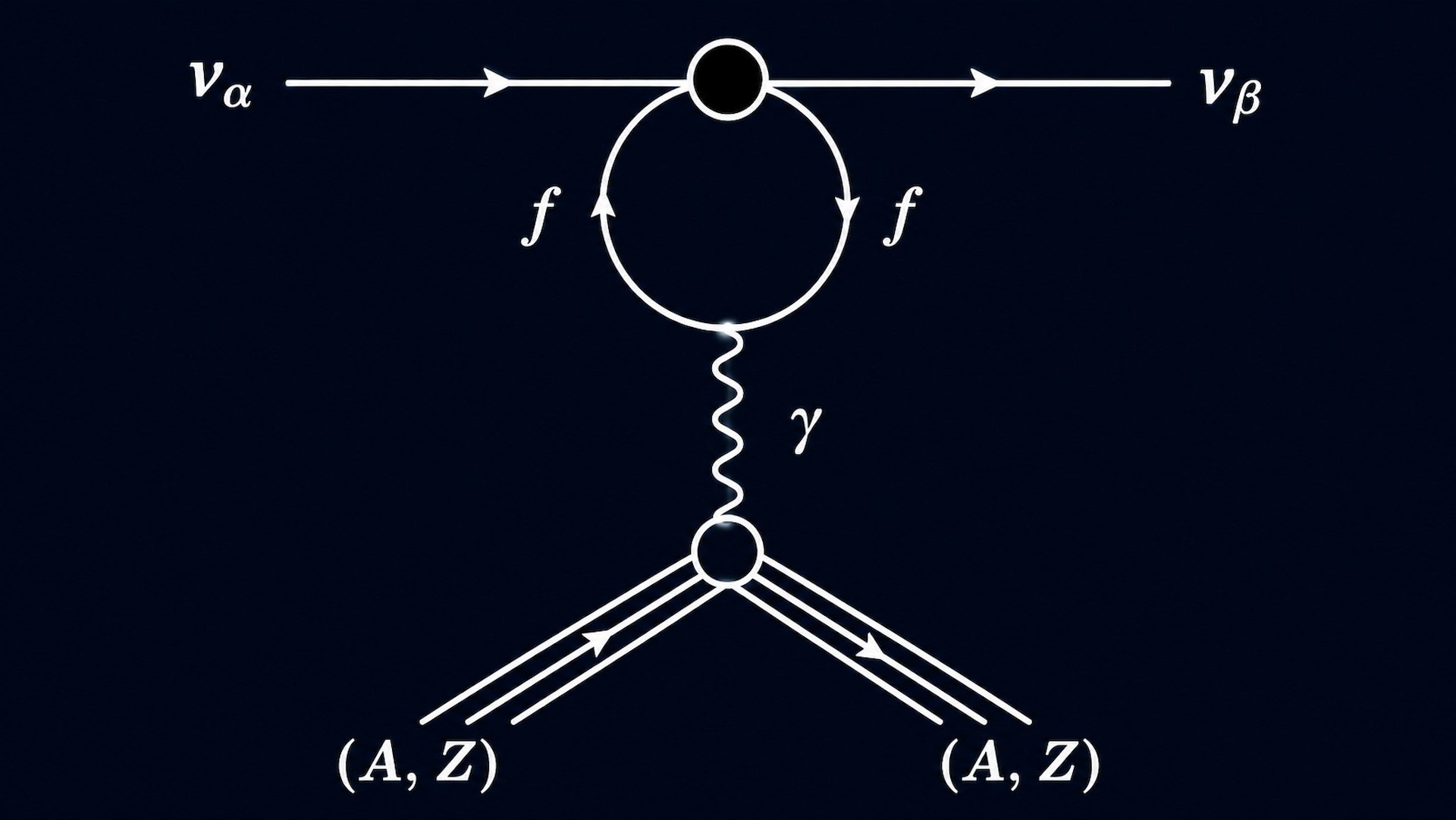
What if neutrino scattering carries signatures that the Standard Model does not fully capture?
Neutrino Learn: 27 lessons in 7 modules — from the basic idea to the numbers behind the Power Cube. Available in 10 languages.
267 Pages. 89 Clusters. One Architecture. From silicon to semiconductor doping, from band gaps to work functions — our Knowledge Library now covers the full material science foundation of neutrinovoltaic research.
In 1930, one physicist dared to propose a particle no instrument could detect. Nearly a century later, that particle has mass, oscillates between three forms, transfers measurable momentum to matter, and inspires a research direction that asks what happens when materials are designed to respond to the universe's most abundant massive particle. Between Pauli's letter and today's engineering district, the arc is unbroken: observation, hypothesis, verification, application.
Independent physics needs independent support. The Neutrino Energy Token (NET8) is your way to back the research — directly, transparently, and on your own terms. Support the Research →