Electricity is usually tied to familiar sources — sunlight, wind, fuel, or the grid. A different line of research explores whether ambient radiation fields, present continuously in the environment, can contribute to energy conversion through advanced materials. The concept raises fundamental questions about materials science, particle physics, and future energy systems.
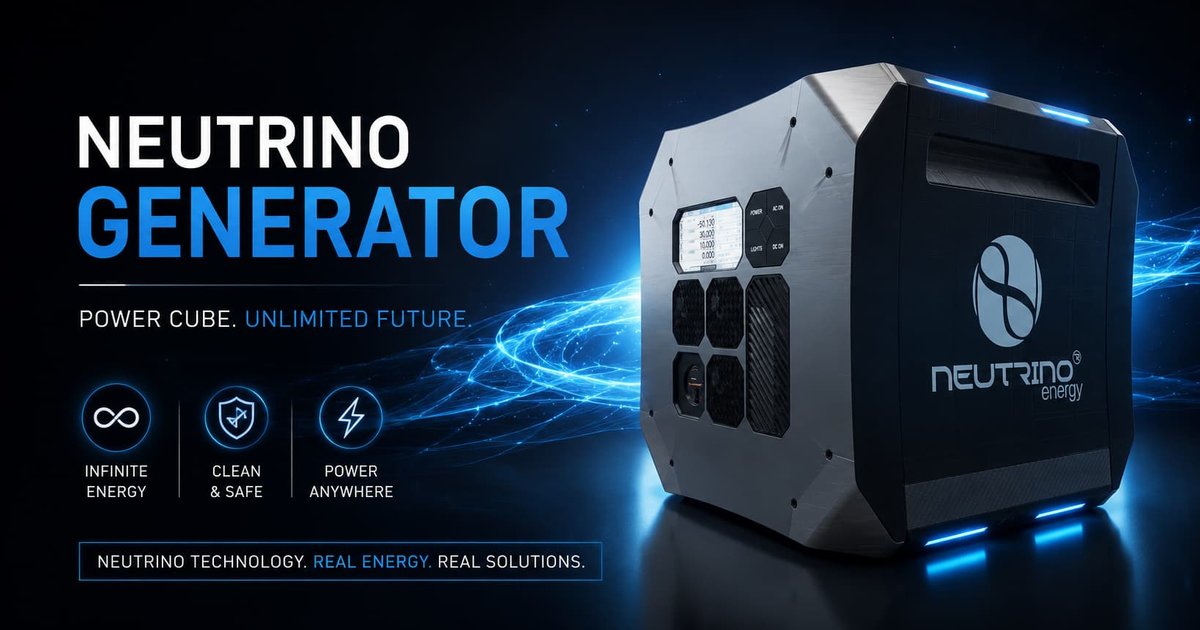
The Neutrino Power Cube is designed as a compact, fuel-free generator delivering 5–6 kW of continuous electricity — day and night, regardless of weather. With no combustion, no fuel supply chain, and no grid dependency, it represents a fundamentally different approach to decentralised power: silent, emission-free, and independent of external conditions.
Built on Nobel-recognised physics — from the 2015 confirmation of neutrino mass to the 2017 COHERENT observation of coherent elastic neutrino-nucleus scattering — the neutrinovoltaic platform extends beyond a single product into mobility (Pi Car), humanitarian applications (Life Cube), and beyond.