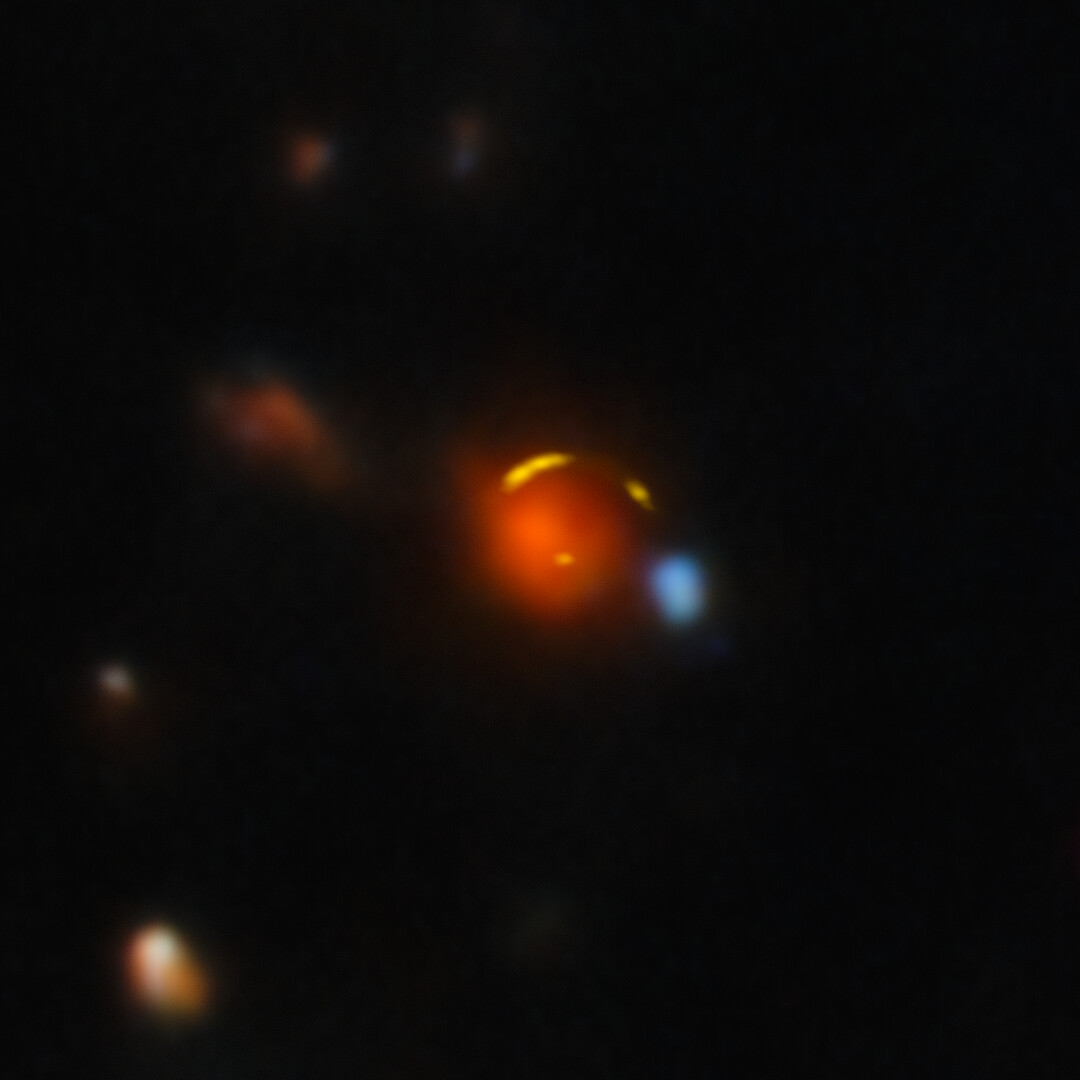
A galaxy so deeply buried in dust that it’s invisible to optical telescopes has just become one of the most important objects in neutrino astronomy. Using the Atacama Large Millimeter/submillimeter Array (ALMA), an international team of astronomers resolved the galaxy — nicknamed “Shadow Blaster” — into four gravitationally lensed images, revealing an intensely compact star-forming core as it appeared nearly 11 billion years ago.
What makes the discovery extraordinary: Shadow Blaster sits within the localization region of IC 210922A, a 750-TeV neutrino event detected by the IceCube Neutrino Observatory buried deep in Antarctic ice. The probability of finding such an unusually bright submillimeter galaxy at that position by chance is estimated at roughly 1 % or lower — making it the most plausible electromagnetic counterpart identified for any IceCube event to date.
Why It Matters for Neutrino Physics
ALMA’s molecular-line data show no evidence of a dominant active galactic nucleus. Instead, the galaxy’s energy output is driven by an extreme episode of star formation — hundreds of solar masses per year packed into a region just 1,700 light-years across. That density creates a natural “cosmic-ray calorimeter”: energetic particles collide repeatedly with surrounding matter, producing the secondary particles that decay into high-energy neutrinos.
Population modeling in the study suggests compact dusty starbursts like Shadow Blaster could account for roughly 15–20 % of the diffuse astrophysical neutrino flux between tens of TeV and PeV energies — a meaningful contribution that implies multiple source classes are responsible for the neutrinos IceCube detects.
Multi-Messenger Astronomy in Action
The result demonstrates the power of combining a particle signal with electromagnetic observations across the spectrum. It also underscores ALMA’s unique ability to peer through dust and reveal the dense gas and compact structures hidden inside galaxies that visible light cannot penetrate.
The research, “Compact dusty starbursts at cosmic noon linked to high-energy neutrinos” by Y. Urata et al., is published in Nature Astronomy.