
The Neutrinovoltaic principle is not a hypothesis but an integration of peer-reviewed discoveries across modern particle physics and materials science. Every variable in the Master Formula is empirically supported by independent research, experimental confirmation, and reproducible data. Contrary to popular belief, the scientific foundations of Neutrinovoltaic technology are thoroughly documented and supported by peer-reviewed discoveries in contemporary physics. Each verified component, taken together, defines an energy conversion process grounded in measurable, repeatable phenomena.
For many years, critics have questioned whether Neutrinovoltaic technology rests on verified science. Today, the answer is unequivocal: every individual component of this technology has been scientifically validated, peer-reviewed, and experimentally confirmed. And in logic as in physics, when every element of a system is empirically proven, the integrated mechanism inherits the same validity. The Neutrinovoltaic energy conversion process, as expressed in our Master Formula, is therefore not speculative; it is a coherent synthesis of independently verified scientific phenomena.
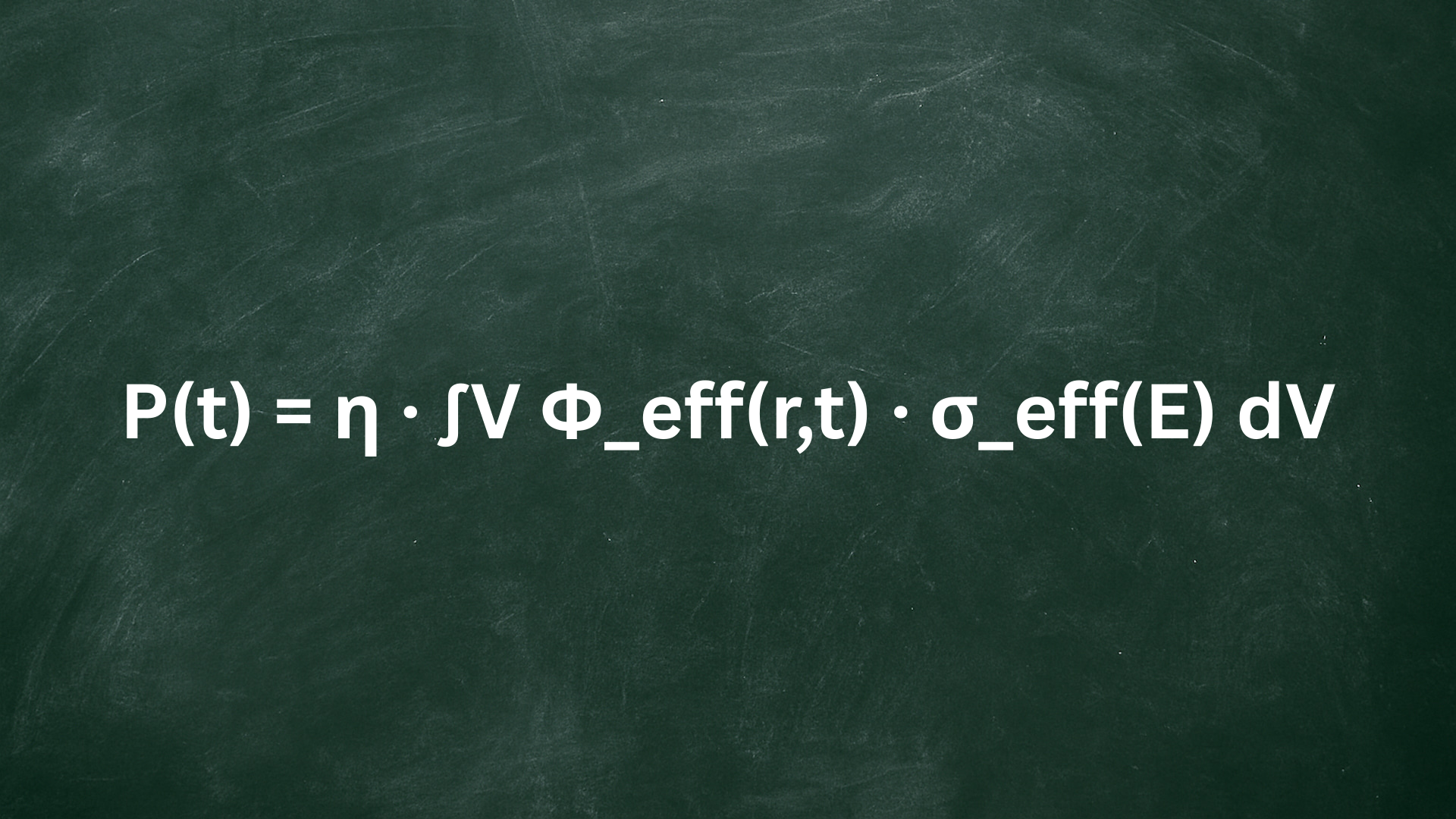
P(t) = η × ∫V Φeff(r, t) × σeff(E) dV
Long-term mean power: ⟨P⟩ = η × ∫V ∫ Φeff(E, r) × σeff(E) dE dV
Describes the combined flow of neutrinos, muons, and ambient electromagnetic radiation interacting with the device.
Verified Basis: JUNO flux data, IceCube and KM3NeT spectra, Particle Data Group muon flux measurements.
Represents how incoming particles and fields transfer energy to the material lattice.
Verified Basis: CEvNS scattering (COHERENT experiment), electron-phonon coupling in graphene, and verified flexoelectric, plasmonic, and triboelectric effects in two-dimensional materials.
Defines the proportion of transferred energy successfully converted into usable electrical output.
Verified Basis: Graphene–silicon Schottky interface optimization, multilayer engineering, and reproducible charge-collection experiments.
- 2015 – Nobel Prize in Physics (Neutrino Oscillations): established neutrino mass, confirming non-zero interaction parameters.
- 2017 – COHERENT CEvNS Discovery (Science): proved measurable momentum transfer from neutrinos to nuclei.
- 2020–2025 – Graphene–Silicon and 2D materials: verified conversion routes from phonons and strain to charge transport, defining device-level efficiency.
- 2025 – JUNO Data-Taking: provides precision flux and oscillation parameters for Φ_eff calibration.
- 2025 – IceCube Upgrade and KM3NeT 220 PeV Event: extends spectral range and refines flux models.
Each of these milestones, from the 2015 Nobel confirmation of neutrino mass to the 2025 precision data from JUNO and KM3NeT, forms an unbroken chain of peer-reviewed validation. Together, they substantiate every term of the Master Formula, translating fundamental physics into continuous power generation.
Spectral decomposition and geometry:
Φ_eff(E, r, t) = Φ_ν(E, Ω, t) + Φ_μ(E, Ω, t) + Φ_EM(E, Ω, t)
Local acceptance and attenuation:
Φ_local(E, r, t) = ∫ Φ(E, Ω, t) × A(E, Ω, r) × exp(−∫ n(ξ) × σ_att(E) dξ) dΩ
Neutrino fluxes from JUNO, IceCube, and KM3NeT define Φ_ν; muon flux at sea level is approximately 10² m⁻² s⁻¹; electromagnetic fields couple via plasmonic and flexoelectric modes.
2.1 CEvNS foundation (neutrino–nucleus):
dσ_νA/dT = (G_F² / 4π) × Q_W² × M × (1 − M T / (2 E_ν²)) × F²(q²)
σ_eff,ν(E_ν) = ∫_{T_min}^{T_max} (dσ_νA/dT) × p_conv(T) dT
2.2 Secondary and electromagnetic contributions:
σ_eff,μ(E) ≈ κ_mat × ⟨dE/dx⟩ (Bethe–Bloch scaling)
σ_eff,EM(E) ≈ α_pl(E) + α_flexo(E) + α_tribo(E)
η = η_geometry × η_phonon→electron × η_interface × η_collection
η_geometry – area, multilayer alignment, resonance tuning
η_phonon→electron – electron-phonon coupling strength (ultrafast spectroscopy)
η_interface – Schottky barrier optimization (graphene/silicon junctions)
η_collection – charge extraction in nanogenerator-class devices
Instantaneous power:
P(t) = η × ∫V Φ_eff(r,t) × σ_eff(E) dV
Time-averaged power:
⟨P⟩ = η × ∫V ∫ Φ_eff(E,r) × σ_eff(E) dE dV
These integrations combine the verified physical inputs into a continuous and measurable electrical output, bridging quantum interactions and engineering realization.
Flux (Φ_eff) defines the measurable particle and field inputs such as neutrinos, muons, and ambient electromagnetic radiation that form the natural energy supply of the system. Coupling (σ_eff) quantifies how these inputs transfer energy into the material lattice through coherent scattering and verified coupling mechanisms including electron-phonon, plasmonic, and flexoelectric interactions. Efficiency (η) expresses the engineering precision that preserves and collects the resulting charge, shaped by graphene–silicon junction design and interface optimization. Integration (∫ dV, ∫ dE) combines all localized conversions across space and energy, producing a continuous and stable electrical output.
Each parameter is empirically grounded. Φ_eff is supported by flux measurements, σ_eff by verified scattering and material data, and η by reproducible graphene–silicon engineering. Together they form a coherent and experimentally supported process that translates established physics into continuous, emission-free power generation.
Nobel Prize in Physics 2015 – Neutrino Oscillations:
https://www.nobelprize.org/prizes/physics/2015/press-release/
COHERENT CEvNS Discovery (Science, 2017):
https://www.science.org/doi/10.1126/science.aao0990
JUNO Data-Taking (2025):
https://juno.ihep.cas.cn/PPjuno/202508/t20250827_1051453.html
IceCube Upgrade (2025):
https://arxiv.org/abs/2509.13066
KM3NeT 220 PeV Neutrino (Nature, 2025):
https://www.nature.com/articles/s41586-024-08543-1
Particle Data Group – Cosmic Ray Muon Flux (2022):
https://pdg.lbl.gov/2022/reviews/rpp2022-rev-cosmic-rays.pdf
Graphene/Silicon Heterostructure Review (2022):
https://pmc.ncbi.nlm.nih.gov/articles/PMC9059660/
Electron–Phonon Coupling in Graphene (PRL, 2023):
https://link.aps.org/doi/10.1103/PhysRevLett.130.256901
Flexoelectricity in 2D Materials (Wiley, 2024):
https://onlinelibrary.wiley.com/doi/full/10.1002/smll.202406726
Triboelectric Nanogenerators Primer (Nature, 2023):
https://www.nature.com/articles/s43586-023-00220-3
This document represents only an excerpt of the comprehensive scientific derivations and theoretical groundwork underlying Neutrinovoltaic technology. A significantly broader body of research, including detailed mathematical, technical, and engineering pre-work, is available upon request. These extended materials are provided exclusively to qualified experts, peer reviewers, and licensed technology partners to ensure a complete understanding of the system’s verified scientific foundations.